Volume 1
A dictionary of the English language: in which the words are deduced from their originals, and illustrated in their different significations by examples from the best writers. To which are prefixed, a history of the language, and an English grammar / by Samuel Johnson.
- Samuel Johnson
- Date:
- 1755
Licence: Public Domain Mark
Credit: A dictionary of the English language: in which the words are deduced from their originals, and illustrated in their different significations by examples from the best writers. To which are prefixed, a history of the language, and an English grammar / by Samuel Johnson. Source: Wellcome Collection.
1155/1176
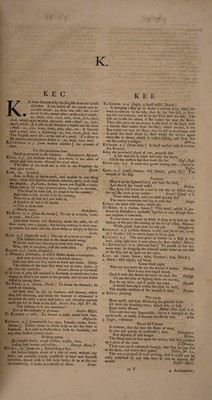
![K E C A letter borrowed by the Englifh from the Greek alphabet. It has before all the vowels one in¬ variable found : as, keen,, ken,, kill-, but is not much in ufe, except after c at the end of words : 7 i , . , as’ knoch dock' crad> back, brick, flick, pluck, check, which were written anciently with * final: as, cloche, cheese, tncke. It is alfo in ufe between a vowel and the iilent • * hnal : as, cloke, broke, brake, pike, duke, eke. It likewife lW°vn aft£r a dlPhthong: as, look, break, Jhock, beek. I he Enghfh never ufe c at the end of a word. K is filent in the preient pronunciation before n: as, knife, knee, knell. CALENDAR, n. f. [now written calendar.] An account of time. 1 Let this pernicious hour ' Stand as accuri'ed in the kalendar. Shakefpeare's Macbeth. •/* Lan Arabick word.] Sea-weed, of the afhes of which glafs was made, whence the word alkali. The afhes of the weed kali is fold to the Venetians for their glafs works. xLam. Quj% Crooked. Kam, in Erie, is fquint-eyed, and applied to any thing awry . clean kam fignifies crooked, athwart, awry, crofs from the prurpofe. A-fchembo, Italian, hence our Englifh a-kimbo. Clean is, by vulgar pronunciation, brought to kirn kam. The blood he hath loft, he dropt it for his country: And what is left, to lofe it by his country. Were to us all that do’t and fuffer it, A brand to th’ end o’ th’ world. —This is clean kam. -Meerlyawry. Shahfpeare. I o Kaw. v. n. [from the found.] To cry as a raven, crow, or rook. See Caw. Jack-daws kawing and fluttering about the nefts, fet all their young ones a gaping ; but having nothing in their emp¬ ty mouths but noife and air, leave them as hungry as before. ^ . ILocke. “■AW. n. J. [from the verb.J The cry of a raven or crow. The daftard crow that to the wood made wing. With her loud katas her craven-kind doth bring, Who, fafe in numbers, cuff the noble bird. ° Dryden. Kayle. 7i.f. [quille, French.] 1. ISinepin; kettlepins, of which fkittles feems a corruption. And now at keels they try a harmlefs chance. And now their cur they teach to fetch and dance. Sidney. The reftd ue of the time they wear out at coits, kayles, or the like idle exercifes. Carew's Survey of Cornwall. 2. A kind of play ftill retained in Scotland, in which nine holes ranged in three’s are made in the ground, and an iron bullet rolled in among them. To Keck. v. n. [kecken, Dutch.] To heave the ftomach ; to reach at vomiting. All thofe diets do dry up humours and rheums, which they firft attenuate, and while the humour is attenuated it troubleth the body a great deal more; and therefore patients muft not keck at them at the firft. Bacon’s Nat. Hijl. N°. 68. n he faction, is it not notorious l Keck at the memory of glorious. Swift's Mifcel. To Ke'ckle a cable. To defend a cable round with rope. Ainfwortb. Ke cksy. n.f [commonly hex. Ague, French; cicuta, Latin. Skimier.J Skinner feems to think keckfy or hex the fame as hemlock. It is ufed in Staftordfhire both for hemlock, and any other hollow jointed plant. Nothing teems But hateful docks, rough thiftles, keckfies, burs, Lofing both beauty and utility. Shahefp. Henry V. Ke'cky. adjl [from kex.] Refembling a kex. An Indian feeptre, made of a fort of cane, without any joint, and perfectly round, confifteth of hard and blackifh cylinders, mixed with a foft kecky body ; fo as at the end cut tranfverfly, it looks as a bundle of wires. Grew. K E E ' ■ ; To Ledge, v. a. [kaghe, a fmall veflel, Dutch.] In bringing a fhip up or down a narrow river, when the wind is contrary to the tide, they fet the fore-fail, or fore¬ top-fail and mizzen, and fo let her drive with the tide. The fails are to flat her about, if fhe comes too near the fliore. T hey alio carry out an anchor in the head of the boat, with a hawfer that comes from the fhip; which anchor, if the fhip comes too near the fliore, they let fall in the ftream, and lb wind her head about it; then weigh the anchor again when fhe is about, which is called hedging, and from this ufe the anchor a kedoer. Har ’.arris. y — O * Xt* III J y Ke'dcer. n.f. [from hedge.] A fmall anchor ufed in a river. See Kedge. Kee, the provincial plural of cow, properly kine. A lafs that Cic’ly hight had won his heart, ^ Cic’ly the weftern lafs that tends the kee. Gay’s Pajl. Ke clack, n.f. A weed that grows among corn ; charnock. T'ufjcr* Keel. n.f. [ccele, Saxon; kiel, Dutch; quille, Fr.] The* bottom of the fhip. Portunus Heav’d up his lighten’d keel, and funk the fand. And fleer’d the facred veil'd. Dr-den. ■ Her fharp bill ferves for a keel to cut the air before her ;* her tail fhe uleth as her rudder. Grew’s Cofmol. b. i! Your cables burft, and you muft quickly feel The waves impetuous ent’ring at your keel. Swift. Keels, the fame with kayles, which fee. J To Keel. v. a. [caelan, Saxon.] This word, which is pre- ferved in Shakefpeare, probably fignifies to cool, though Han- mer explains it otherwife. To keel feems to mean to drink fo deep as to turn up the bottom of the pot, like turning up the keel of a fhip. Hanmer. f While greafy Joan doth keel the pot. Shakefpeare. Ke elfat. 7i. f [coelan, Saxon, to cool, and fat or vat, a vef- ^ lei.] Cooler; tub in which liquor is let to cool. Ke'elsov. n. f. The next piece of timber in a fhip to her keel, lymg right over it next above the floor timber. Harris. I o Ke elhale. v. a. [keel and hale.] To punifti in the fea- mens way, by dragging the criminal under water on one fide ^ of the fhip and up again on the other. Keen. adj. [cene, Saxon; kuhn, German; koen, Dutch.] 1. Sharp ; well edged ; not blunt. Come thick night That my keen knife fee not the wound it makes. Shahefp. ^ _ Here is my keen-1Aged fword, Deck d with fine flower-de-luces on each fide. Shake/p. To me the cries of fighting fields are charms. Keen be my labre, and of proof my arms. Dryden. A fword keen-tdg’d within his right he held, The warlike emblem of the conquer’d field. * Dryden. 2. Severe; piercing. . The winds Blow moift, and keen, fhattering the graceful locks Of thefe fair fpreading trees; which bids us leek Some better fhroud. Milton s Par. Lojl, b. x. The cold was very fupportable ; but as it changed to the north-weft, or north, it became exceflively keen. Ellii 3- Eager; vehement. Never did I know A creature, that did bear the fliape of man, So keen and greedy to confound a man. Shakefpeare. Keen difpatch of real hunger. Milton The fheep were fo keen upon the acrons, that they aobbled up a piece of the coat. L’E/lrange. I hole curs are io extremely hungry, that they are too keen at the fport, and worry their game, Tatler, N°. 62 This was a profpebt fo very inviting, that it could not be eafily withftood by any who have fo keen an appetite for Wealth* Swifts Mifcel. 12 Y](https://iiif.wellcomecollection.org/image/b30451541_0001_1156.jp2/full/800%2C/0/default.jpg)