Volume 1
A dictionary of the English language: in which the words are deduced from their originals, and illustrated in their different significations by examples from the best writers. To which are prefixed, a history of the language, and an English grammar / by Samuel Johnson.
- Samuel Johnson
- Date:
- 1755
Licence: Public Domain Mark
Credit: A dictionary of the English language: in which the words are deduced from their originals, and illustrated in their different significations by examples from the best writers. To which are prefixed, a history of the language, and an English grammar / by Samuel Johnson. Source: Wellcome Collection.
1159/1176
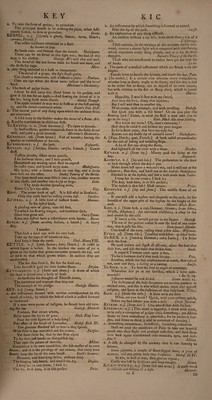
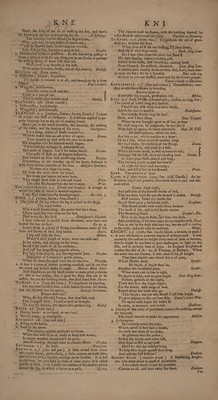
![1. 1 o take the form of grains; to granulate. The principal knack is in making the juice, when fuffi- ciently boiled, to kern or granulate. Grew. KE'RNEL. n.f. [cyjinel, a gland, Saxon; karne, Dutch;* cerneau, Trench.] The edible fubftance contained in a {hell. As brown in hue As hazle nuts, and fweeter than the kernels. Shahfpeare■» I here can be no kernel in this light nut; the foul of this mar\ *s his clothes. Shakefp. All's well that ends well. 1 he kernel of the nut ferves them for bread and meat, and the fhells for cups. More. 2. Any thing included in a hulk or integument. The kernel of a grape, the fig’s fmall grain, Can cloath a mountain, and o’erlhade a plain. Denhami Oats are ripe when the ftraw turns yellow and the kernel Mortimer's Husbandry. 3* 1 he feeds of pulpy fruits. I think he will carry this ifiand home in his pocket, and give it his fon for an apple.'—And fowing the kernels of it in the fea, bring forth more iflands. Shakef Tempejl. The apple inclofed in wax was as frefh as at the firft putting in, and the kernels continued white. Bacon's Nat. HiJL 4* The central part of any thing upon which the ambient ftrata are concreted. . ^A folid body in the bladder makes the kernel of a ftone. Arb. 5- Knobby concretions in childrens flefh. Do Ke rnel. v. n, [from the noun.] To ripen to kernels. In Staffordfhire, garden-rouncivals fown in the fields kernel well, and yield a good increafe. Mortimer's Husbandry. Ke rnelly. adj. [from kernel.] Full of kernels; having the quality- or refemblance of kernels. Ke'rnelwort. n.f. An herb. Ainfworth. Ke'rsey. n.f. [karfaye, Dutch; carifee, French.] Coarfe Ruff. TafFata phrafes, filken terms precife, I do forfwear them ; and I here proteft. Henceforth my wooing mind {hall be expreft In rufTct yeas, and h on eft kerfey noes. •Shakefpeare. His lackey with a linnen ftock on one leg, and a kerfey boot-hofe on the other. Shakef. Taming of the Shrew. The fame wool one man felts it into a hat, another weaves it into cloth, and another into kerfey or ferge. Hale. Thy kerfey doublet fpread ing wide. Drew Cic’ly’s eye afide. Gay. Kest. The preter tenfe of cajl. It is ftill ufed in Scotland. Only that noife heav’ns rolling circles kejl. Fairfax. Ke'strel. n.f. A little kind of baftard hawk. Hanmer. In his kejlrel kind, A pleafmg vein of glory, vain did find. To which his flowing tongue, and troublous fprit, Gave him great aid. Fairy Queen. Kites and kejlrels have a refemblance with hawks. Bacon. Ketch, n.f. [from caicchio, Italian, a barrel.] A heavy {hip. I wonder That fuch a ketch can with his very bulk Take up the rays o’ th’ beneficial fun, And keep it from the earth. Shak. Henry VIII. KE'TTLE. n.f. [cetl, Saxon; ketel, Dutch.] A veil'd in which liquor is boiled. In the kitchen the name of pot is given to the boiler that grows narrower towards the top, and of kettle to that which grows wider. In authors they are confounded. The fire thus form’d, fhe fets the kettle on; Like burnifh’d gold the little feethei {hone. Dryden. .Ke'ttledrum. n.f. [kettle and drum.] A drum of which the head is fpread over a body of brafs. As he drains his draughts of Rhenifh down. The kettledrum and trumpet thus bray out The triumph of his pledge. Shakefp. Hamlet. KEY. n.f. [coeg, Saxon.J I. An inftrument formed with cavities correfpondent to the wards of a lock, by which the bolt of a lock is pulhed forward or backward. If a man were porter of hellgate, he fhould have old turn¬ ing the key. Shakefp. Macbeth. Fortune, that arrant whore, Ne’er turns the key to th’ poor. Shak. King Lear. Poor key cold figure of a holy king ! Pale afties of the houfe of Lancafter. Shakef. Rich. IIT. The glorious ftandard laft to heav’n they fpread, With Peter’s keys ennobled and his crown. Fairfax. Yet fome there be, that by due fteps afpire To lay their juft hands on that golden key, That opes the palace of eternity. Milton. Confeience is its own counfellor, the foie mafter of its own fecrets; and it is the privilege of our nature, that every man fhould keep the key of his own breaft. South's Sermons. He came, and knocking thrice, without delay The longing lady heard, and turn’d the key. Dryden. I keep her in one room, J lock it; The key, look here, is in this pocket. Prior. 2. An infttument by which fomething is fcrcwed or turned. Hide the key of the jack. Swiff. 34 An explanation of any thiirg difficult. An emblem without a key to’t, is no more than a tale of a tub. L' Ejl range. Thefe notions, in the writings of the ancients darkly deli¬ vered, receive a clearer light when compared with this theory, which reprefents every thing plainly, and is a key to their thoughts. Burnet's Theory of the Earth. Thofe who are accuftomed to reafon have got the true key of books. Locke. 4. 'Fhe parts of a mufical inftrument which are ftruck with the fingers. Pamela loves to handle the fpinnet, and touch the keys. Pam. 5. [In mufick.] Is a certain tone whereto every compofition, whether long or fhort, ought to be fitted ; and this key is faid to be either flat or fbarp, not in refpedl of its own nature, but with relation to the flat or {harp third, which is joined with it. Harris. Hippolita, I woo’d thee with my fword, And won thy love, doing thee injuries; But I will wed thee in another key. With pomp, with triumph, and with revelling. Shakefp. But fpeak you with a fad brow? Or do you play the flouting Jack ? Come, in what key {hall a man take you to go in the fong ? Shak. Much Ado about Nothing. Not know my voice ! Oh, time’s extremity ! Haft thou fo crack’d and fplitted my poor tongue In fev’n ftiort years, that here my only fon Knows not my feeble key of untun’d cares ? Shakefpearc. 6. [Kaye, Dutch; quai, French.] A bank raifed perpendicular for the eafe of lading and unlading {hips. A key of fire ran along the fhore. And lighten’d all the river with a blaze. Dryden. Ke'yage. n.f. [from keyf Money paid for lying at the key. Ainfworth. Keyho'le. n. f. \_key and hole.] The perforation in the door or lock through which the key b: put. Make doors faft upon a woman’s wit, and it will out at the cafement; {hut that, and ’twill out at the keyhole. Shakefpearc. Hooked in at the keyhole, and law a well-made man. Tatler. I keep her in one room ; I lock it; The key, look here, is in this pocket; The keyhole is that left ? Mod certain. Prior. KeysTo'ne. n. f. \_key and Jloned\ The middle ftone of an arch. If you will add a keyflone and chaptrels to the arch, let the breadth of the upper part of the keyfione be the height of the arch. Moron's Mcch. Exer. Kibe. n.f. [from kerb, a cut, German, Skinner;. from kibwe, Welfh, Minfloew.] An ulcerated chilblain; a chap in the heel caufed by the cold. If ’twere a kibe, ’twould put me to my flipper. Shakefp. The toe of the peafant comes fo near the heel of our cour* tier, that it galls his kibe. Shakef peare's Hamlet. Oneboaftof the cure, calling them a few kibes. Wifeman. Ki'bed. adj. [from kibe.] Troubled with kibes : as kibed heels. To KICK. v.a. [kauchen, German; calco, Latin.] To ftrike with the foot. He muft endure and digeft all affronts, adore the foot that kicks him, and kifs the hand that ftrikes him. South. It anger’d Turenne once upon a day, To fee a footman kick'd that took his pay. Pope. Another, whofe fon had employments at court, that valued not, now and then, a kicking or a caning. Swift. 7 o Kick. v. n. To beat the foot in anger or contempt. Wherefore kick ye at my facrifice, which I have com- manded ' 1 Sa. ii. 29. Jeftiurun waxed fat and kicked. Deutr. xxxix. 15. I he doctrines of the holy Scriptures are terrible enemies to wicked men, and this is that which makes them kick againft: r religion, and fpurn at thedo&rines of that holy book. Tillotf Kick, n.f [from the verb.] A blow with the foot. What, are you dumb ? Quick, with your anfwer, quick. Before my foot falutes you with a kick. Dryd. Juvenal. Ki'cker. n. f. [from kick.] One who ftrikes with his foot. Ki'ckshaw. n.f. [This word is fuppofed, I think with truth, to be only a corruption of quelque choje, fomething ; yet Milton feems to have underftood it otherwise; for he writes it kick- fhoe, and feems to think it ufed in contempt of dancing ] 1. Something uncommon; fantaftical; fomething ridiculous. Shall we need the moniieurs of Paris to take our hopeful youth into their flight and prodigal cuftodies, and fend them over back again transformed into mimicks, apes, and kick- ' ? Milton. 2. A dtfh fo changed by the cookery that it can fcarcely be known. Some pigeons, a couple of fhort-legged hens, a joint of mutton, and any pretty little tiny kukjhaws. Shakef. H. IV. In wit, as well as war, they give us vigour ; Creffy was loft by kick/haws and foup-meagre. Fenton. Ki cksy-wicksey. n.f. [from kick and wince.] A made word in ridicule and difdain of a wife. Hanmer. 12 2 He](https://iiif.wellcomecollection.org/image/b30451541_0001_1160.jp2/full/800%2C/0/default.jpg)