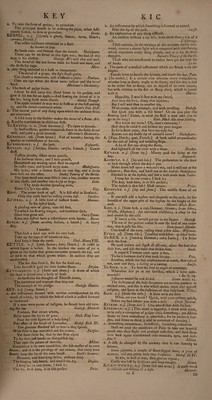
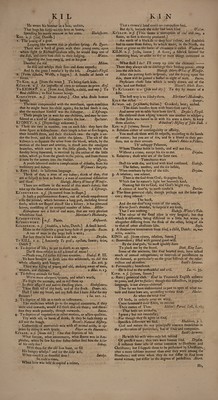
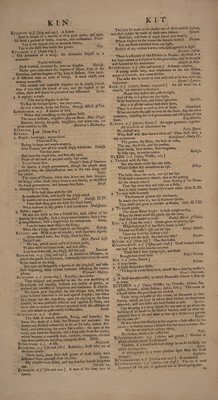
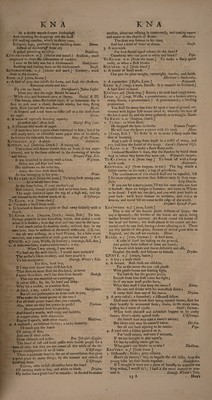
Volume 1
A dictionary of the English language: in which the words are deduced from their originals, and illustrated in their different significations by examples from the best writers. To which are prefixed, a history of the language, and an English grammar / by Samuel Johnson.
- Samuel Johnson
- Date:
- 1755
Licence: Public Domain Mark
Credit: A dictionary of the English language: in which the words are deduced from their originals, and illustrated in their different significations by examples from the best writers. To which are prefixed, a history of the language, and an English grammar / by Samuel Johnson. Source: Wellcome Collection.
1161/1176
![^c» with a hundred arts refin'd* Shall ftretch thy conquefts over half the kind. p0fie 2. Particular nature. No human laws arc exempt from faults, fince thofe that have been looked upon as moft perfed in their kind, have been found, upon enquiry, to have fo many. 3. Natural Hate. ' tb^rC ,|K',’ !,y,C.di,a’ E!ve goods of all the prifoners unto thofe that had aken them, either to take them in Und, or compound for them BWr Htnry VII. •The tax upon tillage was often levied in Uni upon corn, and called d,cum« or tithes. Aybutbnot on Coins. 4* Nature; natural determination. The fkilful fhepherd peel’d me certain wands* And in the doing of the deed of kind. He ftuck them up before the fulfome ewes. Shakefpeare. Some of you, on pure inftina of nature, Are led by kind t’ admire your fellow-creature. Dryden. 5* Manner j way, J Send me your prifoners with the fpeedieft means* Ur you (hall hear in fuch a kind from me As will difpleafe you. _ Shakef Henry IV. This will encourage induftrious improvements, becaufe many will rather venture in that kind than take five in the hun- C Z; 77 7, rr u J • Bacon's EJfays. D. oort. It has a flight and unimportant fenfe. Diogenes was afked, in a kind of fcorn, what was the mat¬ ter that philosophers haunted rich men, and not rich men phi- iofophers ? He anfwercd, becaufe the one knew what they wanted, the other did not. 1 o Ki ndle. v. a. ^ on fire; to light; to make to burn. He will take thereof, and warm himfelf; yea, he kindleth it and baketh bread. Aixliv. ic I was not forgetful of thofe fparks, which fome mens dif- tempers formerly ftudied to kindle in parliaments. K. Charles. If the fire burns vigoroufly, it is no matter by what means it was at firft kindled: there is the fame force and the fame re- frefhing virtue in it, kindled by a fpark from a flint, as if it were kindled from the fun. South's Sermons. 2. To inflame the paflions ; to exafperate; to animate; to heat; to fire the mind. I’ve been to you a true and humble wife; At all times to your will conformable: Ever in fear to 'kindle your diflike. Shake/. Henry VIII. He hath kindled his wrath againft me* and counteth me as one of his enemies. j0fr x;x j x Thus one by one kindling each other’s fire, ’Till all inflam’d, they all in one agree. Daniel's Civ. War. Each was a caufe alone, and all combin’d To kindle vengeance in her haughty mind. Dryden. To Kl'NDLE. v. n. [cinnu, Welfh; cynbelan, Saxon. 1 1. To catch fire. When thou walked through the fire, thou fhalt not be burnt, neither fhall the flame kindle upon thee. 1/ xliii. 2. 2. [From cennan, to bring forth, Saxon.] Are you native of this place? ^ —As the coney that you fee dwells where fhe is kindled. Shak. K.I ndler. n.f. [from kindle.J One that lights ; one who inflames. Now is the time that rakes their revels keep, Kindlers of riot, enemies of fleep. Gay. Ki'ndly. adv. [from kind.J j. Benevolently; favourably; with goodwill. Sir Thurio borrows his wit from your ladyfhip’s looks, and /pends what he borrows kindly in your company. Shakefpeare. I fometime lay here in Corioli, At a poor man’s houfe: he us’d me kindly. Shake/p. Coriol. Be kindly affedtioned one to another, with brotherly love, in honour prefering one another. Ro. xii. 10. His grief fome pity, others blame; The fatal caufe all kindly feek. Prior. Who, with lefs defigning ends. Kindlier entertain their friends; With good words, and count’nance fprightly. Strive to treat them all politely ? Swift. Ki'ndly. adj. [from kind-, probably from kind the fubftantive.] 1. Homogeneal; congeneal; kindred; of the fame nature. This competency I befeech God I may be able to digeft into kindly juice, that I may grow thereby. Hammond. Thefe foft fires Not only enlighten, but with kindly heat, Of various influence, foment and warm, Temper or nouri/h. Milton's Par ad. Lcjl, h. iv. 2. The foregoing fenfe feems to have been originally implied by this word; but following writers, inattentive to its etymology, confounded it with kind. 3- Bland ; mild ; foftening. Through all the living regions do’ft thou move, And fcatter’ft, where thou goeft, the kindly feeds of love. Dryden. Dryden. hen. Johnfon. Gay. K I N Ve heav’ns, from high the dewy ne&ar pour, And in foft filence /hed the kindly fhow’r! Pof>t. Kindness, n.f [from kind.] Benevolence; beneficence; good will; favour; love. If there be kindnefs, mecknefs, or comfort in her tongue, then is not her hufband like other men. Eccluf. xxxvi. 23. Old Lelius profefles he had art extraordinary kindnefs for feveral young people. Collier of Friendfhip. Ever bleft be Cythtrea’s (brine, Since thy dear bread; has felt an equal wound, Since in thy kindnefs my defires are crown’d. Prior. Love and inclination can be produced only by an expe- „ rience or opinion of kindnefs to us. Rogers's Sermons» Ki'ndred. n. f [from kin ; cynjiene, Saxon ] 1. Relation by birth or marriage; cognation; affinity. Like her, of equal kindred to the throne, You keep her conquefts, and extend your own. Dryden. 2. Relation; fort. His horfe hipp’d with an old mothy faddle, and the ftirrups of no kindred. Shakefp. Taming of the Sbrnv. 3. Relatives. I think there is ho man fecure But the queen’s kindred. Shakefp. Richard III. Nor needs thy jufter title the foul guilt Of Eaftetn kings, who, to fecure their reign, , Muft have their brothers. Tons, and kindred (lain. Denham. Kindred, adj. Congeneal; related; cognate. From Tufcan Coritum he claim’d his birth ; But after, when exempt from mortal earth. From thence afeended to his kindred (kies A god. Kine» n.f plur. from cow. To milk the kine. E’er the milk-maid fine Hath open’d her eyne. A field I went, arnid’ the motning dew* To milk my kine. ^ KING. n.f. [A contra£Hoft of theTeutonick word cuning, or cymng, the name of fovereign dignity. In the primitive tongue it fignifies flout or valiant, the kings of moft nations being, in the beginning, chofen by the people oh account of their valour and ftrength. Verjlegan.J 1. Monarch; fupreme governour. The great king of kings, Hath in the table of his law commanded. That thou (halt do'no murder. A fubftrtute (hines brightly as a king. Until a king be by; and then his ftate Empties itfelf, as doth an inland brook Into the main of waters. . Shak. Merck of Venice. True hope is fwift, and flies with fwallows wings ; Kings it makes gods, and meaner creatures kings. Shakefp. The king becoming graces. As juftice, verity, temp’rance, ftablenefs. Bounty, perfev’rance, mercy* lowlihefs, Devotion, patience, courage, fortitude* I have no relilh of them. Shakefpeare's Macleth. t Thus ftates were form’d; the name of king unknown, Lill common int’reft plac’d the fway in one; ’Twas virtue only, or in arts or arms, Diffufing bleffings, or averting harms, The fame which in a fire the fons obey’d, A prince the father of a people made. Pope. 2. It is taken by Bacon in the feminine ; as prince alfo is. Ferdinand and Ifabella, kings of Spain, recovered the great and rich kingdom of Granada from the Moors. Bacon. 3. A card with the pi&ure of a king. The king unfeen Lurk’d in her hand, attd mourn’d his captive qtieen. Pope. 4. King at Arms, or of heralds, a principal officer at arms, that has the pre-eminence of the fociety; of whom there are three in number, viz. Garter, Norroy, and Clarencieux. Phillips, A letter under his own hand was latelv (hewed me by fir William Dugdale, king at arms. ' Walton. To King. v.a. [from the noun.] 1. To fupply with a king. England is fo idly king'd, Her (ceptre fo fantaftically borne, By a vain, giddy, (hallow, humorous youth, I hat fear attends her not. Shakefpeare's Henry V, 2. To make royal; to raife to royalty. Sometimes am I a king; 7 hen treafon makes me wifh myfelf a beggar* And fo I am : then crufliing penury Perfuades me, I was better when a king; Then am I king'd again. Shakefpeare's Richard II, Ki' ngapple, n.f. A kind oft apple. The kingapple is preferred before the jenneting. Mortimer. Ki'ngcraft. n.f. [king and craft.~\ The adl of governing. A word commonly ufed by king James. Shakef. R. Ill, Ki'nccup,](https://iiif.wellcomecollection.org/image/b30451541_0001_1162.jp2/full/800%2C/0/default.jpg)