Volume 2
A dictionary of the English language: in which the words are deduced from their originals, and illustrated in their different significations by examples from the best writers. To which are prefixed, a history of the language, and an English grammar / by Samuel Johnson.
- Samuel Johnson
- Date:
- 1755
Licence: Public Domain Mark
Credit: A dictionary of the English language: in which the words are deduced from their originals, and illustrated in their different significations by examples from the best writers. To which are prefixed, a history of the language, and an English grammar / by Samuel Johnson. Source: Wellcome Collection.
1163/1176
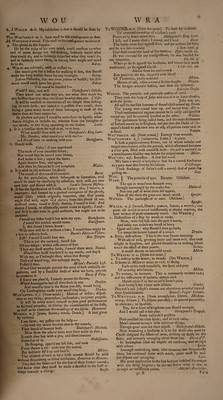
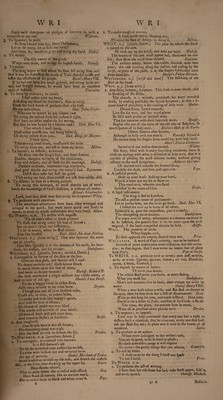
![4‘ At this time; fo Toon ; hitherto: with a Negative before it. 1 hales being alked when a man fhould marry, faid, voung mennoty^j old men, not at all. Bacon 5* At leaft; at all. Noting uncertainty or indetermination. A man that would form a eomparifon betwixt Quintilian’s declamations, if yet they be Quintilian’s, and the orations of 1 ully, would be in danger of forfeiting his diferetion. Baker. •* It notes increafe or extenfion of the fenfe of the words to which it is joined. Shake not his hour-glafs, when his hady fand Is ebbing to the lad : A little longer, yet a little longer, And nature drops him down without your fin, Like mellow fruit without a winter dorm. Dryden. let a. few days, and thofe which now appear Jn youth and beauty like the blooming year. In life’s fwift feene fhall change. ° Dryden. 7* Still; in a new degree. He that takes from a thief, that which the thief took from an honeft man, and keeps it to himfelf, is the wickeder thief of the two, by how much the rapine is made yet blacker by g the pretence of piety and judice. L’Ef range. ten after all. A kind of emphatical addition to a ne¬ gative. If any man negledl his duty, his fault mud: not be aferibed to the rule appointed, neither y*/ to the whole church. Whitg. Men may not too rafhly believe the confedions of witches, nor yet the evidence againd them ; for the witches themfelves are imaginative, and people are credulous, and ready to im¬ pute accidents and natural operations to witchcraft. Bacon. Nor yet amidd this joy and brightell morn Wasabfent, after all his mifehief done, The prince of darknefs. Milton s Paradlfe Regain’d* 9, Hitherto. Hope beginning here, with a trembling expectation of things far removed, and as yet but only heard of, endeth with real ar*d aCtual fruition of that which no tongue can exprefs. Hook* Ye'ven, for given-. Wants not a fourth grace to make the dance even ? Let that room to my lady bey even-t She fhall be a grace. To fill the fourth place, And reign with the red: in heaven. Spenfer. Yew. n.f. [ ip, Saxon; yw, Weldr. This is often written eugh ; but the former orthography is at once nearer to the found and the derivation. See Eugh.] A tree of tough wood. It hath amentaceous flowers, which conlld of many apices, for the mod part fhaped like a mufhroom, and are barren ; but the embryoes, which are produced at remote didances on the fame tree, do afterward become hollow bell-fhaped berries, which are full of juice, and include feeds fomewhat like acorns, having, as it were, a little cup to each. Miller. The fhooter eugh, the broad-leav’d fycamore, The barren plantane, and the walnut found ; The myrrhe, that her foul fin doth dill deplore, Alder the owner of all waterifh ground. Fairfax. Slips of yeiv, Shiver’d in the moon's eclipfe. Sbakefp. Macbeth. They would bind me here Unto the body of a difmal yew. Sbakefp. Titus Andronicus. He drew, And almod join’d the horns of the tough yew. Dryden. The didinguidi’d yew is ever feen. Unchang’d his branch, and permanent his green. Prior. Ye/ WEN. adj. [fromyew ] Made of the wood of yew. His difF arms to Aretch with eughen bow. And manly legs dill palling to and fro. Hubberd’s Tare. YfeTe. adv. [ypejie, Saxon.] Together. Spenfer. To YIELD. v. a. [gel&an, Saxon, to pay.] 1. To produce; to give in return for cultivation or labour. When thou tilled the ground, it fiiall not henceforth yield unto thep her drer»gth. Gen. iv. 12. Strabo tells us the mines at Carthagenay/V/^W the Romans, per diem, to the value of twenty-dve thoufand drachms, eight hundred and feven pounds five drillings and ten pence. Arbuth. 2. To produce in general. He makes milch kineyield blood. Shakefpeare. The wildernefs yieldeth food for them. Job xxiv. 5. All the fubdances of an animal, fed even with acefcent fub- ftances, yield by fire nothing but alkaline falts. Arbuthnot. 2. To afford; to exhibit. Philoclea would needs have her glove, and not without fo mighty a lour as that face could yield. Sidney. The mind of man defireth evermore to know the truth, according to the mod infallible certainty which the nature of things can yield. Hooker. If you take the idea of white, which one parcel of fnow yielded yederday to your fight, and another idea of white from . another parcel of fnow you fee to-day, and put them toge¬ ther in your mind, they run into one, and the idea of white- nefs is not at all increafed. Locks, Y O K 4. To give as claimed of right. I the praife Yield thee, fo well thou had this day purvey’d. Milton. 5. To allow; to permit. I yield it jud, faid Adam, and fubmit. Milton, Life is but air. That yields a pafiage to the whidling fword. And clofes when ’tisgone. Dryden s Don Sebafiani 6. To emit; to expire. Often did I drive To yield the ghod ; but dill the envious flood Kept in my foul, and would not let it forth To find the empty, vad and wand’ring air. Shak. Rich. III. He gathered up his feet into the bed, and yielded up the ghod. Gen. xlix. 33. 7. To refign ; to give up; He not yielding over to old age his country delights, efpe- cially of hawking, was at that time, following a merlin, brought to fee this injury offered unto us. Sidney. Thus I have yielded up into your hand The circle of my glory. Shakefp. King John. She to realities yields all her fhows. Milton. ’Tis the pride of man which is the fpring of this evil, and an unwillingnefs to yield up their own opinions. Watts. 8. To furrender. The enemies fometimes offered unto the foldiers, upon the walls, great rewards, if they would yield up the city, and fometimes threatened them as fad. Knolles. They laugh, as if to them I had quitted all. At random yielded up to their mifrule. Milton. To Yield, v. n. 1. To give up the conqued; to fubmit. Ido yields not in his fall; But fighting dies, and dying kills withal. Daniel. All is not lod : immortal hate, And courage never to fubmit or yield. Milton. If the infpiring and expiring organ of any animal be dopt, it fuddenly yields to nature, and dies. Walton’s Angler. There he faw the fainting Grecians yield. And here the trembling Trojans quit the field, Purfu’d by fierce Achilles. DrydrL 2. To comply with any perfon. Confidering this prefent age fo full of tongue, and weak of brain, behold we yield to the dream thereof. Plcoker* I fee ayielding in the looks of France : Mark, how they whifper. Shakefp. King John. This fupernatural foliciting, if ill, Why hath it given me earned of fuccefs? If good, why do I yield to that fuggedion, Whofe horrid image doth upfixmyhair? Shakefp. K. Lear: With her much fair fpeech fhe caufed him to yield. Prov. The Jews have agreed to defire thee that thou wouldd bring down Paul; but do not thou yield unto them. Adis xxiii. 21. 3. To comply with things. _ There could be no fecure peace, except the Lacedemonians yielded to thofe things, which being granted, it would be no longer in their power to hurt the Athenians. Bacon. If much converfe Thee fatiate, to fhort abfence I could yield. Milton. 4. To concede; to admit; to allow ; not to deny. If wee yield that there is a God, and that this God is al¬ mighty and jud, it cannot be avoided but that, after this life ended, he adminiders judice unto men. Hakewill. 5. To give place as inferiour in excellence or any other quality. The fight of Achilles and Cygnus, and the fray betwixt the Lapithae and Centaurs, yield to no other part of this poet. Dry. Tell me in what more happy fields The thidle fprings, to which the \Uy yields F Pope. YieTder. n.f. [fromyield.] One who yields. Briars and thorns at their apparel fnatch, Some fleeves, fomehats; from fielders all things catch. Shak. Some guard thefe traitors to the block of death, Treafon’s true bed, and y;V/^r up of breath. Shak. Hen. IV. YOKE. n. f. [jeoc. Sax. jock, Dutch; jugum, Lat. joug, Fr.] 1. The bandage placed on the neck of draught oxen. Bring a red heifer, wherein is no blemifli, and upon which never came yoke. Numb. xix. 2. A yearling bullock to thy name fhall fmoke, Untam’d, unconfcious of the galling yoke. Pope, 2. A mark of fervitude; flavery. Our country finks beneath the yoke ; It weeps, it bleeds. ’ Shakefpeare's Macbeth. In bands of iron fetter’d you fhall be; An eafier yoke than what you put on me. Dryd. Aurengz. 3. A chain ; a link ; a bond. This yoke of marriage from us both remove, Where two are bound to draw, though neither love. Dryd. 4. A couple; two; a pair. Thofe that accufe him in his intent towards our wives, are a yoke of his difearded men. Shakefpeare. His lands a hundred yoke of oxen till’d. Dryden s Ain. A yoke &](https://iiif.wellcomecollection.org/image/b30451541_0002_1164.jp2/full/800%2C/0/default.jpg)