Volume 1
A dictionary of the English language: in which the words are deduced from their originals, and illustrated in their different significations by examples from the best writers. To which are prefixed, a history of the language, and an English grammar / by Samuel Johnson.
- Samuel Johnson
- Date:
- 1755
Licence: Public Domain Mark
Credit: A dictionary of the English language: in which the words are deduced from their originals, and illustrated in their different significations by examples from the best writers. To which are prefixed, a history of the language, and an English grammar / by Samuel Johnson. Source: Wellcome Collection.
1164/1176
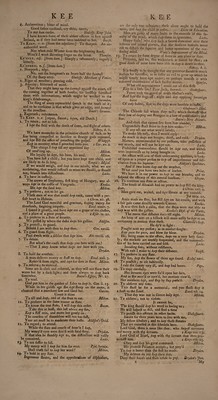
![and knavijh to do it from Popes Letters. Shakefp \ Dome. Dryden. Dryden. Prior. Prior. t trough in Ex. viii. 3. Here’s the folly of the afs in truding the fox, and here’s knavery ok the fox in betraying the ais. L’Ejlrangc. The cunning courtier (hould be (lighted too, Who with dull khavery makes fo much ado ; ’ f ill the (hrewd fool, by thriving too too fad, Like /Efoifs fox, becomes a prey at lad. Dryden. 2. Mifchievous tricks or pradices. In the following paflkge it feems a general term for any thing put to an ill ufe^or perhaps for trifling things of more cod than ufe. We’ll revel it as bravely as the bed, With amber bracelets, beads, and all this knav’ry. Shakefp. Kna' vish. adj. [from knave.] 1. Difliori'eft ; wicked; fraudulent. ’Tis foolifli to conceal it at all, friends. 2. Waggifn; mifchievous. Here fhe comes curd and fad ; Cupid is a knav/JJj lad, 'I hus to make poor females mad. KnaVishly. adv. [from knavijh.] 1. Difitonedly ; fraudulently. 2. Waggifhly; mifehievoufly. To KNEAD, v. a. [cnaeban, Saxon ; kneden, Dutch.] To beat or mingle any duff or fubdance. It is feldom applied in po¬ pular language but to the ad of making bread. Here s yet in the word hereafter, the kneading, the making of the cakes, and the heating ot the oven. Shakejpeare. It is a lump, where all beads kneaded be ; Wifdom makes him an ark where all agree. Thus kneaded up with milk the new made man His kingdom o’er his kindred world began; ’Till knowledge mifapply’d, mifunderdood, And pride of empire, four’d his balmv blood. One pade of field on all degrees bedow’d. And kneaded up alike with moid’ning blood. Prometheus, in the kneading up of the heart, feafoned it with fume furious particles of the lion. Addifcn’s Spectator. No man ever reapt his corn, Or from the oven drew his bread. Ere hinds and bakers yet were born, That taught them both to fow and knead. 1 he cake One kneaded was the fav’rvmeat. KnUadingtrough. n.f. [knead and trough.] which the pade of bread is worked together. P rogs fhall come into thy kneadingtroughs. KNEE. n.f. [cneop, Saxon ; knee, Dutch ] J. 7 he joint of the leg where the leg is joined to the thigh. Thv royal father V/:as a mod fainted king: the queen that bore thee, Oltner upon her knees than on her feet, Died every day fire liv’d. Shakefpeare's Macbeth. 1 have'referved to myfelf feven thoufand, who have not bowed the knee to Baal. Ro. xi. 4. Scotch (kink is a kind of drong nourifhment, made of the knees and finews of beef long boiled. Bacon. I beg and clafp thy knees. Milton. Weary’d with length of ways, worn out with toil, Io lay down, and leaning on her knees. Invok’d the caufe of all her miferies ; And cad her languidiing regards above. For help from heav’n, and her ungrateful Jove. Dryden. Difdainful of Campania’s gentle plains, When for them (he mud bend the fervile knee. Thomfon. 2. A knee is a piece of timber growing crooked, and fo cut that the trunk and branch make an angle. Moxon s Mech. Exer. Such difpofitions are the fitted timber to make great politicks of: like to knee timber, that is good for (hips that are to be toffed ; but not for building houfes, that (hall dand firm. Bacon. To Knee. v. a. [from the noun.] To fupplicate by kneeling. Go you that banidi’d him, a mile before his tent, fall down, and knee the way into his mercy. Shakefp. Corio/anus. Return with her! Why, the hot-blooded France, that dow’rlefs took Our younged born : I could as well be brought To knee his throne, and fquire-like penfion beg, Kneed, adj. [from knee.] 1. Having knees : as in-kneed, or out-kneed. 2. Having joints : as bleed grafs. Kne'edeep. aclj. [knee and deep.] 1. Rifing to the knees. 2. Sunk to the knees. The country peafant meditates no harm, When clad with (kins of beads to keep him warm ; In winter weather unconcern’d he goes, Almod kneedeep, through mire in clumfey (hoes. Dryden. Kne ehoem. n.f. An herb. Ainfworth. Kne'epan. n.J. [knee and pan.] A little round bone about two inches broad, pretty thick, a little convex on both Tides, and covered with a fmooth cartilage on its forefide. It is foft in children, but very hard in thofe of riper years: it is called patella or mola. Over it pafies the tendon of the mulcles which extend the leg, to which it ferves as a pully. jmy. Shakef. The kneepan mud be (hewn, with the knitting thereof, by a fine (hadow underneath the joint. Peacham on Drawing. 7 o Kneel, v.n. [from knee.] To perform the a£t of genu- fledtion ; to bend the knee. When thou do’d afk me bleffing, I’ll kneel down. And a(k of thee forgivenefs. Shak. King Lear. Ere I was rifen from the place that (hew’d My duty kneeling, came a recking pod, Stew’d in his hade, half breathing, panting forth From Goneril, his midrefs, falutation. Shak. King Lear. A certain man kneeling down to him, faid. Lord, have mer¬ cy upon my fon ; for he is lunatick. Mat. xvii. 14. As foon as you are dreffed, kneel and fay the Lord’s prayer. Taylor s Guide to Devotion. Kne'etribute. n.f. [knee and tribute.] Genufledtionj wor- (hip or obeifance (hown by kneeling. Receive from us Kneetribute yet unpaid, prodration vile. Milton. Knel. n.f. [cnil, Wclfh, a funeral pile; cnyllan, to ring, Sax.] 7 he found of a bell rung at a funeral. I would not wifh them to a fairer death, And fo his knell is knoll’d. Shakefpeare. Sea nymphs hourly ring his knell: Hark, now I hear them. Shak. Tempejl. When he was brought again to th’ bar, to hear His knell rung out, his judgment, he was dirr’d With fuch an agony, he fweat extremely. Shak. H. VIII. All thefe motions, which we faw, Are but as ice, which crackles at a thaw: Or as a lute, which in moid weather rings Her knell alone, by cracking of her drings. Donne. Unhappy (lave, and pupil to a bell, Which his hours work, as well as hours do tell; > Unhappy ’till the lad, the kind releafing knell. Cowley, j At dawn poor Stella danc’d and fung ; The am’rous youth around her bow’d : At night her fatal knell was rung; I faw, and kifs’d her in her (hrowd. Prior. Knew. The preterite of know. Knife, n f plur.knives, [cmy, Sax. knijf, Danidi.] An in- drument edged and pointed, wherewith meat is cut, and ani¬ mals killed. Come, thick night. And pall thee in the dunned fmoke of hell, That my keen knife fee not the wound it makes. Shakefp. Bled powers, forbid thy tender life Should bleed upon a barbarous knife. Crajhaw. The facred prieds with ready knives bereave The bead of life, and in full bowls receive The dreaming blood. Dryden's AEn. Ev’n in his deep he darts, and fears the knife. And, trembling, in his arms takes his accomplice wife. Dryd. Pain is not in the knife that cuts us ; but we call it cutting in the knife, and pain only in ourfelves. Watts. KNIGHT. n.J'. [cmj2r, Sax. knecht, Germ, a fervant, or pupil.] 1. A man advanced to a certain degree of military rank. It was anciently the cudom to knight every man of rank or fortune, that he might be qualified to give challenges, to fight in the lids, and to perform feats of arms. In England knighthood confers the title of fir: as, fir Thomas, fir Richard. When the name was not known, it was ufual to fay fir knight. That fame knight’s own fword this is of yore. Which Merlin made. Spenfer. Sir knight, if knight thou be, Abandon this foredalled place. Spenfer. When every cafe in law is right, No fquire in debt, and no poor knight. Shak. King Lear. Pardon, goddefs of the night, Thofe that (lew thy virgin knight; For the which, with fongs of woe. Round about her tomb they go. Shakefp. This knight; but yet why (hould I call him knight, To give impiety to this rev’rent dile. Daniel's Civil War. No fquire with knight did better fit In parts, in manners, and in wit. Hudibras. 2. Among us the order of gentlemen next to the nobility, except the baronets. The knight intends to make his appearance. Addifon. 3. A champion. He fuddenly unties the poke, Which out of it fent fuch a fmoke, As ready was them all to choke, So grievous was the pother ; So that the knights each other lod. And dood as dill as any pod. Drayton. Did I for this my country bring To help their knight againd their king. And raife the firlt fedition ? Denham. Knight Errant. [ chevalier errant ] A wandering knight; one who went about in qued of adventures. Like a bold knight errant did proclaim Combat to all, and bore away the dame. Denham. The](https://iiif.wellcomecollection.org/image/b30451541_0001_1165.jp2/full/800%2C/0/default.jpg)