Volume 1
A dictionary of the English language: in which the words are deduced from their originals, and illustrated in their different significations by examples from the best writers. To which are prefixed, a history of the language, and an English grammar / by Samuel Johnson.
- Samuel Johnson
- Date:
- 1755
Licence: Public Domain Mark
Credit: A dictionary of the English language: in which the words are deduced from their originals, and illustrated in their different significations by examples from the best writers. To which are prefixed, a history of the language, and an English grammar / by Samuel Johnson. Source: Wellcome Collection.
1167/1176
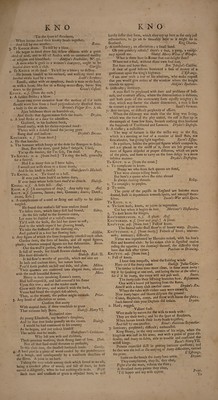
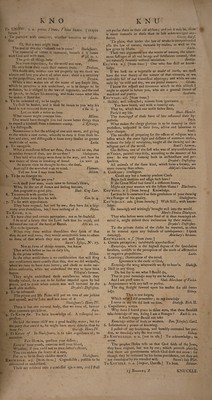
![lo KNOM . v. a. prctcr. 1 knew-, I have known. [ cnapan Saxon.j j 1. To perceive with certainty, whether intuitive or difeur- five. O, that a man might know The end of this day’s bufuiefs ere it come! Shakejpeare. 1 he memorial of virtue is immortal, becaufe it is known with God and with men. Wild, iv. i. 1 he gods all things know. Aiilton. Not from experience, for the world was new. He only from their caule their natures knew. Denham. We doubt not, neither can we properly lay we think we admire and love you above all other men : there is a certainty in the propefition, and we know it. Dry den. W hen a man makes ufe of the name of any fimple idea, which he perceives is not underllood, or is in danger to be miftaken, he is obliged by the 'aws of ingenuity, and the end of fpeech, to declare his meaning, and make known what idea he makes it Hand for. Locke. 2. To be informed of; to be taught. Ye fhall be healed, and it lhall be known to you why his hand is not removed from you. I Sa. vi 3. Led on with a defire to know What nearer might concern him. Milton. One would have thought you had known better things than to expect a kindnefs from a common enemy. L'Ejlrange. 3. To diftinguifh. Numeration is but the adding of one unit more, and giving to the whole a new name, whereby to know it from thofe be¬ fore and after, and diftinguifh it from every fmaller or greater multitude of units. Locke. 4. To recognife. What a monftrous fellow art thou, thus to rail on me, that is neither known of thee, nor kn-ws thee ? Shakejpeare. They told what things were done in the wav, and how he was known of them in breaking of bread. Lu. xxiv. 35. At nearer view be thought he knew the dead. And call’d the wretched man to mind. Flatman. Tell me how 1 may know him. Alilton. 5. To be no ftranger to. What are you ? — A moft poor man, made tame to fortune’s blows. Who, by the art of known and feeling forrows. Am pregnant to good pity. Shak. King Lear. 6. To converfe with another fex. And Adam knew Eve his wife. Gen. iv. 4. 7. To fee with approbation. They have reigned, but not by me; they have fet a feig- nioty over themfelves, but I knew nothing of it. Hojea. To Know. t>. n. 1. To have clear and certain perception ; not to be doubtful. I kn tv of a furety that the Lord hath fent his angel, and delivered me out of the hand of Herod. ALL xii. 11. 2. Not to be ignorant. When they know within themfelves they fpeak of that they do not well know, they would neverthelefs feem to others to know of that which they may not well fpeak. Bacon s EJJays, N°. 27. Not to knew of things remote, but know That which before us lies in daily life. Is the prime wifdom. Milton. In the other world there is no confideration that will fling onr confciences more cruelly than this, that we did wickedly, -when we knew to have done better ; and chofe to make our- felves miferable, when we underftood the way to have been happy. Tillotjon’s Sermons. They might underhand thofe excellencies which they blindly valued, fo as not to be farther impofed upon by bad pieces, and to know when nature was well imitated by the mod able mailers. Dry den's Dufrefnoy. 3. To be informed. The prince and Mr. Poins will put on two of our jerkins and aprons’, and fir John mull not knoiv of it. Shakejpeare's Henry IV. There is hut one mineral body, that we know of, heavier than common quickfilver. Boyle. 4. To KNOw/^r. To have knowledge of. A colloquial ex- preffion. He faid the water itfelf was a good healthy water; hut for the party that own’d it, he might have more difeafes than he knew for. Shakefp. Henry IV. 5. Vi? Know of In Shakejpeare, is to take coguifance of 5 to examine. Fair Hermia, queftion your defires ; Know of your youth, examine well your blood. Whether,* if you yield not to your father’s choice, You can endure the livery of a nun, For ay to be in fhady cloifler mew’d. Shakejpeare. Kno'wable. adj. [from knjW.~\ Cognofcible ; pofhbie to be difeovered or underllood. Thefe are refolved into a confcfTed ign nance, and I fhall not purfue them to their old afylum ; and yet it may he, there is 'more knowahle in thefe than in lefs acknowledged my- fleries. Glanv. See J. ’Tis plain, that under the law of works is comprehended alfo the law of nature, knowahle by reafon, as well as the law given by Mofes. Locke. Thefe two arguments are the voices of nature, the unani¬ mous fufflages of all real beings and fubllances created, that are naturally knowahle without revelation. Bentley. Kno'wer. n.J [from know J One who has fkill or know- ledge. If we look on a vegetable as made* of earth, we mufl have the true theory of the nature of that element, or we miferably fail of our fcientifical afpirings; and while we can only fay ’tis cold and dry, we are pitiful knowers. Glanv. I know the refpedl and reverence which in this addrefs I ought to appear in before you, who are a general knower of mankind and poetry. Southern. Kn o'wing. adj. [from how. ] 1. Skilful; well i n fir u died ; remote from ignorance. You have heard, and with a knowing ear. That he, which hath our noble father flain, Purfu’d my life. ' ‘ Shak. Hamlet. The knowlngejl of thefe have of late reformed their hy¬ pothecs. _ Boyle. What makes the clergy glorious is to be knowing in their profeffion, unfpotted in their lives, adlive and laborious in their charges. South. The neceffity of preparing for the offices of religion was a leflon which the mere light and didlates of common reafon, without the help of revelation, taught all the knowing and in¬ telligent part of the world. South's Sermons. Gio Bellino, one of the firft who was of any confideration at Venice, painted very drily, according to the manner of his time: he was very knowing both in architecture and per- fpedlive. Dryden’s Dufrefnoy. All animals of the fame kind, which form a fociety, are more knowing than others. Addljon’s Guardian* 2. Confciousintelligent. Could any but a knowing prudent Caufe Begin fuch motions and affign fuch laws ? If the Great Mind had form’d a different frame. Might not your wanton wit the fyllem blame ? Blackmore. Kno'wing. n. J. [from know.J Knowledge. Let him be fo entertain’d as fuits gentlemen of your knowing to a ftranger of his quality. Shakejpeare. Kno'wingly. adv. [from knowing.] With fkill; with know¬ ledge. He knowingly and wittingly brought evil into the world. More's Divine Dialogues. They who before were rather fond of it than knowingly ad¬ mired it, might defend their inclination by their reafon. Dry den s Dufrefnoy. To the private duties of the clofet he repaired, as often as he entered upon any bufinefs of confequence: 1 fpeak knowingly. Atterbury s Sermons. Knowledge. n.J. [from know.'] 1. Certain perception ; indubitable apprehenfion. • Knowledge, which is the highell degree of the fpeculative faculties, confifts in the perception of the truth of affirmative or negative propofitions. Locke. 2. Learning; illumination of the mind. Ignorance is the curfe of God, Knowledge the wing wherewith we fly to heav’n. Shakefp. 3. Skill in any thing. Do but fay to me what I fhould do. That in your knowledge may by me be done. And I am preft unto it. Shak. Merchant of Venice. 4. Acquaintance with any fadl or perfon. The dog ftraight fawned upon his mafter for old know- ledge. Sidney. That is not forgot. Which ne’er I did remember ; to my knowledge I never in my life did look on him. Shakefp. Rich. II. 5. Cognifance ; notice. Why have I found grace in thine eyes, that thou fhouldft: take knowledge of me, feeing I am a ftranger ? Ruth ii. 10. A Hate’s anger fhould not take Knowledge cither of fools or women. Ben. Jchnfoiis Catil. 6. Information ; power of knowing. I pulled oft my headpiece, and humbly entreated her par¬ don, or knowledge why fhe was cruel. Sidney. To Knowledge, v. a. [not in ufe.J To acknowledge; to avow. The prophet Hofea tells us that God faith of the Jews, they have reigned, but not by me; which proveth plainly, that there are governments which God doth not avow: for though they be ordained by his fecret providence, yet they are not knowledged by his revealed will. Bacon’s holy War. ToKnu'bble. v. a. [knipler, Danifh.J To beat. Skinner. 13 B-14 Z KNU ckle.](https://iiif.wellcomecollection.org/image/b30451541_0001_1168.jp2/full/800%2C/0/default.jpg)