Volume 1
A dictionary of the English language: in which the words are deduced from their originals, and illustrated in their different significations by examples from the best writers. To which are prefixed, a history of the language, and an English grammar / by Samuel Johnson.
- Samuel Johnson
- Date:
- 1755
Licence: Public Domain Mark
Credit: A dictionary of the English language: in which the words are deduced from their originals, and illustrated in their different significations by examples from the best writers. To which are prefixed, a history of the language, and an English grammar / by Samuel Johnson. Source: Wellcome Collection.
13/1176
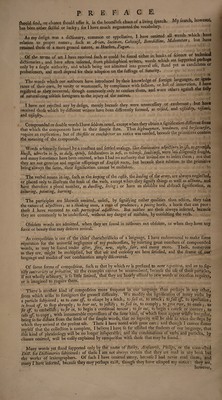
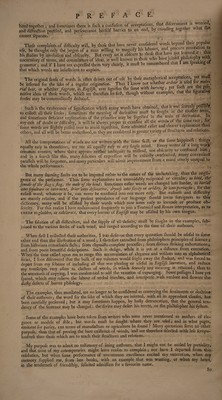
![vent, circumjlanccy delude, concave, and complicatCy though compounds in the Latin, are to us prim I* tives. Derivatives, are all thofe that can be referred to any word in Englijh of greater fimplicity. The derivatives I have referred to their primitives, with an accuracy fometime9 needlefs; for who does not fee that rcmotenefs comes from remote, lovely from love, concavity from concave, and demonjlrative from demonftrate ? but this grammatical exuberance the fcheme of my work did not allow me to reprefs* It is of great importance in examining the general fabrick of a language, to trace one word from another, by noting the ufual modes of derivation and inflexion; and uniformity mult be preferved in fyftematical works, though fometimes at the expence of particular propriety. Among other derivatives I have been careful to infert and elucidate the anomalous plurals of nouns afrd preterites ot verbs, which in the Feutomck dialedls are very frequent, and, though familiar to thofe who have always ufed them, interrupt and embarrafs the learners of our language. . The two languages from which our primitives have been derived are the Roman and Feutonick: under the Roman I comprehend the French and provincial tongues; and under the Feutonick range the Saxon, Germany and all their kindred dialedls. Moll of our polyfyllables are Roman, and our words of one fyllable are very often Feutonick. In affigning the Roman original, it has perhaps fometimes happened that I have mentioned only the Latin, when the word was borrowed from the French; and considering myfelf as employed only in the illuftration of my own language, I have not been very careful to obferve whether the Latin word be pure or barbarous, or the French elegant or obfolete. For the 'Teutonick etymologies I am commonly indebted to Junius and Skinner, the only names which I have forborn to quote when I copied their books; not that I might appropriate their labours or ufurp their honours, but that I might fpare a perpetual repetition by one general acknowledgment. Of thefe, whom I ought not to mention but with the reverence due to inllrudtors and benefactors, Junius ap¬ pears to have excelled in extent of learning, and Skinner in redtitude of underllanding. Junius was accurately {killed in all the northern languages, Skinner probably examined the ancient and remoter dialedls only by occafional infpedtion into dictionaries; but the learning of Junius is often of no other ufe than to iliow him a track by which he may deviate from his purpofe, to which Skinner always preifes forward by the fhorteft way. Skinner is often ignorant, but never ridiculous: Junius is always full of knowledge; but his variety diftraCts his judgment, and his learning is very frequently difgraced by his abfurdities. The votaries of the northern mufes will not perhaps eafily reftrain their indignation, when they find the name of Junius thus degraded by a difadvantageous comparifon; but whatever reverence is due to his diligence, or his attainments, it can be no criminal degree of cenforioufnefs to charge that etymo- logift with want of judgment, who can ferioufly derive dream from drama, becaufe life is a drama, and -a drama is a dreamy and who declares with a tone of defiance, that no man can fail to derive moan from p6v@*y monos, who confiders that grief naturally loves to be alone *. Our knowledge of the northern literature is fo fcanty, that of words undoubtedly Feutonick the original is not always to be found in any ancient language , and I have therefore inferted Dutch or German fubfti- tutes, which I confider not as radical but parallel, not as the parents, but filters of the Englijh. The words which are reprefented as thus related by defcent or cognation, do not always agree in fenfe; for it is incident to words, as to their authours, to degenerate from their anceltors, and to change their manners when they change their country.. It is fufficient, in etymological enquiries, if the fenfes of kindred words be found fuch as general idea. The etymology, fo far as it is yet known, was eafily found in the volumes where it is par¬ ticularly and profelfedly delivered; and, by proper attention to the rules of derivation, the orthogra¬ phy was foon adjufted. But to collect the Words of our language was a talk of greater difficulty : the deficiency of dictionaries was immediately apparent; and when they were exhaulled, what was yet wanting mull be fought by fortuitous and unguided excurfions into books, and gleaned as induftry may eafily pafs into each other, or fuch as may both be referred to one * That I may not appear to have fpoken too irreverently of Junius, I have here fubjoined a few Specimens of his etymolo¬ gical extravagance. 0 Banish, rcligarc, ex banno vel territorio exigere, in exilium ogere. G. bannir. It. bandire, bandeggiare. H. bandir. B. ban- nen. JEvi medii feriptores bannire dicebant. V. Spelm. in Ban- num & in Banleuga. Quoniam verb regionum urbiumq; limites arduis plerumq; montibus, altis fluxninibus, longisdeniq; flexuo- fifq; anguftiftimarum viarum amfrabtibus includebantur, fieri poteft id genus limites ban dici ab eo quod Bawdroa Sc Bavvdlfoi Tarentinis olim, ficuti tradit Hefychius, vocabantur a\ A©£o\ ^ fxri I%t£vi7^ oJ'oty iC obliquae ac minime in redtum tendentes vise.” Ac fortafl'e quoque hue facit quod Bav«?, eodem Hefychio tefte, dicebant ogy f^txyyvXy, montes arduos. Empty, emtie, vacuus, inanis. A. S. ./Ermpig. Nefcio an fint ab vel f[xtlolw. Vomo, evomo, vomitu evacuo. Videtur interim etymologiam hanc non obfeure firmare codex Rulh. Mat. xii. 22. ubi antique feriptum invenimus gemoeteb hit emetij. <c Invenit earn vacantem/’ Hill, monsy collis. A S. hyll. Quod videri poteft abfeiflum ex xoAw»v] Vel xoAwvoj. Collis, tumulus, locus in piano editior. Horn. 11. b. v. 811, ert Hi TK 7T^07rcl^0i^'£ 7roA£®J ocnviiocy noXoovy. Ubi authori brevium fcholiorum y.oXum exp. toV^ hj avriKooVy yfwAoCp©’ Nap, to take a nap. Dormire, condormifcere. Cym. heppian. A. S. hnaeppan. Quod poftremum videri poteft defumptum cx xv'i(px;y obfeuritas, tenebrae : nihil enim aeque folet conciliare fomnum, quam caliginofa profundae notis obfeuritas. Stammerer, Balbus, blaefus Goth. STAMMS. A. S. ptamej-i, ptamup. D. (lam. B. ftameler. Su. ftamma. Ifl. ftamr. Sunt a ruy.vXs7v vel rwjuuAAnv, nimia loquacitate alios offendcre; quod impedite loquentes libentiffime garrire foleant; vel quod aliis nimii Temper videantur, etiarn parciflime loquentes. B Ihould](https://iiif.wellcomecollection.org/image/b30451541_0001_0014.jp2/full/800%2C/0/default.jpg)