Volume 1
A dictionary of the English language: in which the words are deduced from their originals, and illustrated in their different significations by examples from the best writers. To which are prefixed, a history of the language, and an English grammar / by Samuel Johnson.
- Samuel Johnson
- Date:
- 1755
Licence: Public Domain Mark
Credit: A dictionary of the English language: in which the words are deduced from their originals, and illustrated in their different significations by examples from the best writers. To which are prefixed, a history of the language, and an English grammar / by Samuel Johnson. Source: Wellcome Collection.
52/1176
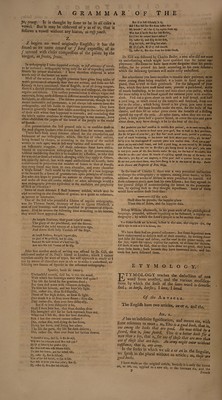
![young. It is thought by fome to be in all cafes a vowel. But it may be obferved of y as of w, that it follows a vowel without any hiatus, as rofy youth. Z. Z begins no word originally Englilh; it has the found as its name izzard or f hard exprefles, of an / uttered with clofer compreffion of the palate by the tongue, as freeze, froze. In orthography I have fuppofed orthoepy, or juft utterance of words, to be included ; orthography being only the art of expreffing certain founds by proper charadters. I have therefore obferved in what words any of the letters are mute. Molt of the writers of Englifh grammar have given long tables of words pronounced otherwife than they are written, and feem not fuf- ficiently to have confidered, that of Englilh, as of all living tongues, there is a double pronunciation, one curfory and colloquia^he other regular and folemn. 1 he curfory pronunciation is always vague and uncertain, being made different in different mouths by negligence, un¬ ikill ulnefs, or aftedtation. The folemn pronunciation, though by no means immutable and permanent, is yet always lefs remote from the orthography, and lefs liable to capricious innovation. They have however generally formed their tables according to the curfory fpeech °f tjiofe with whom they happened to converfe; and concluding that the whom nation combines to vitiate language in one manner, have often eftablifhed the jargon of the loweft of the people as the model of fpeech. For pronunciation the bell general rule is, to confider thofe as the moll elegant fpeakers. who deviate leall from the written words. Theie have been many fchemes offered for the emendation and fettlement of our orthography, which, like that of other nations, being formed by chance, or according to the fancy of the earlieit writers in rude ages, was at firlt very various and uncertain, and is vet fufficiently irregular. Of thefe reformers fome have endea- vouied to accommodate orthography better to the pronunciation, vvithout conlidering that this is to meafure by a lhadovv, to take that for a model or itandard which is changing while thev apply it. Others, lefs abfurdly indeed, but with equal unlikelihood of iuccefs, have endeavoured to proportion the number of letters to that of founds, that every found may have its own character, and every character a fmgle lound. Such would be the orthography of a new language to be formed by a fynod of grammarians upon principles of fcience. But who can hope to prevail on nations to change their practice, and make all their old books ufelefs ? or what advantage w'ould a new orthography procure equivalent to the confufion and perplexity of fuch an alteration ? 1 Some of thefe fchemes I fhall however exhibit, which may be uQ:d according to the diverfities of genius, as a guide to reformers, or terrour to innovators. One of the firlt who propofed a fcheme of regular orthography, was Sir Thomas Smith, fecretary of date to Queen Elizabeth, a man of real learning, and much pradifed in grammatical difquifi- tions. Had he written the following lines according to his fcheme, they would have appeared thus. At length Erafmus, that great injur’d name. The glory of the priedhood, and the lhame, Stemm’d the wild torrent of a barb’rous age. And drove thofe holy Vandals off the dage. At lengfc Erafmus, JSat giet i'njurd nam, Ae glor’i of $e prefthiid, and Se zam, Stemmd $e «ri»'ld torrent of a barb’rous aj. And diov Sos holi Vandals off $e flaj. After him another mode of writing was offered by Dr. Gill, the celebiated mader of St. Paul’s fchool in London; which I cannot reprefent exa&Iy for want of types, but will approach as nearly as I can by means of charadlers now in ufe as to make it underdood, ex¬ hibiting two danzas of Spenfer in the reformed orthography. Spenfer, book iii. canto 5. Unthankful wretch, faid he, is this the meed, With which her fovereign mercy thou dod quite ? Thy life fhe faved by her gracious deed ; But thou dod ween with villanous defpight. To blot her honour, and her heav’nly light. Die, rather die, than fo difloyally. Deem of her high defert, or feem fo light. Fair death it is to Oiun more fhame ; then die. Die,’ rather die, than ever love didoyally. But if to love difloyalty it be, Shall I then hate her, that from deathes door Me brought ? ah ! far be fuch reproach from ms. What can l lefs do, than her love therefore, Sith I her due reward cannot redore ? Die, rather die, and dying do her ferve. Dying her ferve, and living her adore. 'f hy life fhe gave, thy life die doth deferve ; Die, rather die, than ever from her fervice fwerve. Vnl;<znkful wrss, faid hj, iz <Sis £e mjd, Wilj lob hsr foturain msrfi Sou dull qujt ? Dj Ijf pi Gibed bj her grafius djd ; But Sou dull wen wil) biknus difpjt, Tu blot hsr honor, and her hebnJj Wbt, Dj, raStr dj. Sen fo difloialj. Djm of her hib dszert, or fjm fo Wbt. 1 Fair de() it iz tu pun mur yam ; Sen dj, Dj, raScr dj, S;n et)er lull difloialj. But if tu lu& difloialtj it bj, Sal I Sen hat her Sat from deSez d»r Mj brou&t ? ah ! far bj fus reproa from mj. Wat kan I les du Sen her lull Serfar. Sib I her du reward kanot rellar ? Dj, raSer dj, and djij du her fer&, D;ij herferh, and liliig her adar. Dj IK pi Sj ljf pj dtiib dezerh. Dj, raSer di, Sen eller from her ferbis fwerff. Dr. Gill was followed by Charles Butler, a man who did not want an underilanding which might have qualified him for better em¬ ployment. He feems to have been more fanguine than his prede- ceffors, for he printed his book according to his own fcheme ; which the following fpecimen will make ealily underltood. But vvhenfoever you have occafion to trouble their patience, or to come among them being troubled, it is better to Hand upon your guard, than to trull to their gentlenefs. For the fafeguard of your face, which they have molt mind unto, provide a purfehood, made of coarfe boultering, to be drawn and knit about your collar, which for more fafety is to be lined againit the eminent parts with woollen cloth. Firlt cut a piece about an inch and a half broad, and half a yard long, to reach round by the temples and forehead, from one ear to the other ; which being fowed in his place, join unto it two Ihort peces of the fame breadth under the eyes, for the balls of the cheeks, and then fet an other piece about the breadth of a /hilling againit the top of the nofe. At other times, when they are not an¬ gered, a little piece half a quarter broad, to cover the eyes and parts about them, may ferve though it be in the heat of the day. Bet f enfoever you hav’ occafion to trubble Seir patienc’, or to c#»m among Sem beeing trubled, it is better to Hand upon your gard, San to truft to Seir gentlenes. For Se faf’gard of your fac’, p3 Sey hav’ moll mind’ unto, provid’ a purfehood, mad’ of coorle boultering, to bee drawn and knit about your collar, pb for mor* faf’ty is to bee lined againft S’ eminent parts wit woollen clot. Firlt cut a peoc’ about an ino and a half broad, and half a yard long, to reaa round by Se temples and for'head, from one ear to Se cSer; pb booing fowed in his plac’, join unto it two port pooces of the fam breadt under Se eys, for the bals of Se crooks, and then fet an oScr poec’ about Se breadt of a pilling againft the top of Se nofe. At cSer tim’s, pen Sey ar’not angered, a little piec’ half a quarter broad, to cover Se eys and parts about them, may ferve Sowg it be in the heat of Se day. Butler on the Nature and Properties of Bees, 1634, In the time of Charles I. there was a very prevalent inclination to change the orthography; as appears, among other books, in fuch editions of the works of Milton as were publilhed by himfelf. Of thefe reformers every man had his own fcheme ; but they agreed in one general defign of accommodating the letters to the pronuncia¬ tion, by ejecting fuch as they thought fuperfluous. Some of them would have written thefe lines thus; - -All the erth Shall then be paradis, far happier place Than this of Eden, and far happier dais. Bilhop Wilkins afterwards, in his great work of the philofophical language, propofed, without expedting to be followed, a regular or¬ thography ; by which the Lord’s prayer is to be written thus: Yur Fadher h«itlh art in heven, halloed bi dhyi ndm, dhyi cingdym cym, dhy till bi dyn in erth as it is in heven, &c. We have fince had no general reformers; but fome ingenious men have endeavoured to deferve well of their country, by writing honor and labor for honour and labour, red for read in the preter-tenle, sais for fays repete for repeat, explane for explain, or declame for de'elaim. Of thefe it may be faid, that as they have done no good, they have done little harm; both becaufe they have innovated little and hp caufe few have followed them. ETYMOLOGY. ETYMOLOGY teaches the deduction of one word from another, and the various modifica¬ tions by which the fenfe of the fame word is diverfi- fied ; as horfe, horfes ; I love, I loved. • Of the Article. The Englilh have two articles, an or a, and the. zfhas an indefinite fignification, and means one, v, fome reference to more ; as. This is a good took, that one among the hooks that are good. He vas killed b fiverd, that is, fome J-word. This is a better book fo man than a hoy, that is, for one of thofe that are menu one of thofe that are boys. An army might enter with refiflance, that is, any army. In the fenfes in which we ufe * or *0 in the fincrU] we fpeak in the plural without an article ; as, the/} good books. * J I have made an, or sn, one, 9 an the original article applied to a new ufe; , becaufe it is only the Saxon as the German e'm, and the French 4](https://iiif.wellcomecollection.org/image/b30451541_0001_0053.jp2/full/800%2C/0/default.jpg)