Volume 1
A dictionary of the English language: in which the words are deduced from their originals, and illustrated in their different significations by examples from the best writers. To which are prefixed, a history of the language, and an English grammar / by Samuel Johnson.
- Samuel Johnson
- Date:
- 1755
Licence: Public Domain Mark
Credit: A dictionary of the English language: in which the words are deduced from their originals, and illustrated in their different significations by examples from the best writers. To which are prefixed, a history of the language, and an English grammar / by Samuel Johnson. Source: Wellcome Collection.
70/1176
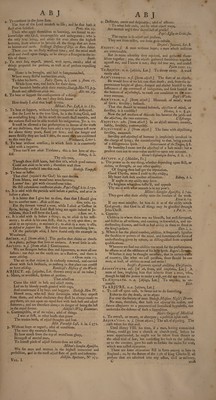
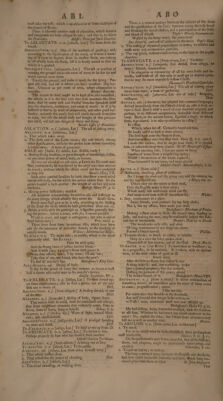
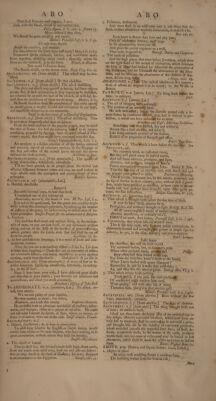
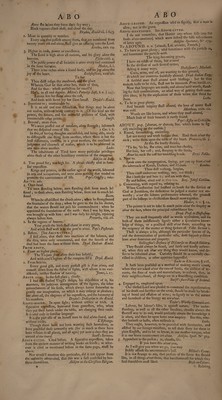
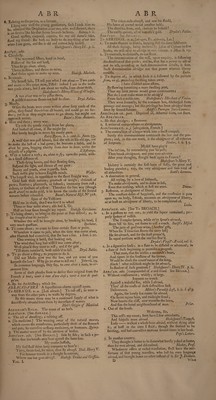
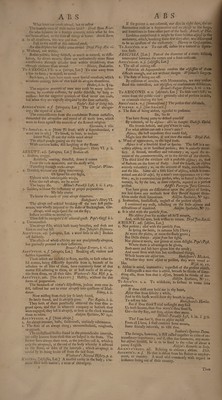
![Above tlie brims they force their firy way ; Black vapours climb aloft, and cloud the day. Dryden, /Eneid vii. /. 643. 2. More in quantity or number. Every one that paffeth among them, that are numbered from twenty years old and above, {hall give an offering unto the Lord. Exodus, xxx. 14. 3. Higher in rank, power or excellence. The Lord is high above all nations, and his glory above the heavens. Pfalm cxiii. 4. The public power of all focieties is above every foul contained in the fame fociaties. Hooker, b. i. There is no riches above a found body, and no joy above the joy of the heart. Ecclefaficus, xxx. 16. To her Thou didft refign thy manhood, and the place Wherein God fet thee above her, made of thee. And for thee : whofe perfection far excell’d Her’s, in all real dignity. Milton’s Paradife Lof, b, x. /. 147. Latona fees her fhine above the reft, And feeds with fecret joy her filent breaft. Dryden’s /Eneid. 4. Superiourto; unattainable by. It is an old and true diftinCtion, that things may be above our reafon, without being contrary to it. Of this kind are the power, the nature, and the univerfal prefence of God, with innumerable other points. Swift. 5. Beyond; more than. We were prefTed out of meafure, above ftrength ; infomuch that we defpaired even of life. 2 Cor. i. 8. In this, of having thoughts unconfufed, and being able, nicely to diftinguifh one thing from another, v/here there is but the leaft difference, confifts, in a great meafure, the exa&nefs of judgment and clearnefs of reafon, which is to be obferved in one man above another. Locke. The inhabitants of Tirol have many particular privileges above thofe of the other hereditary countries of the emperour. Addifon on Italy. 6. Too proud for; too high for. A phrafe chiefly ufed in fami¬ liar expreflion. Kings and princes, in the earlier ages of the world, laboured in arts and occupations, and were above nothing that tended to promote the conveniences of life. Pope’s Odyffey j notes. Abo've. adv. 1. Over-head. To men {landing below, men {landing aloft feem much lef- fened ; to thofe above, men {landing below, feem not fo much lef- fened. Bacon. When he eftablifhed the clouds above ; when he {Lengthened the fountains of the deep ; when he gave to the fea his decree, that the waters fhould not pafs his commandment: when he appointed the foundations of the earth : then I was by him, as one brought up with him: and I was daily his delight, rejoicing always before him. Proverbs, viii. 28. 2. In the regions of heaven. Your praife the birds {hall chant in every grove, And winds {hall waft it to the pow’rs above. Pope’s Pajlorals. 3. Before. [See Above-cited.] I faid above, that thefe two machines of the balance, and the dira, were only ornamental, and that the fuccefs of the duel had been the fame without them. Dryd. Dedicat. /Eneid, Fr OM ABOVE. 1. From an higher place. The Trojans from above their foes beheld; And with arm’d legions all the rampires fill’d. Dryd. /Eneid. 2. From heaven. Every good gift, and every perfect gift is from above, and cometh down from the father of lights, with whom is no vari- ablenefs, neither ftiadow of turning. fames, i. 17. Above all. In the firft place ; chiefly. I had alfo ftudied Virgil’s defign, his difpofition of it, his manners, his judicious management of the figures, the fober retrenchments of his fenfe, which always leaves fomewhat to gratify our imagination, on which it may enlarge at pleafure ; but above all, the elegance of his expreflion, and the harmony of his numbers. Dryden s Dedication to the /Eneid. Aeove-eoard. In open fight; without artifice or trick. A fio-urative expreflion, borrowed from gamefters, who, when they put their hands under the table, are changing their cards. It is ufed only in familiar language. It is the part alfo of an honeft man to deal above-board, and without tricks. L Ejlrange. Though there have not been wanting fuch heretofore, as have praCtifed thefe unworthy arts (for as much as there have keen villains in all places, and all ages) yet now-a-days they are owned above-board. South s Sermons. Above-cited. Cited before. A figurative expreflion, taken from the ancient manner of writing books on fcrolls; as what¬ ever is cited or mentioned before in the fame page, muft be above. Nor would I mention this particular, did it not appear from the authority above-cited, that this was a fadt confeiled by hea¬ thens themfelves. Jddijon on the Chrijlian Religion. ABO Abovf.-g round. An expreflion ufed to fignify, that a man is alive; not in the grave. Above-mentioned. See Above-cited. , I do not remember, that Homer any-where falls into the faults above-mentioned, which were indeed the falfe refinements, of latter ages. Mdifif- Spf**,™ ° 2 79- To ABOUND, v. n. [abUndd, Lat. abonder, french.J _ 1. To have in great plenty ; uled fometimes with tie particle in, and fometimes the particle with. The king-becoming graces, I have no relifh of them, but abound In the divifion of each feveral crime, , Adding it many ways. _ Shakefpearc s Macbeth. Corn, wine, and oil, are wanting to this ground, _ In which our countries fruitfully abound. Dryd. Indian Emp. A faithful man fhall abound with bleflings : but he that maketh hafte to be rich, {hall not be innocent Prov. xxviii.2C. Now that languages are made, and abound with words, ftand- ino- for fuch combinations, an ufual way of getting thefe com¬ plex ideas, is by the explication of thofe terms _that ftand for them. Locke' 2. To be in great plenty. And becaufe iniquity {hall abound, the love of many lhall wax cold. Matthew, xxiv. 12. Words are like leaves, and where they moll abound. Much fruit of fenfe beneath is rarely found. Pope’s EJfay on Criticifm. ABOUT, prep, [abutan, or abuton, Sax. which feems to fig¬ nify encircling on the outfide.] I. Round, furrounding, encircling. Let not mercy and truth forfake thee. Bind them about thy . neck; write them upon the table of thy heart. Proverbs, iii. 3. At this the loudly fhrieks, ’Tis he, ’tis he, {he cries, and tears her cheeks. Her hair, her veft ; and, Hooping to the fands, Lie nprt fhp rail her fremblinp- hands. Drvd. Fables. 2. Near to. Speak unto the congregation, faying, get you up from <7 W the tabernacle of Korah, Dathan, and Abiram. Exodus. Thou doft nothing, Sergius, Thou canft endeavour nothing, nay, not think ; But 1 both fee and hear it; and am with thee. By and before, about and in thee too. Benj. fohnf. Catiline. 3. Concerning, with regard to, relating to. When Conftantine had finiftied an houfe for the fervice ot God at Jerufalem, the dedication he judged a matter not un¬ worthy ; about the folemn performance whereof, the greateft: part of the biihops in chriftendom fhould meet together. Hooker, b. v. § r 2. The painter is not to take fo much pains about the drapery as about the face, where the principal refemblance lies. Dryd. Pref. to Dufrefnoy. They are moft frequently ufed as words equivalent, and do both of them indifferently fignify either a fpeculative know¬ ledge of things, or a practical skill about them, according to the exigency of the matter or thing fpoken of. Tillot. Sermon i. Theft is always a fin, although the particular fpecies of it, and the denomination of particular a£ls, doth fuppofe pofitive laws about dominion and property. Stillingfeet’s Defence of Difcourfes on Romijh Idolatry. They fhould always be heard, and fairly and kindly anfwer- ed, when they ask after any thing they would know, and de¬ fire to be informed about. Curiofity fhould be as carefully che- rifhed in children, as other appetites fuppreffed. Locke on Education, § 108. It hath been pra&ifed as a method of making men’s court, when they are asked about the rate of lands, the abilities of te¬ nants, the ftate of trade and manufacture, to anfwer, that, in their neighbourhood, all things are in a flourifhing condition. Swift'sjhort View of Ireland. 4. Engaged in, employed upon. Our blefied Lord was pleafed to command the reprefentation of his death and facrifice on the crofs, fhould be made by break¬ ing of bread and effufion of wine; to fignify to us the nature and facrednefs of the liturgy we are about. Taylor’s JVorthy Communicant. Labour, for labour’s fake, is againft nature. The under- ftanding, as well as all the other faculties, choofes always the fhorteft way to its end, would prefently obtain the knowledge it is about, and then fet upon fome new enquiry. But this, whe¬ ther lazinefs or hafte, often mifleads it. Locke. They ought, however, to be provided with fecretaries, and aflifted by our foreign minillers, to tell their ftorv for them in plain Englifh, and to let us know, in our mother-tongue, what it is our brave countrymen are about. Addifon. Spctf?.°N° 309. 5. Appendant to the perfon ; as, cloaths, itfe. If you have this about you, As I will give you when we go, you may Boldly a {fault the necromancer’s hall. Milton’s Comus. It is not ftrange to me, that perfons of the fairer fex fhould like, in all things about them, that handfomenefs for which they find themfelves moft liked. Boyle on Colours. \](https://iiif.wellcomecollection.org/image/b30451541_0001_0071.jp2/full/800%2C/0/default.jpg)