Volume 1
A dictionary of the English language: in which the words are deduced from their originals, and illustrated in their different significations by examples from the best writers. To which are prefixed, a history of the language, and an English grammar / by Samuel Johnson.
- Samuel Johnson
- Date:
- 1755
Licence: Public Domain Mark
Credit: A dictionary of the English language: in which the words are deduced from their originals, and illustrated in their different significations by examples from the best writers. To which are prefixed, a history of the language, and an English grammar / by Samuel Johnson. Source: Wellcome Collection.
71/1176
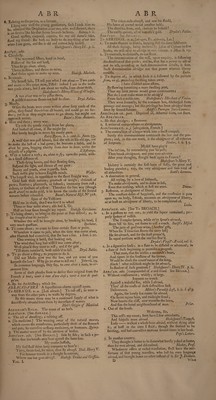
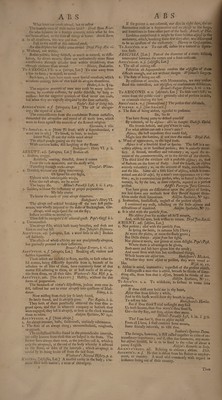
![6. Relating to the perfon, as a fervant. Likin'* very well the young gentleman, fuch I took him to be admitted this Deiphantus about me, who well (hewed, there is no fervice like his that ferves becaufe he loves. Sidney, b. ii. Good matter, corporal, captain, for my old dame’s lake, {land my friend: (lie hath no body to do any thing about her when I am gone, and (he is old and cannot help herfelf. Shakefpeare’s Henry IV. p. ii. Abo'ut. adv. 1. Circularly. The weyward fillers, hand in hand. Potters of the fea and land. Thus do go about, about, Thrice to thine, and thrice to mine, And thrice again to make up nine. Sbah e/p. Macbeth. 2. In circuit. _ , My honeft lads. I’ll tell you what I am about.— Two yards and more.— No quips now, Piftol: indeed I am in the watte two yards about ; but I am about no watte, I am about thrift. Shakefpeare’s Merry Wives of JVindjor. A tun about was ev’ry pillar there, A polifh’d mirrour (hone not half fo clear. Dryd. Fables. 3. Nearly. When the. boats were come within about fixty yards of the pillar, they found themfelves all bound, and could go no far- ■ ther; yet fo as they might move to go about, but might not approach nearer. Bacon s Hew Atalantis. 4. Here and there ; every way. Up rofe the gentle virgin from her place. And looked all about, if (he might fpy Her lovely knight to move his manly pace. Fairy tHhicen, b. i. cant. ii. Jlan%. 33. A wolf that was pad labour, had the wit in his old age, yet to make the beft of a bad game; he borrows a habit, and fo about he goes, begging charity from door to door, under the difguife of sa pilgrim. L’EJlrange. 5. With to before a verb ; as, about to fly; upon the point, with¬ in a fmall diftance of. Thefe dying lovers, and their floating fons, Sufpend the fight, and filence all our guns : Beauty and youth, about to perifh, finds Such noble pity in brave Englifh minds. W’tiler. 6. The longed way, in oppofition to the (hort ftraight way. Gold hath thefe natures; greatnefs of weight; clofenefs of parts; fixation ; pliantnefs, or foftnefs ; immunity from ruft ; colour, or Mure of yellow : Therefore the fure way (though moft about) to make gold, is to know the caufes of the feveral natures before rehearfed. Bacon’s Natural Hifl. N° 3 2 8. Spies of theVolfcians Held me in chafe, that I was forc’d to wheel Three or four miles about; elfe had I, Sir, Half an hour fince brought my report. Shake/p. Coriolanus. 7. To bring about; to bring to the point or (late defired; as, be has brought about bis purpofes. Whether this will be brought about, by breaking his head, I very much queftion. Spectator. 8. To come about; to come to fome certain ftate or point. Wherefore it came to pafs, when the time was come about, after Hannah had conceived, that (he bare a fon. 1 Sam. i. 20. One evening it befel, that looking out. The wind they long had wilh’d was come about; Well pleas’d they went to reft ; and if the gale ’Till morn continu’d, both refolv’d to fail. Dryd. Fables. 9. To go about a thing ; to prepare to do it. Did not Mofes give you the law, and yet none of you keepeth the law ? Why go ye about to kill me ? John vii. 19. In common language, they fay, to come about a man, to ch - cunment him. Some of thefe phrafes feem to derive their original from the French a bout; venir a bout d’une chofe; venir a bout de quel- qu’un. A. Bp. for Archbifhop; which fee. A B RAC A DA'BRA. A fuperftitious charm againft agues. To ABRA'DE. v. a. [Lat. abrado.] To rub off; to wear a- way from the other parts ; to watte by degrees. By this means there may be a continued fupply of what is fucceflively abraded from them by decurfion of waters. Hale’s Origin of Mankind. Abraham’s Balm. The name of an herb. Abrasion. [See Abrade.] 1. The act of abrading; a rubbing off. 2. [In medicine.] The wearing away of the natural mucus, which covers the membranes, particularly thofe of the ftomach and guts, by corrofive or (harp medicines, or humours. Quincy. 3. The matter worn off by the attrition of bodies. Abre'ast. adv. [See Breast.] Side by fide; in fuch a po- fition that the breads may bear againft the fame line. My coufin Suffolk, My foul (hall thine keep company to heav’n : T arry, fwcet foul, for mine, then fly abreafl. Sbak. Henry \ . For honour travels in a (freight fo narrow, Where one but goes abreafl. Sbakefp. Froilus and Crejflda. VOL. I. The riders rode abrxafl, and one his (hield. His lance of cornel-wood another held ; T he third his bow, and, glorious to behold ! The collly quiver, all of burnilh’d gold. Dryden’s Fables. Arri'cot. See Apricot. 'Fo ABRLDGE. v. a. [abreger, Fr. abbrevio, Lat.] 1. To make (horter in words, keeping Hill the fame fubftance. All thefe fayings, being declared by Jafon of Cyrcne in five books, we will ellay to abridge in one volume. 2 Macc. ii. 23. 2. To contract, todiminifh, to cut (hol t. The determination of the will, upon enquiry, is following the direction of that guide ; and he, that has a power to aft or not to aft, according as fuch determination direfts, is free. Such determination abridges not that power wherein liberty confifts. Locke. 3. To deprive of; in which fenfe it is followed by the particle from, or of preceding the thing taken away. I have difabled mine eftate, By (hewing fomething a more fwelling port, Than my faint means would grant continuance ; Nor do i now make moan to be abridg’d From fuch a noble rate. Sbakefpeare’s Merchant of Venice. They were formerly, by the common law, dilcharged from pontage and murage ; but this privilege has been abridged them fince by feveral ftatutes. Ayliffe’s Parergon Juris Canonici. Abridged of. part. Deprived of, debarred from, cut (hort. An Abri'dger. 1. He that abridges; a (hortener. 2. A writer of compendiums or abridgments. Abridgment, n.f [abregement, french.] 1. The contraction of a larger work into a fmall compafs. Surely this commandment containeth the law and the pro¬ phets ; and, in this one word, is the abridgment of all volumes of feripture. Hooker, b. ii. § 5. Myfelf have play’d The int’rim, by remembring you ’tis paft; Then brook abridgment, and your eyes advance After your thoughts, ftraight back again to France ? Shakefpeare s Henry V. Idolatry is certainly the firft-born of folly, the great and leadin'* paradox; nay, the very abridgment and fum total of all abfurdities. South’s Sermons. 2. A diminution in general. All trying, by a love of littlenefs, To make abridgments, and to draw to lefs. Even that nothing, which at firft we were. Donne. 3. Reftraint, or abridgment of liberty. The conftant defire of happinefs, and the conftraint it puts upon us, no body, I think, accounts an abridgment of liberty, or at lead: an abridgment of liberty, to be complained of. Locke. Abro'ach. adv. [See To BROACH.] 1. In a pofture to run out; to yield the liquor contained ; pro¬ perly fpoken of veffels. The Templer fpruce, while ev’ry fpout’s abroach. Stays ’till ’tis fair, yet feems to call a coach. Swift’s Mifcel. The jarrs of gen’rous wine, (Aceftes’ gift, When his Trinacrian (hores the navy left) He fet abroach, and for the feaft prepar’d. In equal portions with the ven’lon (har’d. Dryden’s Virgil’s JEneid, vol. ii. 2. In a figurative fenfe; in a ftate to be diffufed or advanced; in a ftate of fuch beginning as promifes a progrefs. That man, that fits within a monarch’s heart. And ripens in the fun(hine of his favour. Would he abufe the count’nance of the king. Alack ! what mifehiefs might be fet abroach. In (hadow of fuch greatnefs ? Shakefpeare’s Henry IV. p. ii, Abro'ad. adv. [compounded of a and broad. See Broad.] 1. Without confinement; widely; at large. Intermit no watch Againft a wakeful foe, while I abroad. Thro’ all the coafts of dark deftruftion feek Deliverance. Milton’s Paradife Lofl, b. ii. /. 463, Again, the lonely fox roams far abroad, On fecret rapine bent, and midnight fraud ; Now haunts the cliff, now traverfes the lawn. And flies the hated neighbourhood of man. Prior. 2. Out of the houfe. Welcome, Sir, This cell’s my court; here have I few attendants, And fubjefts none abroad. Shakefpeare’s Fcmpefl. La(ly-walked a whole hour abroad, without dying after it; at leaft in the time I ftaid ; though (he feemed to be faintin'*, and had convulfive motions feveral times in her head. Pope’s Letters. 3. In another country. They thought it better to be fomewhat hardly yoked at home, than for ever abroad, and diferedited. Hooker, Pref. Whofoever offers at verbal tranflation, (hall have the mil- fortune of that young traveller, who loft his own language abroad, and brought home no other inftead of it. Sir J. Denham. D What](https://iiif.wellcomecollection.org/image/b30451541_0001_0072.jp2/full/800%2C/0/default.jpg)