Volume 1
A dictionary of the English language: in which the words are deduced from their originals, and illustrated in their different significations by examples from the best writers. To which are prefixed, a history of the language, and an English grammar / by Samuel Johnson.
- Samuel Johnson
- Date:
- 1755
Licence: Public Domain Mark
Credit: A dictionary of the English language: in which the words are deduced from their originals, and illustrated in their different significations by examples from the best writers. To which are prefixed, a history of the language, and an English grammar / by Samuel Johnson. Source: Wellcome Collection.
77/1176
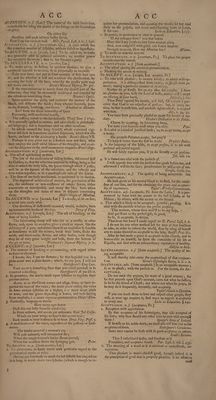
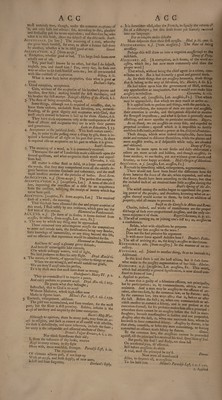
![AC A NTHUS. n.f. [Lat.] The name of the herb bears-foot, remarkable for being the model of the foliage on the Corinthian chapiter. On either fide Acanthus, and each od’rous bufhy fhrub, Fenc’d up the verdant wall. Milt. Parad. Lojl, b. iv. /. 696. Acatale'ctic. n. f. [:lxx~x?Axlix<&, Gr.] A verfe which has the compleat number of fyllables, without defeft or fuperfluity. 'loACCE'DE. v. n. [accede, Lat.] To be added to, to come to; generally ufed in political accounts; as, another power has acceded to the treaty ; that is, has become a party. To ACCELERATE, v. a. [accelero, Lat.] 1. To make quick, to haften, to quicken motion ; to give a continual impulfe to motion, fo as perpetually to encreafe. Take new beer, and put in fome quantity of ftale beer into it ; and fee whether it will not accelerate the clarification, by opening the body of the beer, whereby the groffer parts may fall down into lees. Bacon s Natural Hiftory, N9 307. If the rays endeavour to recede from the den fell: part of the vibration, they may be alternately accelerated and retarded by the vibrations overtaking them. Newton s Optics. Spices quicken the pulfe, and accelerate the motion of the blood, and difHpate the fluids; from whence leannefs, pains in the ftomach, loathings, and fevers. Arbuihnot on Alments. Lo ! from the dread immenfityof fpace Returning, with accelerated courfe, The rufliing comet to the fun defeends. Thomf. Sum. 1. 1690. 2. It is generally applied to matter, and ufed chiefly in philofophi- cal language; but is fometimes ufed on other occafions. In which council the king himfelf, whofe continual vigi- Jancv did fuck in fometimes caufelefs fufpicions, which few elfe knew, inclined to the accelerating a battle. Bacon's Henry VII. Perhaps it may point out to a ftudent now and then, what may employ the moft ufeful labours of his thoughts, and accele¬ rate his diligence in the moft momentous enquiries. Waits'sbnpr. Acceleration, n. f [acceleration Lat.] 1. Theadl of quickening motion. The law of the acceleration of falling bodies, difeovered find by Galileo, is, that the velocities acquired by falling, being as the time in which the body falls, the fpaces through which it paffes, will be as the fquares of the velocities, and the velocity and time taken together, as in a quadruplicate ratio of the fpaces. 2. The ftate of the body accelerated, or quickened in its motion. The degrees of acceleration of motion, the gravitation of the air, the exiftence or non-exiftence of empty fpaces, either coacervate or interfperfed, and many the like, have taken up the thoughts and times of men in difputes concerning them. Hale’s Origin of Mankind. To ACCE'ND. v. a. [accendo, Lat.] To kindle, to fet on fire; a word very rarely ufed. Our devotion, if fufficientlv accended, would, as theirs, burn up innumerable books of this fort. Decay of Piety. Accession, n.f [accenfio, Lat.] The ach of kindling, or the ftate of being kindled. The fulminating damp will take fire at a candle, or other flame, and, upon its accenfion, gives a crack or report, like the difeharge of a gun, and makes likewife an exploiion fo forcible as fometimes to kill the miners, break their limbs, Ihake the earth, and force coals, ftones, and other bodies, even though they be of very great weight and bulk, from the bottom of the pit or mine. Woodward's Natural Hijiory, p. iv. A’ C C E N T. n. f. [accentus, Lat. ] j. The manner of fpeaking or pronouncing, with regard either to force or elegance. I know. Sir, I am no flatterer; he that beguiled you in a plain accent was a plain knave ; which, for my part, I will not be. Shakefpeare's King Lear. Your accent is fomething finer than you could purchafe in fo removed a dwelling. Shakefpeare’s As you like it. 2, In grammar, the marks made upon fyllables to regulate their pronunciation. Accent, as in the Greek names and ufage, feems to have re¬ garded the tune of the voice; the acute accent railing the voice in fome certain fyllables to a higher, i. e. more acute pitch or tone, and the grave deprdling it lower, and both having fome emphafis, i. e. more vigorous pronunciation.Holder sElem. 3, Poetically, language or vrords. How many ages hence Shall this our lofty feenebe adted o’er. Inflates unborn, and accents yet unknown. Shak.Jul. Cafar. Winds on your wings to heav’n her accents bear ; Such words as heav’n alone is fit to hear. Dr yd. Virg. Pajl. 3. 4, A modification of the voice, cxprefiive of the paflions or fenti- ments. The tender accent of a woman’s cry Will pafs unheard, will unregarded die ; When the rough feaman’s louder fhouts prevail. When fair occafion fhews the fpringing gale. Prior. To Acce'nt. v. a. [from accentus, Lat.] I. To pronounce, to fpeak words with particular regard to the grammatical marks or rules. Having got fomebody to mark thelaft fyllable but one, where it is long, in words above two fyllables (which is enough to re- gulate her pronunciation, and accenting the words) let her read daily in the gofpels, and avoid underftanding them in Latin, if fhe can. Locke on Education, § 177. 2. In poetry, to pronounce or utter in general. O my unhappy lines ! you that before Have ferv’d my youth to vent fome wanton cries, And, now congeal’d with grief, can fcarce implore Strength to accent. Here my Albertus lies ! Wctton. 3. To write or note the accents. I o Accentuate, v. a. [accentuer, Fr.J T o place the proper accents over the vowels. AccentuaTion. n.f. [from accentuate.] 1. The a£t of placing the accent in pronunciation. 2. Marking the accent in writing. To ACCE'PT. v. a. [accipio, Lat. accepter, Fr.] 1. To take with pleafure ; to receive kindly; to admit with ap¬ probation. It is diftinguifhed from receive, as fpcciftc from ge¬ neral ; noting a particular manner of receiving. Neither do ye kindle fire on my altar for nought. I have no pleafure in you, faith the Lord of hofts, neither will I accept an offering at your hand, Malachi, i. 1 o. Then Peter opened his mouth, and faid, Of a truth I per¬ ceive that God is no refpedler of perfons: but, in every na¬ tion, he that feareth him, and worketh righteoufnefs, is accepted with him. Akts,x. 34,35. You have been gracioufly pleafed to accept this tender of my duty. Dryden’s Dedication to his Fables. Charm by accepting, by fubmitting fway, Yet have your humour moft when you obey. Pope. 2. It is ufed in a kind of juridical fenfe ; as, to accept terms, accept a treaty. His promife Palamon accepts, but pray’d To keep it better than the firft he made. Dryden's Fables. 3. In the language of the bible, to accept perfons, is to a<ft with perfonal and partial regard. He will furely reprove you, if ye do fecretly accept perfons. Job, xiii. 10. 4. It is fometimes ufed with the particle of. I will appeafe him with the prefent that goeth before me, and afterward I will fee his face; peradventure he will accept of me. Genefis, xxxii. 20. Acceptability, n.f. The quality of being acceptable. See Acceptable. He hath given us his natural blood to be filed, for the remif- fion of our fins, and for the obtaining the grace and acceptabi¬ lity of repentance. Taylor's Worthy Communicant. Acceptable, ad]. [acceptable, Fr. from the Latin.] It is pro¬ nounced by fome with the accent in the firft fyllable, as by Milton ; by others, with the accent on the fecond. I. That which is likely to be accepted; grateful; pleafing. It is ufed with the particle to before the perfon accepting. This woman, whom thou mad’ft to be my help, 1 And gav’ft me as thy perfect gift, fo good. So fit, fo acceptable, fo divine. That from her hand I could expecl no ill. Parad. LoJl, b. ii. I do not fee any other method left for men of that function to take, in order to reform the world, than by ufing all honeft arts to make themfelves acceptable to the laity. Swift's Pro]. Ode. After he had made a peace fo acceptable to the church, and fo honourable to himfelf, he fpent the remainder of his life at Ripaille, and died with an extraordinary reputation of lan&ity. Addifon on Italy. Acce'ptableness. n.f. [from acceptable.] The quality of be¬ ing acceptable. It will thereby take away the acceptablenefs of that conjunc- t on. Grew's Cofmologia Sacra, b. ii. c. 2. AccePtaely. adv. [from acceptable.] In an acceptable manner ; fo as to pleafe; with the particle to. For the accent, fee Ac¬ ceptable. Do not omit thy prayers, for want of a good oratory; for he that prayeth upon God’s account, cares not what he fuffers, fo he be the friend of Chrift ; nor where nor when he prays, fo he may do it frequently, fervently, and acceptably. Taylor’s Guide to Devotion. If you can teach them to love and refpeft other people, they will, as your age requires it, find ways to exprefs it acceptably to every one. Locke on Education, § 145. Acceptance, n.f. [acceptance, Fr.] 1. Reception with approbation. By that acceptance of his fovereignty, they alfo accepted of his laws; why then Ihould any other laws be now ufed among# them ? Spenfer's State of Ireland. If he tells us his noble deeds, we mull alfo tell him our noble acceptance of them. Shakefpeare's Coriolanus. Some men cannot be fools with fo good acceptance as others. South's Sermons. Thus I imbolden’d fpake, and freedom us’d Permiflive, and acceptance found. Par. Loft, b. viii. /. 433. 2. The meaning of a word as it is received or underftood; ac¬ ceptation. That pleafure is man’s chiefeft good, becaufe indeed it is the perception of good that is properly pleafure, is an affertion moft](https://iiif.wellcomecollection.org/image/b30451541_0001_0078.jp2/full/800%2C/0/default.jpg)