Upon the intracellular constituents of the typhoid bacillus / by Allan Macfadyen and Sydney Rowland.
- Macfayden, Allan, 1860-1907
- Date:
- 1903
Licence: In copyright
Credit: Upon the intracellular constituents of the typhoid bacillus / by Allan Macfadyen and Sydney Rowland. Source: Wellcome Collection.
Provider: This material has been provided by The Royal College of Surgeons of England. The original may be consulted at The Royal College of Surgeons of England.
11/18
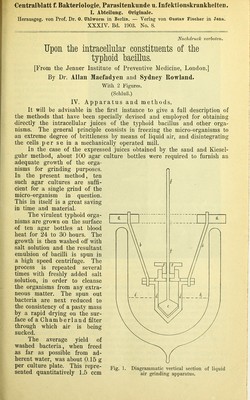
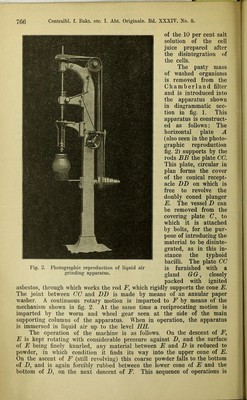
![Centralblatt f. Bakteriologie, Parasitenkunde u.InfektionskrankheiteD. I. AMeilung'. Originale. Herausgeg. von Prof. Dr, 0. Uhlworm in Berlin. — Verlag von Gustav Fischer in Jena. XXXIV. Bd. 1903. No. 8. Nachdruck verboten. Upon the intracellular constituents of the typhoid bacillus. [From the Jenner Institute of Preventive Medicine, London.] By Dr. Allan Macfadyen and Sydney Rowland. With 2 Figures. (SchluB.) IV. Apparatus and methods. It will be advisable in the first instance to give a full description of the methods that have been specially devised and employed for obtaining directly the intracellular juices of the typhoid bacillus and other orga- nisms. The general principle consists in freezing the micro-organisms to an extreme degree of brittleness by means of liquid air, and disintegrating the cells per se in a mechanically operated mill. In the case of the expressed juices obtained by the sand and Kiesel- guhr method, about 100 agar culture bottles were required to furnish an adequate growth of the orga- nisms for grinding purposes. In the present method, ten such agar cultures are suffi- cient for a single grind of the micro-organism in question. This in itself is a great saving in time and material. The virulent typhoid orga- nisms are grown on the surface of ten agar bottles at blood heat for 24 to 30 hours. The growth is then washed off with salt solution and the resultant emulsion of bacilli is spun in a high speed centrifuge. The process is repeated several times with freshly added salt solution, in order to cleanse the organisms from any extra- neous matter. The spun out bacteria are next reduced to the consistency of a pasty mass by a rapid drying on the sur- face ofaChamberland filter through which air is being sucked. The average yield of washed bacteria, when freed as far as possible from ad- herent water, was about 0.15 g per culture plate. This repre- sented quantitatively 1.5 ccm Fig. 1. Diagrammatic vertical section of liquid air grinding apparatus.](https://iiif.wellcomecollection.org/image/b22398831_0013.jp2/full/800%2C/0/default.jpg)