Upon the intracellular constituents of the typhoid bacillus / by Allan Macfadyen and Sydney Rowland.
- Macfayden, Allan, 1860-1907
- Date:
- 1903
Licence: In copyright
Credit: Upon the intracellular constituents of the typhoid bacillus / by Allan Macfadyen and Sydney Rowland. Source: Wellcome Collection.
Provider: This material has been provided by The Royal College of Surgeons of England. The original may be consulted at The Royal College of Surgeons of England.
4/18 (page 618)
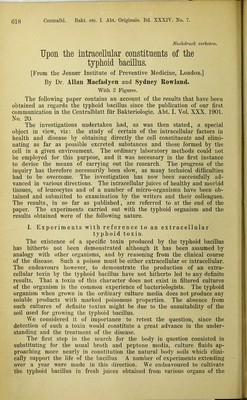
![Nachdruch verboten. Upon the intracellular constituents of the typhoid bacillus. [From the Jenner Institute of Preventive Medicine, London.] By Dr. Allan Macfadyen and Sydney Rowland. With 2 Figures. The following paper contains an account of the results that have been obtained as regards the typhoid bacillus since the publication of our first communication in the Centralblatt fiir Bakteriologie. Abt. I. Vol. XXX. 1901. No. 20. The investigations undertaken had, as was then stated, a special object in view, viz: the study of certain of the intracellular factors in health and disease by obtaining directly the cell constituents and elimi- nating as far as possible excreted substances and those formed by the cell in a given environment. The ordinary laboratory methods could not be employed for this purpose, and it was necessary in the first instance to devise the means of carrying out the research. The progress of the inquiry has therefore necessarily been slow, as many technical difficulties had to be overcome. The investigation has now been successfully ad- vanced in various directions. The intracellular juices of healthy and morbid tissues, of leucocytes and of a number of micro-organism.s have been ob- tained and submitted to examination by the writers and their colleagues. The results, in so far as published, are referred to at the end of the paper. The experiments carried out with the typhoid organism and the results obtained were of the following nature. I. Experiments with reference to an extracellular typhoid toxin. The existence of a specific toxin produced by the typhoid bacillus has hitherto not been demonstrated although it has been assumed by analogy with other organisms, and by reasoning from the clinical course of the disease. Such a poison must be either extracellular or intracellular. The endeavours however, to demonstrate the production of an extra- cellular toxin by the typhoid bacillus have not hitherto led to any definite results. That a toxin of this character does not exist in filtered cultures of the organism is the common experience of bacteriologists. The typhoid organism when grown in the ordinary culture media does not produce any soluble products with marked poisonous properties. The absence from such cultures of definite toxins might be due to the unsuitability of the soil used for growing the typhoid bacillus. We considered it of importance to retest the question, since the detection of such a toxin would constitute a great advance in the under- standing and the treatment of the disease. The first step in the search for the body in question consisted in substituting for the usual broth and peptone media, culture fiuids ap- proaching more nearly in constitution the natural body soils which clini- cally support the life of the bacillus. A number of experiments extending over a year were made in this direction. We endeavoured to cultivate the typhoid bacillus in fresh juices obtained from various organs of the](https://iiif.wellcomecollection.org/image/b22398831_0006.jp2/full/800%2C/0/default.jpg)