Directions for a practical course in chemical physiology / W. Cramer.
- Cramer, William, 1878-1945.
- Date:
- 1915
Licence: In copyright
Credit: Directions for a practical course in chemical physiology / W. Cramer. Source: Wellcome Collection.
20/216 page 5
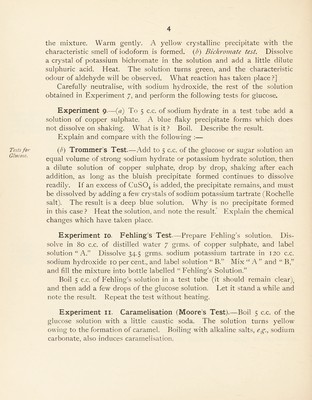
![4 Tests for Glucose. the mixture. Warm gently. A yellow crystalline precipitate with the characteristic smell of iodoform is formed, {jb) Bichromate test. Dissolve a crystal of potassium bichromate in the solution and add a little dilute sulphuric acid. Heat. The solution turns green, and the characteristic odour of aldehyde will be observed. What reaction has taken place?] Carefully neutralise, with sodium hydroxide, the rest of the solution obtained in Experiment 7, and perform the following tests for glucose. Experiment 9.—(a) To 5 c.c. of sodium hydrate in a test tube add a solution of copper sulphate. A blue flaky precipitate forms which does not dissolve on shaking. What is it? Boil. Describe the result. Explain and compare with the following :—- (b) Trommer’s Test .—Add to 5 c.c. of the glucose or sugar solution an equal volume of strong sodium hydrate or potassium hydrate solution, then a dilute solution of copper sulphate, drop by drop, shaking after each addition, as long as the bluish precipitate formed continues to dissolve readily. If an excess of CuS04 is added, the precipitate remains, and must be dissolved by adding a few crystals of sodium potassium tartrate (Rochelle salt). The result is a deep blue solution. Why is no precipitate formed in this case? Heat the solution, and note the result. Explain the chemical changes which have taken place. Experiment 10. Fehling’s Test.—Prepare Fehling’s solution. Dis- solve in 80 c.c. of distilled water 7 grms. of copper sulphate, and label solution “ A.” Dissolve 34.5 grms. sodium potassium tartrate in 120 c.c. sodium hydroxide 10 per cent., and label solution “ B.” Mix “ A ” and “ B,” and fill the mixture into bottle labelled “ Fehling’s Solution.” Boil 5 c.c. of Fehling’s solution in a test tube (it should remain clear), and then add a few drops of the glucose solution. Let it stand a while and note the result. Repeat the test without heating. Experiment 11. Caramelisation (Moore’s Test).—Boil 5 c.c. of the glucose solution with a little caustic soda. The solution turns yellow owing to the formation of caramel. Boiling with alkaline salts, e.g., sodium carbonate, also induces caramelisation.](https://iiif.wellcomecollection.org/image/b29807372_0020.jp2/full/800%2C/0/default.jpg)