Directions for a practical course in chemical physiology / W. Cramer.
- Cramer, William, 1878-1945.
- Date:
- 1915
Licence: In copyright
Credit: Directions for a practical course in chemical physiology / W. Cramer. Source: Wellcome Collection.
22/216 page 7
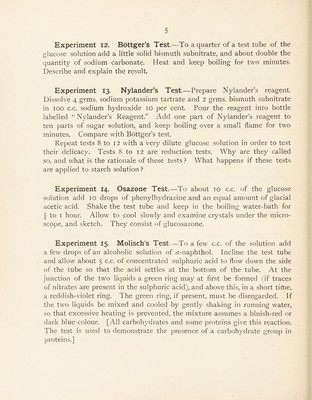
![5 Experiment 12. Bottger’s Test.—To a quarter of a test tube of the glucose solution add a little solid bismuth subnitrate, and about double the quantity of sodium carbonate. Heat and keep boiling for two minutes. Describe and explain the result. Experiment 13. Nylander’s Test.—Prepare Nylander’s reagent. Dissolve 4 grms. sodium potassium tartrate and 2 grms. bismuth subnitrate in 100 c.c. sodium hydroxide 10 per cent. Pour the reagent into bottle labelled “ Nylander’s Reagent.” Add one part of Nylander’s reagent to ten parts of sugar solution, and keep boiling over a small flame for two minutes. Compare with Bottger’s test. Repeat tests 8 to 12 with a very dilute glucose solution in order to test their delicacy. Tests 8 to 12 are reduction tests. Why are they called so, and what is the rationale of these tests ? What happens if these tests are applied to starch solution ? Experiment 14. Osazone Test.—To about 10 c.c. of the glucose solution add 10 drops of phenylhydrazine and an equal amount of glacial acetic acid. Shake the test tube and keep in the boiling water-bath for J to 1 hour. Allow to cool slowly and examine crystals under the micro- scope, and sketch. They consist of glucosazone. Experiment 15- Molisch’s Test-—To a few c.c. of the solution add a few drops of an alcoholic solution of ^-naphthol. Incline the test tube and allow about 5 c.c. of concentrated sulphuric acid to flow down the side of the tube so that the acid settles at the bottom of the tube. At the junction of the two liquids a green ring may at first be formed (if traces of nitrates are present in the sulphuric acid), and above this, in a short time, a reddish-violet ring. The green ring, if present, must be disregarded. If the two liquids be mixed and cooled by gently shaking in running water, so that excessive heating is prevented, the mixture assumes a bluish-red or dark blue colour. [All carbohydrates and some proteins give this reaction. The test is used to demonstrate the presence of a carbohydrate group in proteins.]](https://iiif.wellcomecollection.org/image/b29807372_0022.jp2/full/800%2C/0/default.jpg)