Orion, or, Researches into the antiquity of the Vedas / by Bal Gangadhar Tilak.
- Bal Gangadhar Tilak
- Date:
- 1916
Licence: Public Domain Mark
Credit: Orion, or, Researches into the antiquity of the Vedas / by Bal Gangadhar Tilak. Source: Wellcome Collection.
213/248 page 197
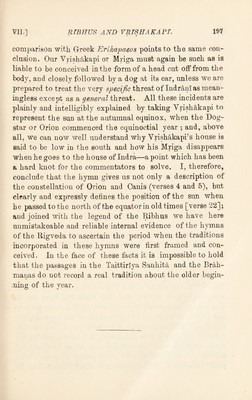
![comparison with Greek Erikapaeos points to the same con¬ clusion. Our Vrishakapi or Mriga must again be such as is liable to be conceived in the form of a head cut off from the body, and closely followed by a dog at its ear, unless we are prepared to treat the very specific threat of Indrani as mean¬ ingless except as a general threat. All these incidents are plainly and intelligibly explained by taking Vrishakapi to represent the sun at the autumnal equinox, when the Dog- star or Orion commenced the equinoctial year ; and, above all, we can now well understand why Vrishakapi’s house is said to be low in the south and how his Mriga disappears when he goes to the house of Indra—a point which has been a hard knot for the commentators to solve. I, therefore, conclude that the hymn gives us not only a description of the constellation of Orion and Canis (verses 4 and 5), but clearly and expressly defines the position of the sun when he passed to the north of the equator in old times [verse 22]; and joined with the legend of the Ribhus we have here unmistakeable and reliable internal evidence of the hymns of the Rigveda to ascertain the period when the traditions incorporated in these hymns were first framed and con¬ ceived. In the face of these facts it is impossible to hold that the passages in the Taittiriya Sanhita and the Brah- manas do not record a real tradition about the older begin¬ ning of the year.](https://iiif.wellcomecollection.org/image/b29827401_0213.jp2/full/800%2C/0/default.jpg)




 No text description is available for this image
 No text description is available for this image
 No text description is available for this image