Kemps nine daies wonder: performed in a daunce from London to Norwich / With an introduction and notes by the Rev. Alexander Dyce.
- William Kempe
- Date:
- 1840
Licence: Public Domain Mark
Credit: Kemps nine daies wonder: performed in a daunce from London to Norwich / With an introduction and notes by the Rev. Alexander Dyce. Source: Wellcome Collection.
18/72
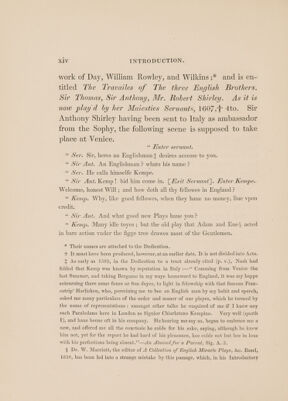
![work of Day, William Rowley, and Wilkins ;* and is en- titled The Travailes of The three English Brothers. Sir Thomas, Sir Anthony, Mr. Robert Shirley. As it is now play d by her Maiesties Seruants, 1607, 4to. Sir Anthony Shirley having been sent to Italy as ambassador from the Sophy, the following scene is supposed to take place at Venice. “ Enter seruant. “ Ser. Sir, heres an Englishman desires accesse to you. “ Stir Ant. An Englishman ? whats his name ? “ Ser. He calls himselfe Kempe. “ Sir Ant. Kemp! bid him come in. [wit Seruant]. Enter Kempe. Welcome, honest Will ; and how doth all thy fellowes in England ? “ Kemp. Why, like good fellowes, when they haue no money, liue vpon credit. “ Sir Ant. And what good new Plays haue you? 3 Kemp. Many idle toyes ; but the old play that Adam and Eue§ acted in bare action vnder the figge tree drawes most of the Gentlemen. * Their names are attached to the Dedication. + It must have been produced, however, at an earlier date. It is not divided into Acts. t As early as 1589, in the Dedication to a tract already cited (p. v.), Nash had fabled that Kemp was known by reputation in Italy :—‘‘ Comming from Venice the last Summer, and taking Bergamo in my waye homeward to England, it was my happe soiourning there some foure or fiue dayes, to light in felowship with that famous Fran- catrip’ Harlicken, who, perceiuing me to bee an English man by my habit and speech, asked me many particulars of the order and maner of our playes, which he termed by the name of representations : amongst other talke he enquired of me if I knew any such Parabolano here in London as Signior Chiarlatano Kempino. Very well (quoth I), and haue beene oft in his company. He hearing me say so, began to embrace me a new, and offered me all the courtesie he colde for his sake, saying, although he knew him not, yet for the report he had hard of his pleasance, hee colde not but bee in loue with his perfections being absent.’’—An Almond for a Parrat, Sig. A. 3. § Dr. W. Marriott, the editor of A Collection of English Miracle Plays, &c. Basel, 1838, has been led into a strange mistake by this passage, which, in his Introductory](https://iiif.wellcomecollection.org/image/b33491756_0018.jp2/full/800%2C/0/default.jpg)