Correspondence of Sir Isaac Newton and Professor Cotes : including letters of other eminent men, now first published from the originals in the library of Trinity College, Cambridge; together with an appendix containing other unpublished letters and papers by Newton; with notes, synoptical view of the philosopher's life, and a variety of details illustrative of his history, by J. Edleston.
- Isaac Newton
- Date:
- 1850
Licence: Public Domain Mark
Credit: Correspondence of Sir Isaac Newton and Professor Cotes : including letters of other eminent men, now first published from the originals in the library of Trinity College, Cambridge; together with an appendix containing other unpublished letters and papers by Newton; with notes, synoptical view of the philosopher's life, and a variety of details illustrative of his history, by J. Edleston. Source: Wellcome Collection.
123/430 (page 17)
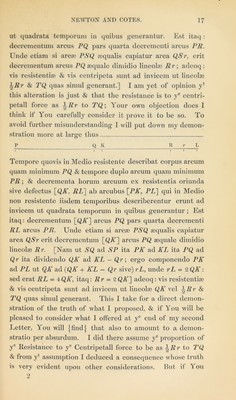
![ut quadrata temporum in quibus generantur. Est itaq : decrementum arcus PQ pars quarta decrementi arcus PR. Unde etiam si areae PSQ aequalis capiatur area QSr, erit decrementum arcus PQ aequale dimidio lineokc Rr; adeoq : vis resistentiie & vis centripeta sunt ad invicem ut lineolas \Rr & TQ quas simul generant.] I am yet of opinion y* this alteration is just & that the resistance is to ye centri- petall force as \Rr to TQ; Your own objection does I think if You carefully consider it prove it to be so. To avoid further misunderstanding I will put down my demon- stration more at large thus P Q Iv R r L T “ i i 111 Tempore quovis in Medio resistente describat corpus arcum quam minimum PQ & tempore duplo arcum quam minimum PR; & decrementa horum arcuum ex resistentia oriunda sive defectus [QY, RL] ab arcubus [PAT, PL~\ qui in Medio non resistente iisdem temporibus describerentur erunt ad invicem ut quadrata temporum in quibus generantur ; Est itaq: decrementum [QK] arcus PQ pars quarta decrementi RL arcus PR. Unde etiam si areae PSQ aequalis capiatur area QSr erit decrementum [QAT] arcus PQ aequale dimidio lineolae Rr. [Nam ut SQ ad SP ita PK ad KL ita PQ ad Qr ita dividendo QK ad KL - Qr; ergo componendo PK ad PL ut QK ad (QK + ILL - Qr sive) rL, unde rL = 2 QK: sed erat RL - 4QK, itaq: Rr = 2QK] adeoq: vis resistentiae & vis centripeta sunt ad invicem ut lineolae QK vel | J?)- & TQ quas simul generant. This I take for a direct demon- stration of the truth of what I proposed, & if You will be pleased to consider what I offered at ye end of my second Letter, You will {findj that also to amount to a demon- stratio per absurdum. I did there assume ye proportion of ye Resistance to ye Centripetall force to be as ^Rr to TQ & from yx assumption I deduced a consequence whose truth is very evident upon other considerations. But if You 2](https://iiif.wellcomecollection.org/image/b28738317_0125.jp2/full/800%2C/0/default.jpg)