Correspondence of Sir Isaac Newton and Professor Cotes : including letters of other eminent men, now first published from the originals in the library of Trinity College, Cambridge; together with an appendix containing other unpublished letters and papers by Newton; with notes, synoptical view of the philosopher's life, and a variety of details illustrative of his history, by J. Edleston.
- Isaac Newton
- Date:
- 1850
Licence: Public Domain Mark
Credit: Correspondence of Sir Isaac Newton and Professor Cotes : including letters of other eminent men, now first published from the originals in the library of Trinity College, Cambridge; together with an appendix containing other unpublished letters and papers by Newton; with notes, synoptical view of the philosopher's life, and a variety of details illustrative of his history, by J. Edleston. Source: Wellcome Collection.
127/430 (page 21)
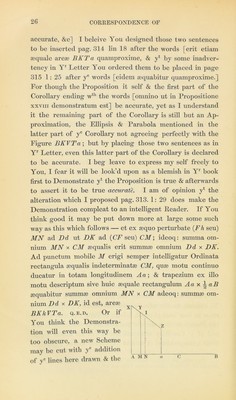
![Sc insuper—Page 303.1: 6 — nisi forte per particulas in- terraedias virtute ilia auctas — T think these words were better left out; for as I apprehend it, they alter ye case of ye Proposition. 1: 11 Ut si particula unaquseq:—quadrato- eubi Densitatis. I think also yf this whole Period ought to be omitted, the two propositions containd in it seeming to me to be erroneous, fdess I mistake the sense of Yr words. Page 304. Coroll: 5 & G for [quadratum temporis directe] You have substituted in Yr copy [quadrato-quad- ratum temporis directe] I find written in ye margin of Yr book by a different hand [quadr. quadratum temporis (credo)] This marginal note, not Yr own judgment, was I beleive ye occasion of Yr making the alteration. Page 308 1: 10 I would omit ye words [si verbi gratia arcus alter sit altero duplo major]. With Yr leave I would begin the 311 page thus*. [Est itaq: incrementum velocitatis ut V-R Sc particula ilia temporis in qua factum est conjunctim: Sed & velocitas ipsa est ut incrementum contemporaneum spatii descripti directe & particula eadem temporis inverse. Unde cum resistentia (per Hypothesin) sit ut quadratum velocitatis, incrementum resistentiae erit (per Lem : ii) ut velocitas & incrementum velocitatis conjunctim, id est, ut momentum spatii Sc V-R conjunctim; atq: adeo si mo- mentum — In my Opinion this alteration is necessary to make the Demonstration accurate. When I first look’d over this passage upon account of it I thought the whole construction erroneous. I therefore set my self, after the following manner, to examine how it ought to be, which I here put down for a further use I have of it. Taking x, %, v for quantitys analogous to the Force arising from ye gravity of ye Pendulous body, the force of resistance, Sc ye * In Prop. xxix. Lib. 2. “Posito quod corpori in cycloide oscillanti resistitur in duplicata ratione velocitatis : invenire resistentiam in locis singulis.” This Proposition contains the geometrical construction of the expression (2hs + 1 - 2k a + 1 e~'ka-’), a being the first arc of descent.](https://iiif.wellcomecollection.org/image/b28738317_0129.jp2/full/800%2C/0/default.jpg)