Correspondence of Sir Isaac Newton and Professor Cotes : including letters of other eminent men, now first published from the originals in the library of Trinity College, Cambridge; together with an appendix containing other unpublished letters and papers by Newton; with notes, synoptical view of the philosopher's life, and a variety of details illustrative of his history, by J. Edleston.
- Isaac Newton
- Date:
- 1850
Licence: Public Domain Mark
Credit: Correspondence of Sir Isaac Newton and Professor Cotes : including letters of other eminent men, now first published from the originals in the library of Trinity College, Cambridge; together with an appendix containing other unpublished letters and papers by Newton; with notes, synoptical view of the philosopher's life, and a variety of details illustrative of his history, by J. Edleston. Source: Wellcome Collection.
131/430 (page 25)
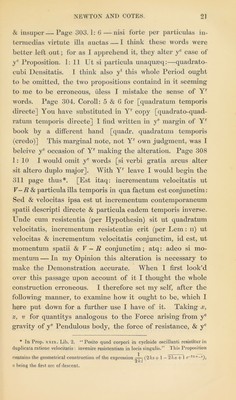
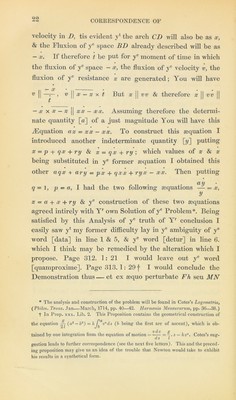
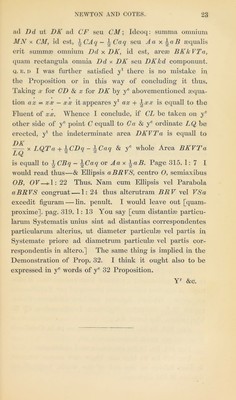
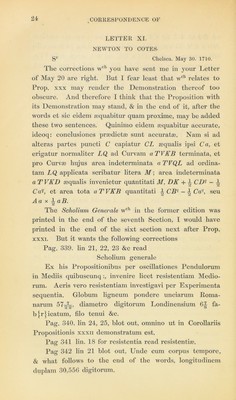
![Pag. 343 lin 6 for pedum read digitorum. Ib lin 8 read vis resistentia3 eodem tempore uniformiter continuata. Ib lin 12 read posset. Pag 344 lin 13, 14 for prima, secunda, tertia read ter- i J tia quinta septima & for read . 1 193 193 Pag. 345 lin 7, 25 for dimidiata read subduplicata. Ib. lin. 8 read Nam ratio 7^-^ ad 1 - 1 seu 10J ad 1, non longe * Pag. 349 blot out the lines 17, 18, 19, 20, 21, 22, 23, 24, 25, 26, 27 Pag. 350 lin. 32 blot out Quare cum globus aqueus in aere movendo & what follows to the end of the words, probe tamen cum praecedentibus congruebat. Pag 354 blot out the lines 11, 12, 13, 14, 15. In the beginning of Sect vii pag. 317 lin. 5 after the words similes sint, insert the words & proportionates. I am Your most humble servant. For the Rnd Mr Cotes, Professor Is. Newton of Astronomy, fy Fellow of Trinity College in Cambridge. LETTER XII. COTES TO NEWTON. S' June. 1st 1710 I received Your Letter last night, by which You give Yr consent to the other alterations which I proposed, but seem to fear least y1 which relates to Prop xxx may render the Demonstration thereof too obscure & therefore at the end of ye Corollary after the words [et sic eidem jequa- bitur quamproxime] You add [Quinimo eidem aequabitur * The words, “ Ib. lin. 8 non longe”, are crossed out, apparently by Cotes, in pursuance of Newton’s orders in letters XIII, and XV.](https://iiif.wellcomecollection.org/image/b28738317_0133.jp2/full/800%2C/0/default.jpg)