Correspondence of Sir Isaac Newton and Professor Cotes : including letters of other eminent men, now first published from the originals in the library of Trinity College, Cambridge; together with an appendix containing other unpublished letters and papers by Newton; with notes, synoptical view of the philosopher's life, and a variety of details illustrative of his history, by J. Edleston.
- Isaac Newton
- Date:
- 1850
Licence: Public Domain Mark
Credit: Correspondence of Sir Isaac Newton and Professor Cotes : including letters of other eminent men, now first published from the originals in the library of Trinity College, Cambridge; together with an appendix containing other unpublished letters and papers by Newton; with notes, synoptical view of the philosopher's life, and a variety of details illustrative of his history, by J. Edleston. Source: Wellcome Collection.
132/430 (page 26)
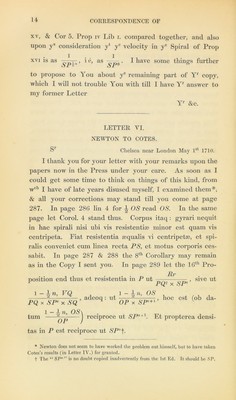
![accurate, &c] I beleive You designed those two sentences to be inserted pag. 314 lin 18 after the words [ erit etiam sequale areae BKTa quamproxime, & y* by some inadver- tency in Yr Letter You ordered them to be placed in page 315 1: 25 after ye words [eidem aequabitur quamproxime.] For though the Proposition it self & the first part of the Corollary ending wtTl the words [omnino ut in Propositione xxviii demonstratum est] be accurate, yet as I understand it the remaining part of the Corollary is still but an Ap- proximation, the Ellipsis & Parabola mentioned in the latter part of ye Corollary not agreeing perfectly with the Figure BKVTa; but by placing those two sentences as in Yr Letter, even this latter part of the Corollary is declared to be accurate. I beg leave to express my self freely to You, I fear it will be look’d upon as a blemish in Yr book first to Demonstrate yt the Proposition is true & afterwards to assert it to be true accurate. I am of opinion y* the alteration which I proposed pag. 313. 1: 29 does make the Demonstration compleat to an intelligent Header. If You think good it may be put down more at large some such way as this which follows — et ex aequo perturbate (Fh seu) MN ad Dd ut DK ad (CF seu) CM; ideoq: summa om- nium MN x CM aequalis erit summae omnium Dd x DK. Ad punctual mobile M erigi semper intelligatur Ordinata rectangula aequalis indeterminatae CM, quae motu continuo ducatur in totam longitudinem A a; & trapezium ex illo motu descriptum sive huic aequale rectangulum A a x 1 a B aequabitur summae omnium MN x CM adeoq: summae om- nium Dd x DK, id est, areae You think the Demonstra- tion will even this way be too obscure, a new Scheme may be cut with yc addition BKkVTa. q.e.d. Or if of yc lines here drawn & the a C B](https://iiif.wellcomecollection.org/image/b28738317_0134.jp2/full/800%2C/0/default.jpg)