Correspondence of Sir Isaac Newton and Professor Cotes : including letters of other eminent men, now first published from the originals in the library of Trinity College, Cambridge; together with an appendix containing other unpublished letters and papers by Newton; with notes, synoptical view of the philosopher's life, and a variety of details illustrative of his history, by J. Edleston.
- Isaac Newton
- Date:
- 1850
Licence: Public Domain Mark
Credit: Correspondence of Sir Isaac Newton and Professor Cotes : including letters of other eminent men, now first published from the originals in the library of Trinity College, Cambridge; together with an appendix containing other unpublished letters and papers by Newton; with notes, synoptical view of the philosopher's life, and a variety of details illustrative of his history, by J. Edleston. Source: Wellcome Collection.
147/430 (page 41)
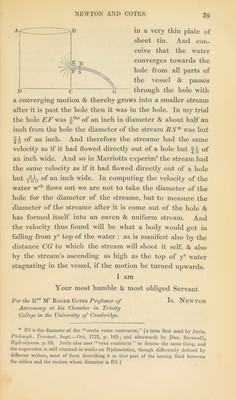
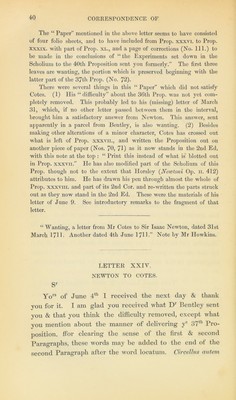
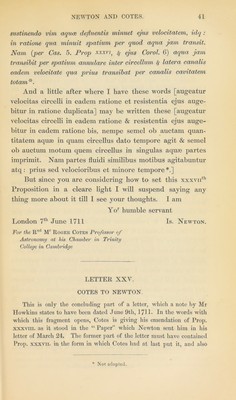
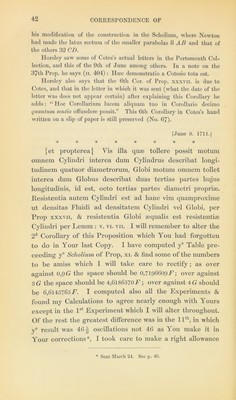
![sustinendo vim aquce defluentis minuet ejus velocitatem, idq : in ratione qua minuit spatium per quod aqua jam transit. Nam (per Cas. 5. Prop xxxvi} $ ejus Corol. 6) aqua jam transibit per spatium annulare inter circellum 8f latera canalis eadem velocitate qua prius transibat per canalis cavitatem totam And a little after where I have these words [augeatur velocitas circelli in eadem ratione et resistentia ejus auge- bitur in ratione duplicata] may be written these [augeatur velocitas circelli in eadem ratione & resistentia ejus auge- bitur in eadem ratione bis, nempe semel ob auctam quan- titatem aquas in quam circellus dato tempore agit & semel ob auctum motum quern circellus in singulas aquae partes imprimit. Nam partes fluidi similibus motibus agitabuntur atq : prius sed velocioribus et minore tempore *.] But since you are considering how to set this xxxvnth Proposition in a cleare light I will suspend saying any thing more about it till I see your thoughts. I am Yor humble servant London 7th June 1711 Is. Newton. For the Rnd Mr Roger Cotes Professor of Astronomy at his Chamber in Trinity College in Cambridge LETTER XXY. COTES TO NEWTON. This is only the concluding part of a letter, which a note by Mr Howkins states to have been dated June 9th, 1711* In the words with which this fragment opens, Cotes is giving his emendation of Prop, xxxvm. as it stood in the “ Paper” which Newton sent him in his letter of March 24. The former part of the letter must have contained Prop, xxxvn. in the form in which Cotes had at last put it, and also Not adopted.](https://iiif.wellcomecollection.org/image/b28738317_0149.jp2/full/800%2C/0/default.jpg)