Correspondence of Sir Isaac Newton and Professor Cotes : including letters of other eminent men, now first published from the originals in the library of Trinity College, Cambridge; together with an appendix containing other unpublished letters and papers by Newton; with notes, synoptical view of the philosopher's life, and a variety of details illustrative of his history, by J. Edleston.
- Isaac Newton
- Date:
- 1850
Licence: Public Domain Mark
Credit: Correspondence of Sir Isaac Newton and Professor Cotes : including letters of other eminent men, now first published from the originals in the library of Trinity College, Cambridge; together with an appendix containing other unpublished letters and papers by Newton; with notes, synoptical view of the philosopher's life, and a variety of details illustrative of his history, by J. Edleston. Source: Wellcome Collection.
154/430 (page 48)
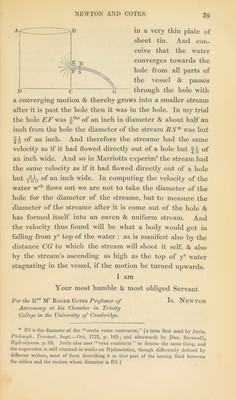
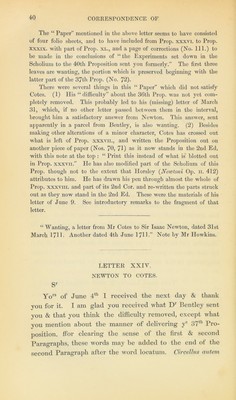
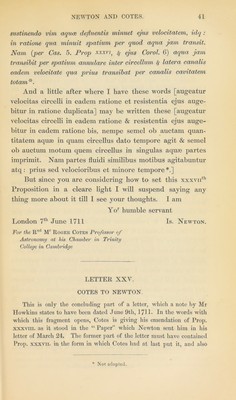
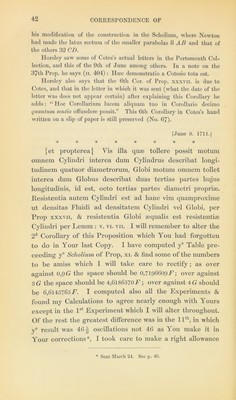
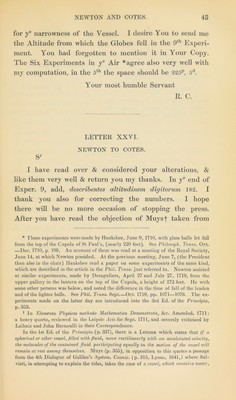
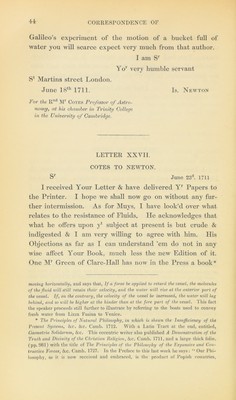
![leratrix lineolao Physic® ey est ut ipsius distantia a medio vibrationis loco F. Proinde tempus (per Prop xxxvm Libr. 1) recte exponitur per arcum & Medii pars linearis ey perget lege praescripta moveri, id est, lege oscillantis Penduli: & par est ratio partium omnium linea- rium ex quibus Medium totu componitur. q.e.d.] I was going to propose an alteration of the Corollary but I choose rather to leave it to Your self. It must be made to cor- respond with what You have at the end of Page 372 where You cite it. I propose to alter Prop. 49 as follows, [p. 368. 1:28 — ad lineolce illius pondus ut HK x A ad V x EG sive ut PO x A ad VV, nam HK erat ad EG ut PO ad F.] [1: 32 — urgente vi ponderis in subduplicata ratione VV ad PO x A atq : adeo —] [1: ult — in sub- duplicata ratione VV ad PO x A & subduplicata ratione PO ad A conjunctim, id est, in ratione integra V ad A. Sed tempore vibrationis unius—.] [Ergo tempus— & reditu composite ut V ad A, id est, ut BC ad circumferen- tiam circuli &c.] I propose to add the 2 following Corol- laries to Prop 49. Cor. 1. Velocitas pulsuum ea est quam acquirunt Gravia aequaliter accelerato motu cadendo et casu suo describendo dimidium altitudinis A. Nam tempore casus hujus, cum velocitate cadendo acquisita, pulsus percurret spatium quod erit sequale toti altitudini A, adeoq: tempore oscillationis unius ex itu & reditu composite percurret spatium sequale circumferentise circuli radio A descripti; est enim tempus casus ad tempus oscillationis ut radius circuli ad ejusdem circumferential!!. Cor. 2. Unde cum altitudo ilia A sit ut Eluidi vis Elastica directe & densitas ejusdem inverse; velocitas pul- suum erit in ratione composita ex subduplicata ratione densitatis inverse & subduplicata ratione vis Elastic® di- recte. I think the 47th Proposition is out of its place : for](https://iiif.wellcomecollection.org/image/b28738317_0156.jp2/full/800%2C/0/default.jpg)