Correspondence of Sir Isaac Newton and Professor Cotes : including letters of other eminent men, now first published from the originals in the library of Trinity College, Cambridge; together with an appendix containing other unpublished letters and papers by Newton; with notes, synoptical view of the philosopher's life, and a variety of details illustrative of his history, by J. Edleston.
- Isaac Newton
- Date:
- 1850
Licence: Public Domain Mark
Credit: Correspondence of Sir Isaac Newton and Professor Cotes : including letters of other eminent men, now first published from the originals in the library of Trinity College, Cambridge; together with an appendix containing other unpublished letters and papers by Newton; with notes, synoptical view of the philosopher's life, and a variety of details illustrative of his history, by J. Edleston. Source: Wellcome Collection.
168/430 (page 62)
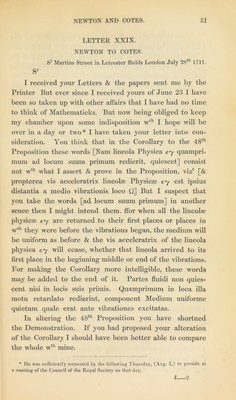
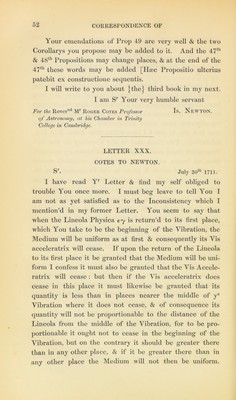
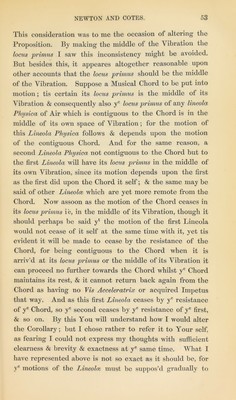
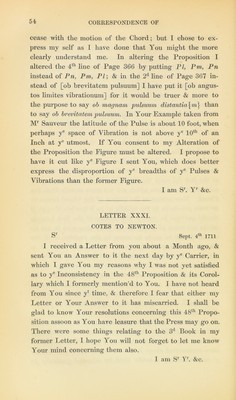
![amongst 57060, 57292, 57303. To take 3 feet 8 lines for ye length of ye Pendulum; for ye French sometimes make it 8-1 sometimes 8-|, & 8-i-| is a mean betwixt these mea- sures. To take 48gT. 50' for ye Latitude of Paris instead of 48°. 45' as You had put it. From these principles the fol- lowing alterations may be made, [semidiameter Terras 19670787 ped] [distantia mediocris Lunae a Terra 1190082614 ped] [distantia])* a communi centro gravitatis 1159567675 ped] [Sinus Versus ped. 14, dig. 9, lin. 5 ^]—id est, in ratione 1 ad 3680,84502 ; ideoq: corpus ad superficiem Terrse vi ilia cadendo describet pedes Parisienses 15, dig. 1, lin. 5 jt. Observation est longitudinem Penduli ad minuta se- cunda oscillantis in vacuo, esse pedum trium Parisiensium & linearum 8 4 seu linearum 8|-. Sumatur longitudo me- diocris pedum trium & linearum 8 -J jj-: & altitudo quam grave in vacuo cadendo tempore minuti unius secundi de- scribit, (cum sit ad dimidiam longitudinem Penduli hujus in duplicata ratione circumferentias ad diametrum circuli, ut indicavit Hugenius,) erit pedum Parisiensium 15, dig. 1, lin. ly^j. Hie est descensus gravium in Latitudine Lu- tetiae Parisioru seu 48gr. 50'. Ad iEquatorem vis centrifuga corporum a diurna rota- tione Terrae oriunda est ad vim gravitatis ut l ad 289 circiter; & in Latitudine Lutetiao minor est, idq: in du- plicata ratione sinus complementi Latitudinis 48°. 50' ad Radium adeoq: est ad vim gravitatis ut 1 ad 667. Et hac vi descensus gravium in latitudine Lutetiae diminuitur. Descensus igitur pedum 15, dig. 1, lin. 1^ augeatur parte jr}Tf. seu lineis 3& habebitur totus gravium descensus pedum 15, dig. 1, lin. 5^ quern gravitas sola, tempore mi- nuti unius secundi in Latitudine 48ffr. 50' cfficere posset, si modo Terra quiesceret. I have gone over the computation of ye vrnth Propo- sition again taking 32'. 12 for ye Suns diameter, for I had](https://iiif.wellcomecollection.org/image/b28738317_0170.jp2/full/800%2C/0/default.jpg)