Correspondence of Sir Isaac Newton and Professor Cotes : including letters of other eminent men, now first published from the originals in the library of Trinity College, Cambridge; together with an appendix containing other unpublished letters and papers by Newton; with notes, synoptical view of the philosopher's life, and a variety of details illustrative of his history, by J. Edleston.
- Isaac Newton
- Date:
- 1850
Licence: Public Domain Mark
Credit: Correspondence of Sir Isaac Newton and Professor Cotes : including letters of other eminent men, now first published from the originals in the library of Trinity College, Cambridge; together with an appendix containing other unpublished letters and papers by Newton; with notes, synoptical view of the philosopher's life, and a variety of details illustrative of his history, by J. Edleston. Source: Wellcome Collection.
174/430 (page 68)
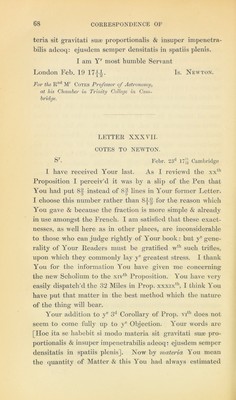
![teria sit gravitati suae proportionalis & insuper impenetra- bilis adeoq: ejusdem semper densitatis in spatiis plenis. I am Yr most humble Servant London Feb. 19 17~|. Is. Newton. For the R,Kl Mr Cotes Professor of Astronomy, at his Chamber in Trinity College in Cam- bridge. LETTER XXXVII. COTES TO NEWTON. S'. Febr. 23d 17^ Cambridge I have received Your last. As I reviewd the xxth Proposition I perceiv’d it was by a slip of the Pen that Yrou had put 8| instead of 8| lines in Your former Letter. I choose this number rather than 8LV f0r the reason which You gave & because the fraction is more simple & already in use amongst the French. I am satisfied that these exact- nesses, as well here as in other places, are inconsiderable to those who can judge rightly of Yrour book: but ye gene- rality of Your Readers must be gratified wth such trifles, upon which they commonly lay ye greatest stress. I thank You for the information You have given me concerning the new Scholium to the xivth Proposition. You have very easily dispatch’d the 32 Miles in Prop. xxxixth, I think You have put that matter in the best method which the nature of the thing will bear. Your addition to ye 3d Corollary of Prop. vith does not seem to come fully up to ye Objection. Your words are [Hoc ita se habebit si modo materia sit gravitati suae pro- portionalis & insuper impenetrabilis adeoq: ejusdem semper densitatis in spatiis plenis]. Now by materia You mean the quantity of Matter & this You had always estimated](https://iiif.wellcomecollection.org/image/b28738317_0176.jp2/full/800%2C/0/default.jpg)