Licence: In copyright
Credit: Methods of air analysis / by J.S. Haldane. Source: Wellcome Collection.
148/162 page 130
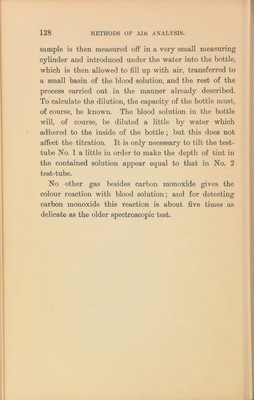
![and a little iodide of potassium slightly acidified, is turned blue even when they are present in very great dilution. Other gaseous impurities, such as sulphuretted hydrogen or hydrocyanic acid, are dangerous on account of their very rapid action, and in sewer air or smoke the smell of sulphuretted hj^drogen is often masked. The presence of sulphuretted hydrogen can easily be recognised chemically by the blackening of a strip of paper which has been dipped into acetate of lead solution. Any air in which this blackening occurs within a minute should be regarded as very dangerous. Sulphuretted hydrogen is about five times as poisonous as carbon monoxide, and much more rapid in causing death on the spot or dangerous after-effects. Phosphoretted hydrogen, which is also extremely poisonous and treacherous in its action, may be recog¬ nised chemically by the fact that it blackens paper dipped in silver nitrate solution, but not paper dipped in lead acetate.1 Arsenietted hydrogen, which is still more poisonous and treacherous, and acts cumulatively in very great dilution, can be detected readily by its action on a strip of filter paper which has been soaked in a solution of mercuric chloride and allowed to dry. The paper is turned yellow. Tests for a gas with a test paper are extremely rapid and delicate if the suspected air is allowed to blow on the paper. 1 A method of determining phosphoretted hydrogen and arsenietted hydrogen is given by Dr Wilson Hake in the Report to the Local Govern¬ ment Board by Dr Copcman, Dr Wilson Hake, and Mr Bennett, on Dangers arising from Ferro-Silicon, Parliamentary Paper [Cd. 4958], 1909.](https://iiif.wellcomecollection.org/image/b29821976_0148.jp2/full/800%2C/0/default.jpg)



 No text description is available for this image
 No text description is available for this image
 No text description is available for this image