Licence: Public Domain Mark
Credit: On fever, as connected with inflammation : an exercise. Source: Wellcome Collection.
Provider: This material has been provided by University of Bristol Library. The original may be consulted at University of Bristol Library.
264/274 page 252
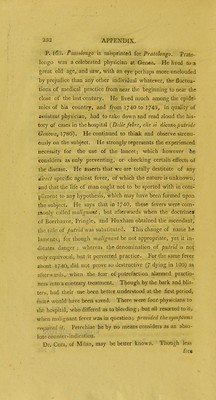
![P. 1(53. Passobngo is misprinted for Pralokngo. Prato- longo was a celebrated physician at Genoa. He lived to a great old age, and saw, with an eye perhaps more unclouded by prejudice than any other individual whatever, the fluctua- tions of medical practice from near the beginning to near the close of the last century. He lived much among the epide- mics of his country, and from 1740 to ] 743, in quality of assistant physician, had to take down and read aloud the his- tory of cases in the hospital (Dclle felre, che si dicono, putride Genova^ 1786). He continued to think and observe strenu- ously on the subject. He strongly represents tlie experienced necessity for the use of the lancet; which however he considers as only preventing, or checking certain effects of the disease. He asserts that we are totally destitute of any direct specific against fever, of which the nature is unknown, and that the life of man ought not to be sported with in com- pliment to any hypothesis, which may have been formed upon the subject. He says that in 1740, these fevers were com* monly called malignant; but afterwards when the doctrine* of Boerhaave, Pringle, and Huxham obtained the ascendant, the title of putrid was substituted. This change of name he laments,; for though maligJiant be not appropriate, yet it in- dicates danger ; whereas the denomination of putrid is not only equivocal, but it pervertcid practice. For the same fever about 1/40, did not prove so destructive (7 dying in 100) as afterwards,, when the fear of putrefaction alarmed practio- hers into a contrary treatment. Though by the bark and blis- ters, had their use been better understood at the first period, more would have been saved. There were four physicians to the hospital, who differed as to bleeding; but all resorted to it, when malignant fever was in question; provided thesy-wptoms reifxiired it. Petechiae he by no means considers as an abso- lute cou n le r- i n di ca tion. Dr. Cera, of Milan, may be better known. Though less fre»](https://iiif.wellcomecollection.org/image/b21439023_0264.jp2/full/800%2C/0/default.jpg)