Embryology, with the physiology of generation ... / Translated from the German, with notes, by William Baly ... From Müller's Elements of physiology and supplement.
- Johannes Peter Müller
- Date:
- 1848
Licence: Public Domain Mark
Credit: Embryology, with the physiology of generation ... / Translated from the German, with notes, by William Baly ... From Müller's Elements of physiology and supplement. Source: Wellcome Collection.
25/376 page 1425
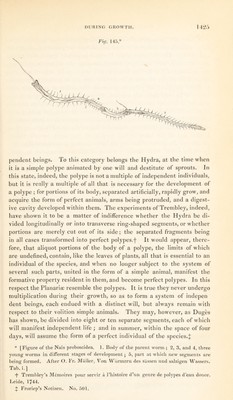
![Fig. 145* pendent beings. To this category belongs the Hydra, at the time when it is a simple polype animated by one will and destitute of sprouts. In this state, indeed, the polype is not a multiple of independent individuals, but it is really a multiple of all that is necessary for the development of a polype ; for portions of its body, separated artificially, rapidly grow, and acquire the form of perfect animals, arms being protruded, and a digest¬ ive cavity developed within them. The experiments of Trembley, indeed, have shown it to be a matter of indifference whether the Hydra be di¬ vided longitudinally or into transverse ring-shaped segments, or whether portions are merely cut out of its side; the separated fragments being in all cases transformed into perfect polypes.f It would appear, there¬ fore, that aliquot portions of the body of a polype, the limits of which are undefined, contain, like the leaves of plants, all that is essential to an individual of the species, and when no longer subject to the system of several such parts, united in the form of a simple animal, manifest the formative property resident in them, and become perfect polypes. In this respect the Planariae resemble the polypes. It is true they never undergo multiplication during their growth, so as to form a system of indepen dent beings, each endued with a distinct will, but always remain with respect to their volition simple animals. They may, however, as Duges has shown, be divided into eight or ten separate segments, each of which will manifest independent life ; and in summer, within the space of four days, will assume the form of a perfect individual of the species.j; * [Figure of the Nais proboscidea. 1. Body of the parent worm ; 2, 3, and 4, three young worms in different stages of development; 5, part at which new segments are being formed. After O. Fr. Muller, Von Wiirmern des stissen und salzigen Wassers. Tab. i.] ■f Trembley’s Memoires pour servir a l’histoire d’un genre de polypes d’eau douce. Leide, 1744. 4 Froriep’s Notizen. No. 501.](https://iiif.wellcomecollection.org/image/b29339601_0025.jp2/full/800%2C/0/default.jpg)