Embryology, with the physiology of generation ... / Translated from the German, with notes, by William Baly ... From Müller's Elements of physiology and supplement.
- Johannes Peter Müller
- Date:
- 1848
Licence: Public Domain Mark
Credit: Embryology, with the physiology of generation ... / Translated from the German, with notes, by William Baly ... From Müller's Elements of physiology and supplement. Source: Wellcome Collection.
36/376 page 1436
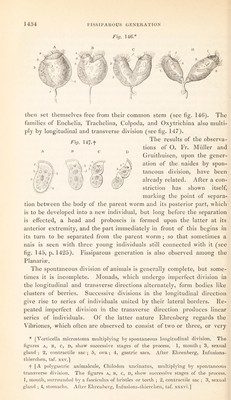
![Fig. 148.* quently split into several masses. Sometimes the green matter became divided into a greater or less number of long segments, and then the tube separated into portions corresponding to these segments. Here the spon¬ taneous division appears to me to consist in division of the spore-mass. The bead-like threads which in the genus Nostoc lie in a gelatinous mass (the phycomater) increase in length, according to Meyen, by the spontaneous division of their componentvesicles or cells. When the old Nostoc perishes, those cells escape from the gelatiniform mass, each having the power with¬ in itself of enlarging and becoming a new Nostoc. The spores of the Nostoc consist of a greenish and somewhat hardened gelatiniform sub¬ stance, and are filled with a mucous colourless fluid ; during the formation of the new plant, the coloured wall of the spore swells and becomes the gelatinous mass of the Nostoc, while in the contained fluid there appear opacities which produce the first vesicles. These vesicles subsequently undergo repeated spontaneous division, and thus become the bead-like spore-threads. The moss and liverwort tribes also, according to Meyen, do not form their seeds within parent cells, but produce them by division, and the in¬ dividual seeds are first separated by constriction from the larger parent seed. Meyen regards the increase of the cells of some articulated con- fervse, for example, Conferva glomerata, by the protrusion of a part of their walls, and the sub¬ sequent separation of the protruded part by a con¬ striction, as an example of the same process. In the lower fungi, as the Penicillium glaucum, also, the development of the sporules is effected, according to Meyen, by the division of the thread-like tube (see fig. 148). In the fungus of yeast, Saccharomyces, which consists of a string of cells, each new cell is formed as a bud from the extremity or side of an old cell (see fig. 149). The component cells of the fungus readily separate from each other, and, when isolated, bud again, and produce new systems of cells. Each cell of the plant is here a spore, or is an individual, which undergoes multiplication by the process of budding, while the newly- formed individuals readily separate themselves Fig. 149.-}- * [Figure of Penicillium glaucum, showing the development of spores by division of the tubular cells. After Meyen, Pflanzen-physiologie, tab. x. fig. 20.] -f* [Figure of the fungus of yeast, Saccharomyces cerevisia?. 1, a cell, developing a bud from its extremity ; 2, a bud becoming separated fi’ora the parent cell. After Meyen, op. cit. tab. x. fig. 22.]](https://iiif.wellcomecollection.org/image/b29339601_0036.jp2/full/800%2C/0/default.jpg)