Selecta è præscriptis = selections from physicians' prescriptions : containing lists of the terms, phrases, contractions and abbreviations used in prescriptions, with explanatory notes ... and a series of abbreviated prescriptions illustrating the use of the preceding terms to which is added a key, containing the prescriptions in an unabbreviated form, with a literal translation, for the use of medical and pharmaceutical students / by Jonathan Pereira.
- Jonathan Pereira
- Date:
- 1873
Licence: Public Domain Mark
Credit: Selecta è præscriptis = selections from physicians' prescriptions : containing lists of the terms, phrases, contractions and abbreviations used in prescriptions, with explanatory notes ... and a series of abbreviated prescriptions illustrating the use of the preceding terms to which is added a key, containing the prescriptions in an unabbreviated form, with a literal translation, for the use of medical and pharmaceutical students / by Jonathan Pereira. Source: Wellcome Collection.
30/368 (page 18)
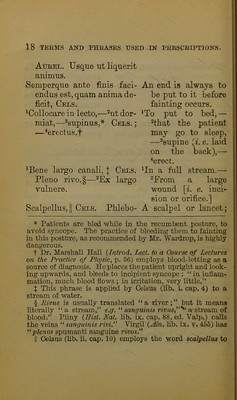
![Aijrel. Usque ut liquerit animus. Semperque ante finis faci- endus est, quam anima de- ficit, Cels. •Collocare in lecto,—* * * §utdor- miat,—®supinus,* Cixs.; —^erectus.f ‘Bene largo canali, | Cels. Pleno rivo.§—*Ex largo vulnere. Scalpellus, || Cels. Phlebo- An end is always to be put to it before fainting occurs. ‘To put to bed,— *that the patient may go to sleep, —^supine (f. e. laid on the back),— ^erect. ‘In a full stream.— ^Erom a large wound [i. e. inci- sion or orifice.] A scalpel or lancet; * Patients are bled while in the recumbent posture, to avoid syncope. The practice of bleeding them to fainting in this posture, as recommended by Mr. Wardrop, is highly dangerous. t Dr. Marshall HaU (Introd, Lect. to a Course of Lectures on the Practice of Phtjsic, p. 36) employs blood-letting as a source of diagnosis. He places the patient upright and look- ing upwards, and bleeds to incipient syncope : “ in inflam- mation, much blood flows ; in initation, very little.” t This phrase is applied by Celsus (lib. i. cap. 4) to a stream of water. § Rivus is usually translated “ a river; ” but it means literally “a stream,” e.g. “sanyainis stream of blood.” Pliny {Hist. Nat. lib. ix. cap, 88, ed. Valp.) calls the veins “ sanguinis rivi.” Virgil {Hin, lib. is. v. 455) has “plenos spumanti sanguine rivos. II Oelsus (lib, ii. cap. 10) employs the word scalpellus to](https://iiif.wellcomecollection.org/image/b28133407_0030.jp2/full/800%2C/0/default.jpg)