Genetic recombination : understanding the mechanisms / Harold L.K. Whitehouse.
- Harold Leslie Keer Whitehouse
- Date:
- [1982]
Licence: Attribution-NonCommercial-NoDerivatives 4.0 International (CC BY-NC-ND 4.0)
Credit: Genetic recombination : understanding the mechanisms / Harold L.K. Whitehouse. Source: Wellcome Collection.
354/448 page 334
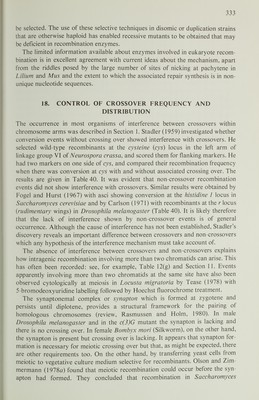
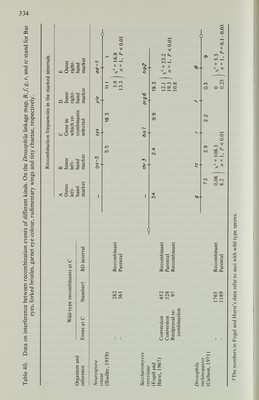
![Table 40. Data on interference between recombination events of different kinds. On the Drosophila linkage map, B,f g, r, and tc stand for Bar eyes, forked bristles, garnet eye-colour, rudimentary wings and tiny chaetae, respectively. Recombination frequencies in the marked intervals Wild-type recombinants at C Organism and reference Event at C Numberf BD interval A B C D E Outer Inner Gene in Inner Outer left- left- which re right- right- hand hand combinants hand hand marker marker selected marker marker Neurospora crassa (Stadler, 1959) 282 Recombinant 361 Parental !ys-5 5.5 c/s H 18.3 ylo ad -7 H 1 o- 11.1 i 3.9 1 x 2 = 16.8 13.3 / n = 1, P< 0.01 Saccharomyces cerevisiae (Fogel and Hurst, 1967) Conversion 452 Recombinant Conversion 528 Parental Reciprocal re- 97 Recombinant combination _ thr 3 his 1 arg 6 trp2 1 1 1 1 34 2.4 9.9 19.3 12.1 } x 2 = 23.2 19.3 / n = 1, P < 0.01 10.8 Drosophila melanogaster (Carlson, 1971) 1765 Recombinant — 1189 Parental g tc r f B H 1 1 1 1- 7.2 2.9 2.2 0.3 9 0.06 ] . x 2 = 108.3 0 lx 2 = 3.3 6.2 j n = 1, T<0.01 0.25 j n = 1, P= 0.1-0.05 tThe numbers in Fogel and Hurst’s data refer to asci with wild-type spores. 334](https://iiif.wellcomecollection.org/image/b18020768_0355.JP2/full/800%2C/0/default.jpg)