The Croonian lectures on some points in the pathology of rheumatism, gout and diabetes : delivered at the Royal College of Physicians, London, March 30, April 1, 6, 1886 / by P. W. Latham, M.A., M.D., F.R.C.P.
- Peter Wallwork Latham
- Date:
- 1887
Licence: Public Domain Mark
Credit: The Croonian lectures on some points in the pathology of rheumatism, gout and diabetes : delivered at the Royal College of Physicians, London, March 30, April 1, 6, 1886 / by P. W. Latham, M.A., M.D., F.R.C.P. Source: Wellcome Collection.
Provider: This material has been provided by University of Bristol Library. The original may be consulted at University of Bristol Library.
12/136 page 4
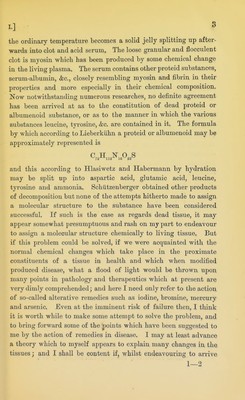
![at the truth, what I say may direct attention to the subject and be useful to others more competent than myself to work out its solution. A certain number of substances which can be obtained from albuminous material, or which are developed in the animal economy can be produced in more or less diverse ways in the laboratory—lactic acid, leucine^ glycocine, <fec. In examining and investigating the various methods by which these bodies may be prepared artificially in the laboratory, we come upon the remarkable fact that a large number of them can be obtained from a particular series of cyanogen compounds, the so-called cyan-alcohols or cyanhydrins—bodies which may be obtained by oxidising the various alcohols, and so forming the aldehyde, and then combining this with hydrocyanic acid. For instance, C^H^.HO + 0 = CH3.CH0 + H^0 ethylic alcohol ethaldehyde CH3.CHO + HCN = CH3.0H(CN)OH* ethaldehyde cyanethylic alcohol. Now these cyan-alcohols are very unstable bodies, readily undergoing change. Treated with ammonia they form a series of cyanamides which also are very unstable, and easily undergo condensation, being converted into imido-nitriles with elimination of ammonia. These facts at once suggest the enquiry: Have we not in these cyanogen compounds substances possessing some pro- perties that belong to living tissue, namely, those of undergoing intra-molecular change, and also condensation] And, further, if from these substances we can obtain the various products which result from the disintegration of albumen, may not albumen itself be simply a compound made up of these elements ? Let me indicate some of the animal products which may be obtained from these cyan-alcohols, and show how these various substances are formed. * Miller's Elements of Chemistry, Part in., 1880, p. 736.](https://iiif.wellcomecollection.org/image/b21445278_0012.jp2/full/800%2C/0/default.jpg)