The Croonian lectures on some points in the pathology of rheumatism, gout and diabetes : delivered at the Royal College of Physicians, London, March 30, April 1, 6, 1886 / by P. W. Latham, M.A., M.D., F.R.C.P.
- Peter Wallwork Latham
- Date:
- 1887
Licence: Public Domain Mark
Credit: The Croonian lectures on some points in the pathology of rheumatism, gout and diabetes : delivered at the Royal College of Physicians, London, March 30, April 1, 6, 1886 / by P. W. Latham, M.A., M.D., F.R.C.P. Source: Wellcome Collection.
Provider: This material has been provided by University of Bristol Library. The original may be consulted at University of Bristol Library.
128/136 page 120
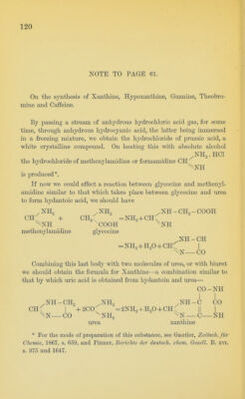
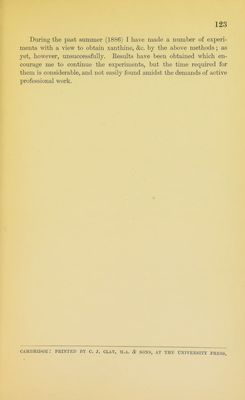
![NOTE TO PAGE 61. On the synthesis of Xanthine, Hypoxanthine, Guanine, Theobro- mine and Caffeine. By passing a stream of anhydrous hydrochloric acid gas, for some time, through anhydrous hydrocyanic acid, the latter being immersed in a freezing mixture, we obtain the hydrochloride of prussic acid, a white crystalline compound. On heating this with absolute alcohol NH2.HCI the hydrochloride of methenylamidine or formamidine CH is produced*. If now we could effect a reaction between glycocine and methenyl- amidine similar to that which takes place between glycocine and urea to form hydantoic acid, we should have /NH2 /NH2 .NH-CH2-COOH CH^ -I- CH2C =NH3+CH\ ^NH ^COOH ■ ^NH methenylamidine glycocine .NH - CH =NH,-f-H204-CH-; ^ \N—CO Combining this last body with two molecules of urea, or with biuret we should obtain the formula for Xanthine—a combination similar to that by which uric acid is obtained from hydantoin and urea— CO-NH I I .NH-CH2 .NH2 .NH-C CO CH< I +2C0^ ^SNHg + HgO-f-CH^ || ] \N—CO ^NH2 ^N — C—NH urea xanthine * For the mode of preparation of this substance, see Gautier, Zeitsch.fiir Chemie, 1867, s. 659, and Pinner, Berichte der deutsch. chem. Gesell. B. xvi. s. 375 und 1647.](https://iiif.wellcomecollection.org/image/b21445278_0128.jp2/full/800%2C/0/default.jpg)