The Croonian lectures on some points in the pathology of rheumatism, gout and diabetes : delivered at the Royal College of Physicians, London, March 30, April 1, 6, 1886 / by P. W. Latham, M.A., M.D., F.R.C.P.
- Peter Wallwork Latham
- Date:
- 1887
Licence: Public Domain Mark
Credit: The Croonian lectures on some points in the pathology of rheumatism, gout and diabetes : delivered at the Royal College of Physicians, London, March 30, April 1, 6, 1886 / by P. W. Latham, M.A., M.D., F.R.C.P. Source: Wellcome Collection.
Provider: This material has been provided by University of Bristol Library. The original may be consulted at University of Bristol Library.
63/136 page 55
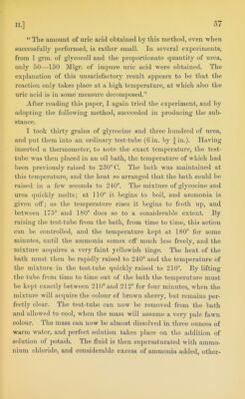
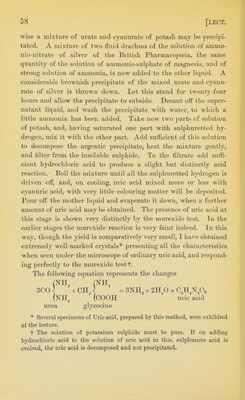
![condensation product of cyanic acid, or that cyanuric acid and biuret are condensation products of urea. Starting with the result obtained by Strecker*, that if uric acid is heated in a sealed tube to 160—170 C. with a cold saturated solution of hydriodic acid, it is decomposed with the formation of ammonium iodide, carbonic acid and glycocine, aH^Np3 + 5Hp = 3NH3 + SCO, + CH, (NH,)COOH, uric acid glycocine I endeavoured, by treating glycocine in sealed tubes and other- wise, with cyanuric acid and potassium cyanate, to reverse the process, and perform the synthesis of uric acid; but unsuccessfully. Horbaczewski, however, stated in a paper published in the Berichte for Nov. 1882, page 2678, that by heating glycocine and urea together, he had accomplished it. On heating glycocine with ten times its weight of urea in an open vessel to 200—230 C. he obtained a cloudy and thick fluid. This on cooling was dissolved in weak potash solution, and supersaturated with ammonium chloride, and preci[>itated with an ammoniacal solution of silver and magnesia. This precipitate, containing the uric acid, was washed with water containing ammonia, and decomposed with potassium sulphide. The filtrate, freed from the precipitate, was supersaturated with hydrochloric acid, and evaporated down. On cooling, the impure ui'ic acid separated, which was again dissolved in a weak sohition of potash, and submitted twice to the same process as above. Lastly, the product was washed with alcohol and dried. It was next treated with bisulphide of carbon to dissolve the sulphur, and then treated with ether, I tried the exi)eriment carefully following the directions, but failed to obtain a satisfactory result. Testing the substance at various stages, I got with nitric acid and ammonia a colour some- what approaching the murexide colour but nothing more, I failed then probably from using too high a temperature. The experi- ment for a long time, received no confirmation, but in May, * Strecker, Zeitschrift f. Chem. [2] iv, 215.](https://iiif.wellcomecollection.org/image/b21445278_0063.jp2/full/800%2C/0/default.jpg)