The Croonian lectures on some points in the pathology of rheumatism, gout and diabetes : delivered at the Royal College of Physicians, London, March 30, April 1, 6, 1886 / by P. W. Latham, M.A., M.D., F.R.C.P.
- Peter Wallwork Latham
- Date:
- 1887
Licence: Public Domain Mark
Credit: The Croonian lectures on some points in the pathology of rheumatism, gout and diabetes : delivered at the Royal College of Physicians, London, March 30, April 1, 6, 1886 / by P. W. Latham, M.A., M.D., F.R.C.P. Source: Wellcome Collection.
Provider: This material has been provided by University of Bristol Library. The original may be consulted at University of Bristol Library.
65/136 page 57
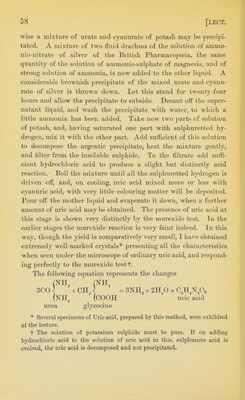
![The amount of uric acid obtained bv this method, even when successfully performed, is rather small. In several experiments, from 1 grm. of glycocoll and the proportionate quantity of urea, only 50—150 Mlgr. of impure uric acid were obtained. The explanatiou of this unsatisfactory result appears to be that the reaction only takes place at a high temperature, at which also the uric acid is in some measure decomposed. After reading this paper, I again tried the experiment, and by adopting the following method, succeeded in producing the sub- stance. I took thirty grains of glycocine and three hundred of urea, and put them into an ordinary test-tube (6 in. by |in.). Having inserted a thermometer, to note the exact temperature, the test- tube was then placed in an oil bath, the temperature of which had been previously raised to 230° C. The bath was maintained at this temperature, and the heat so arranged that the bath could be raised in a few seconds to 240. The mixture of glycocine and urea quickly melts; at 110 it begins to boi], and ammonia is given off; as the temperature rises it begins to fioth np, and between 175° and 180° does so to a considerable extent. By raising the test-tube from the bath, from time to time, this action can be controlled, and the temperature kept at 180° for some minutes, until the ammonia comes off much less freely, and the mixture acquires a very faint yellowish tinge. The heat of the bath must then be rapidly raised to 240 and the temperature of the mixture in the test-tube quickly raised to 210. By lifting the tube from time to time out of the bath the temperature must be kejst exactly between 210 and 212 for four minutes, when the mixture will acquire the colour of brown sherry, but remains per- fectly clear. The test-tube can now be removed from the bath and allowed to cool, when the mass will assume a very pale fawn colour. The mass can now be almost dissolved in three ounces of warm water, and perfect solution takes place on the addition of solution of potash. The fluid is then supersaturated with ammo- nium chloride, and considerable excess of ammonia added, otlier-](https://iiif.wellcomecollection.org/image/b21445278_0065.jp2/full/800%2C/0/default.jpg)