The Croonian lectures on some points in the pathology of rheumatism, gout and diabetes : delivered at the Royal College of Physicians, London, March 30, April 1, 6, 1886 / by P. W. Latham, M.A., M.D., F.R.C.P.
- Peter Wallwork Latham
- Date:
- 1887
Licence: Public Domain Mark
Credit: The Croonian lectures on some points in the pathology of rheumatism, gout and diabetes : delivered at the Royal College of Physicians, London, March 30, April 1, 6, 1886 / by P. W. Latham, M.A., M.D., F.R.C.P. Source: Wellcome Collection.
Provider: This material has been provided by University of Bristol Library. The original may be consulted at University of Bristol Library.
68/136 page 60
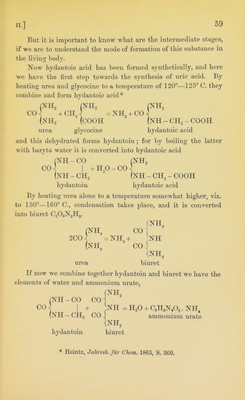
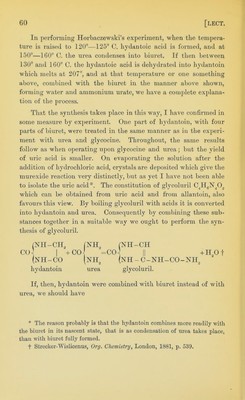
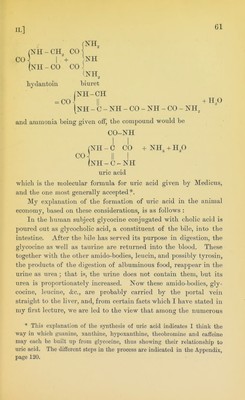
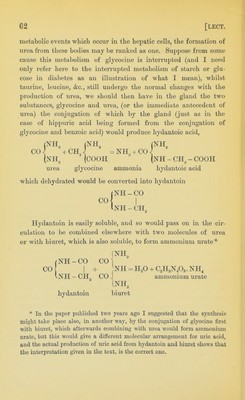
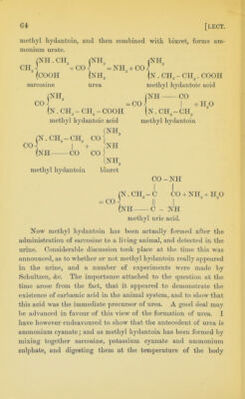
![In performing Horbaczewski's experiment, when the tempera- ture is raised to 120—125° C. hydantoic acid is formed, and at 150—160 C. the urea condenses into biuret. If then between 130 and 160 C. the hydantoic acid is dehydrated into hydantoin which melts at 207, and at that temperature or one something above, combined with the biuret in the manner above shown, forming water and ammonium urate, we have a coiuj^lete explana- tion of the process. That the synthesis takes place in this way, I have confirmed in some measure by ex])eriment. One part of hydantoin, with four parts of biuret, were treated in the same manner as in the experi- ment with urea and glycocine. Throughout, the same results follow as when operating upon glycocine and urea; but the yield of uric acid is smaller. On evaporating the solution after the addition of hydrochloric acid, crystals are deposited which give the murexide reaction very distinctly, but as yet I have not been able to isolate the uric acid*. The constitution of glycoluril C^HgN^O, which can be obtained from uric acid and from allantoin, also favours this view. By boiling glycoluril with acids it is converted into hydantoin and urea. Consequently by combining these sub- stances together in a suitable way we ought to perform the syn- thesis of glycoluril. (NH-CH, (NH, (NH-CH CO-^ I +C0\ =C0\ II +HOt (nh-co [nh^ (nh-c-nh-co-nh^ hydantoin urea glycoluril. If, then, hydantoin were combined with biuret instead of with urea, we should have * The reason probably is that the hydantoin combines more readily with the biuret in its nascent state, that is as condensation of urea takes place, than with biuret fully formed. + Strecker-Wislicenus, Org. Cheviistry, London, 1881, p. 539.](https://iiif.wellcomecollection.org/image/b21445278_0068.jp2/full/800%2C/0/default.jpg)
 No text description is available for this image
 No text description is available for this image
 No text description is available for this image