The pathology and treatment of stricture of the urethra and urinary fistulæ / by Henry Thompson.
- Thompson, Henry, Sir, bart., 1820-1904.
- Date:
- 1885
Licence: Public Domain Mark
Credit: The pathology and treatment of stricture of the urethra and urinary fistulæ / by Henry Thompson. Source: Wellcome Collection.
Provider: This material has been provided by The University of Leeds Library. The original may be consulted at The University of Leeds Library.
69/488 (page 41)
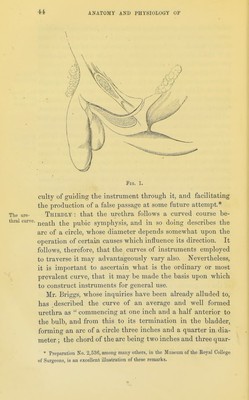
![skin of each thigh above, with that degree of tension which shall maintain the anus in its proper place after the integu- ments and other parts are removed. An incision about four inches long is then to be made through the integuments along the line of the raphe, and of course over the longitu- dinal axis of the bulb, to within half an inch of the anus ; and from its upper extremity a similar one is to be carried transversely outward ; the angular flaps so formed must be reflected outwards, and a careful dissection continued to the deeper structures, dividing the median tendon of the accele- rator urinae muscle, in a line with the first incision, and removing it, so as to clean the bulb and disturb its position as little as possible. Of one of the most successful of these dissections, Mr. H. B. Tuson made for me a model in wax, moulded upon a plaster-cast taken from the body itself, which conveys the appearances of depth and position in a manner not to be accomplished by drawings. Upon these, however, I have constructed a diagram which correctly ex- hibits the relations of the parts referred to. (Fig. ], p. 44.) I have thus fully entered into the examination of this subject, because of the importance it possesses in relation to certain operative proceedings which it may be sometimes necessary to undertake at this part, as will appear in a subsequent portion of this work, and be again referred to. Direction of the adult male urethra.—Nothing can Direction of be more essential to success in the act of traversing with an the urethra- instrument, more or less pointed, as a sound or catheter, this delicately constructed canal, than correct knowledge respect- ing the direction which it assumes throughout every portion of its course, as well as of other mechanical conditions which belong to it, and are constant in health, such as size, mobility, &c.; and as these vary considerably in its different regions, each of the latter must be carefully considered by itself. The spongy region, as has been already stated, is the of the most moveable part of the canal ; its anterior half at least, s^onsy taking any direction (in the flaccid condition of the penis), regl0n which gravity or applied force may give it. As it ap-](https://iiif.wellcomecollection.org/image/b21516790_0069.jp2/full/800%2C/0/default.jpg)