A disquisition of the stone and gravel, together with strictures on the gout, when combined with those disorders; pointing out a safe and efficacious solvent for reducing the stone, and correcting the calculous diathesis in the habit / by S. Perry.
- Perry, S. (Sampson), 1747-1823.
- Date:
- 1815
Licence: Public Domain Mark
Credit: A disquisition of the stone and gravel, together with strictures on the gout, when combined with those disorders; pointing out a safe and efficacious solvent for reducing the stone, and correcting the calculous diathesis in the habit / by S. Perry. Source: Wellcome Collection.
Provider: This material has been provided by Royal College of Physicians, London. The original may be consulted at Royal College of Physicians, London.
32/250 page 12
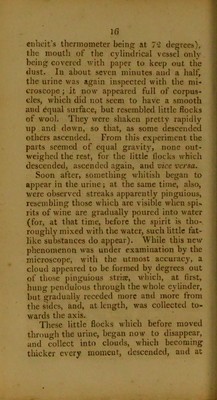
![]2 to it, and which is found in no other animal fluid. Physiologists have ascribed, though mistakenly, its strong taste to the salts con- tained in it, not having paid sufficient atten- tion to the small quantity of such salts pro- portioned to the mass of fluid in which these salts are dissolved. JBut the most extraordi- nary property of the urine, above all other, is, the singular change it undergoes in its own nature, and that is, of becoming alca- lised, and of forming, by a spontaneous alter- ation in the quality of its saline part, am- monia and carbonic acid. This property, which is developed in a few minutes in an elevated temperature, has occasioned it to he considered as the most alcalescent of all the animal humours. Instead of remaining acid, it then turns vegetable colours green, and even produces an effervescence with acids when poured into it: it also changes its colour, assumes a fetid ammoniacal smell, and deposits precipitates and crystallised salts, which it did not contain before. Some alteration in the urine, no doubt, commences as soon as its separation from the blood in the kidneys has taken place, and implies a dispo- sition to form those calculi, whose different colour and density most unquestionably are owing to the varying proportions of the sa- line to the other concreting matter contained in the urine. From duly considering the preceding facts and remarks, we need not wonder that the analyses of urine, pursued by the com-](https://iiif.wellcomecollection.org/image/b28148447_0032.jp2/full/800%2C/0/default.jpg)

 No text description is available for this image
 No text description is available for this image
 No text description is available for this image