Text-book of palaeontology / by Karl A. von Zittel ; translated and edited by Charles R. Eastman.
- Karl Alfred von Zittel
- Date:
- 1900
Licence: In copyright
Credit: Text-book of palaeontology / by Karl A. von Zittel ; translated and edited by Charles R. Eastman. Source: Wellcome Collection.
86/728 (page 70)
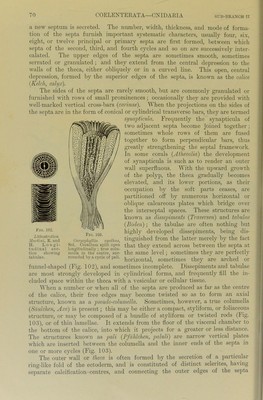
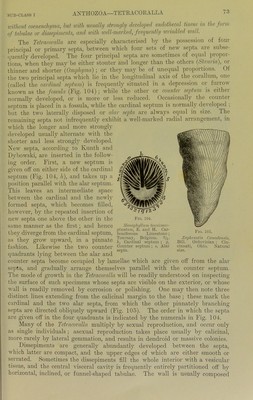
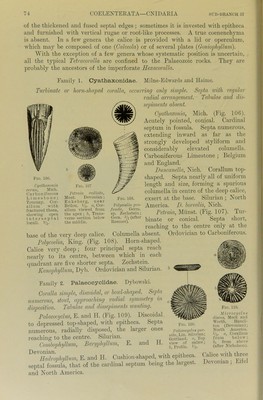
![SCB-BRANCH II a new septum is secreted. The number, width, thickness, and mode of forma- tion of the septa fnrnish important systematic characters, usually fom', six, eight, or tweh-e principal or primary septa are first formed, between which septa of the second, third, and fourth cycles and so on are successively inter- calatecl. The upper edges of the septa are sometimes smooth, sometimes serrated or granulated; and they extern! from the central depression to the walls of the theca, either obliquely or in a curved line. This open, central depression, formed by the superior edges of the septa, is known as the calice [Kelch, calyx). The sides of the septa are rarely smooth, but are commonly granulated or furnished with rows of small prominences; occasionally they are provided with well-marked vertical cross-bars (carinae). When the projections on the sides of the septa are in the form of conical or cylindrical transverse bars, they are termed synapticula. Frequently the synapticula of two adjacent septa become joined together; sometimes whole rows of them are fused together to form perpendicular bars, thus greatly strengthening the septal framework. In some corals (Athecalia) the development of synapticula is such as to render an outer wall superfluous. With the upward growth of the polyp, the theca gradually becomes elevated, and its lower portions, as their occupation by the soft parts ceases, are partitioned off by numerous horizontal or oblique calcareous plates which bridge over the interseptal spaces. These structures are known as clissepiments (Traversen) and tabulae [Böden); the tabulae are often nothing but highly developed clissepiments, being dis- tinguished from the latter merely by the fact feg Fio. 102. Lithostrotlon Martini, E. and H. Longi- tudinal sec- tion showing tabulae. Fio. 103. Caryophyllia cyathus, Sol. Coraiium spiit open {hat they extend across between the septa at longitudinally; true colu- J , , . . r i meiia in the eentre, sur- the same level; sometimes they are pertectly rounded by a cyele of paü. Pj01qz0n ta]? SOmetimes they are arched or funnel-shaped (Fig. 102), and sometimes incomplete. Dissepiments and tabulae are most strongly developed in cylindrical forms, and frequently fill the in- clucled space within the theca with a vesicular or cellular tissue. When a number or when all of the septa are produced as far as the eentre of the calice, their free edges may become twisted so as to form an axial structure, known as a pseudo-columella. Sometimes, however, a true columella (Seitlichen, Axe) is present; this may be either a compact, styliform, or foliaceous structure, or may be composed of a bündle of styliform or twisted rods (Fig. 103), or of tliin lamellae. It extends from the Hoor of the visceral chamber to the bottom of the calice, into which it projects for a greater or less distance. The structures known as pali (Pfählchen, paluli) are narrow vertical plates which are inserted between the columella and the inner ends of the septa in one or more cycles (Fig. 103). The outer wall or theca is often formed by the secretion of a particular ring-like fold of the ectoderm, and is constituted of distinct sclerites, having separate calcification-centres, and connecting the outer edges of the septa](https://iiif.wellcomecollection.org/image/b28132920_0086.jp2/full/800%2C/0/default.jpg)