Curiosities of science past and present : a book for old and young / by John Timbs.
- John Timbs
- Date:
- 1875
Licence: Public Domain Mark
Credit: Curiosities of science past and present : a book for old and young / by John Timbs. Source: Wellcome Collection.
203/548 page 191
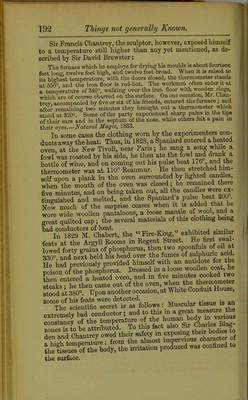
![cooled down to a sub-red heat, or mercury is cooled from the freezing point to zero, or far below. By the same rule, solid mercury, say 50° below zero, may, in any climate or tempera- ture of the atmosphere, be immediately warmed and melted by being imbedded in a cake of ice.—/Scientific American. REPULSION BY HEAT. If water is poured upon an iron sieve, the wires of which fere made red-hot, it wiU not run through; but on cooling, it will pass through rapidly. M. Boutigny, pursuing this curious inquiry, has proved that the moisture upon the skin is sufficient to protect it from disorganisation if the arm is plunged into baths of melted metal. The resistance of the surfaces is so great that little elevation of temperature is experienced. Professor Pliicker has stated, that by washing the arm with ether previ- ously to plunging it into melted metal, the sensation produced while in the molten mass is that of freezing coldness.—E. Eunt, F.E.S. PROTECTION FROM INTENSE HEAT. The singular power which the body possesses of resisting great heats, and of breathing air of high temperatures, has at various times excited popular wonder. In the last century some curious experiments were made on this subject. Sir Joseph Banks, Dr. Solander, and Sir Charles Blagden, entered a room in which the air had a temperature of 198° Fahr., and remained ten minutes. Subsequently they entered the room separately, when Dr. Solander found the heat 210°, and Sir Joseph 211°, whilst their bodies preserved their natural degree of heat. Whenever they breathed upon a thermometer, it sank several degrees; every inspiration gave coolness to their nostrils, and their breath cooled their fingers when it reached them. Sir Charles Blagden entered an apartment when the heat was 1° or 2° above 260°;, and remained eight minutes, mostly on the coolest spot, where the heat was above 240°. Though very hot Sir Charles felt no pain : during seven minutes his breathing was good; but he then felt an oppression in his lungs, and his pulse was 144, double its ordinary quickness. To prove the heat of the room, eggs and a beefsteak were placed upon a tin frame near the thermometer, when in twenty minutes the eggs were roasted hard, and in forty-seven minutes the steak was dressed dry; and when the air was put in motion by a pair of bellows upon another steak, part of it was well done in thirteen mmutes. It is remarkable, that in these experiments the same person who experienced no inconvenience from air heated to 2] 1°, could just bear rectified spuits of wine at 130°, cooling oil at 129°, cooling water at 123°, and cooling quicksilver at 117°](https://iiif.wellcomecollection.org/image/b21497424_0203.jp2/full/800%2C/0/default.jpg)