The American text-book of prosthetic dentistry : in contributions by eminent authorities / edited by Charles J. Essig.
- Date:
- 1897
Licence: Public Domain Mark
Credit: The American text-book of prosthetic dentistry : in contributions by eminent authorities / edited by Charles J. Essig. Source: Wellcome Collection.
Provider: This material has been provided by The University of Glasgow Library. The original may be consulted at The University of Glasgow Library.
27/760 page 23
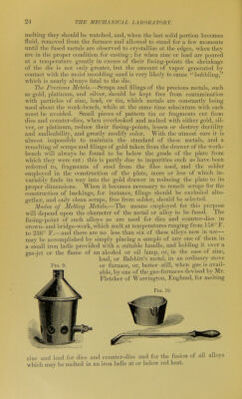
![For taking impression of the mouth, a finely-ground plaster is re- quired, which sets cpiickly, but does not become hard enough to demand a very considerable exhibition of force in its fracture, which is nearly always unavoidable in removing impressions of mouths containing natural teeth and perhaps several dovetailed interdental spaces. A ditferent quality of plaster is demanded for running models and in vulcanite and celluloid work, which need not necessarily possess the quick-setting property, but in which greater hardness and strength are indispensable requirements. (See page 298.) Plaster when not being used should be kept covei'ed to shield it from occasional dampness of the atmosphere and to protect it from water and foreign substances which might accidentally fall into it. The tin cans in which plaster is furnished by the dental depots are admirably suited for this jDurpose, and no im- provement over them need be looked for. Care of Metals used in the Formation of Dies and Counter-dies.— Zinc and lead are the metals most frequently employed for this purpose, but there are also several alloys which have found favor with some of our most skilful and experienced mechanical dentists. The composition, fusing-points, and physical properties of all of these will be described in another chapter. There are other alloys used in crown- and bridge- work, and these demand special care in their storage and handling. First, it is important that they be kept strictly apart and that sejDarate melting-pots or ladles be provided for each. This is especially true with regard to zinc and lead, two metals n^hich resemble each other so closely that it may easily happen that a zinc die be remelted in a pot already partly full of lead. The necessity for carefully keeping these two metals separate in all moulding operations will readily be appreciated when it is remembered that zinc and lead combine with each other to a very limited extent, and that when melted together and allowed to cool they separate in two layers, the upper, and consequently the lighter one, zinc, retaining 1.2 per cent, of the lead, while the lower layer consists of lead alloyed with 1.6 percent, of zinc. If by accident lead becomes mixed with zinc used for dies, the lead by its greater specific gravity settles to the bottom and fills up the deeper portions of the sand matrix representing the alveolar ridge, the most prominent part of the die. This may not be discovered until an attempt to swage is made, when the die will be found to be totally unfit for the purpose. In such cases the mixed metal should be discarded and new zinc substituted. Lead belongs to a small, class of metals which are so soft that they can be scratched by the finger-nail, while zinc is so much liarder that no impression can be made upon it by that means. This simple test is therefore an excellent way of deciding between lead and zinc as they appear in the pot or ladle after having been previously melted. In casting metals of the class to \w\\\v\\ zinc and lead belong their fusing-point should be borne in mind, so that they may not be subjected to temperatures greatly in excess of that which is suflicient to melt them; otherwise partial oxidation will occur, which greatly impairs the working qualities of the metals by rendering them viscid and difficult to ])our when fused, and so brittle after cas^ting as to be unfit to bear the blows of the swaging hannncr without breaking. While the metals used in the formation of dies and counter-dies are](https://iiif.wellcomecollection.org/image/b2144979x_0027.jp2/full/800%2C/0/default.jpg)