The American text-book of prosthetic dentistry : in contributions by eminent authorities / edited by Charles J. Essig.
- Date:
- 1897
Licence: Public Domain Mark
Credit: The American text-book of prosthetic dentistry : in contributions by eminent authorities / edited by Charles J. Essig. Source: Wellcome Collection.
Provider: This material has been provided by The University of Glasgow Library. The original may be consulted at The University of Glasgow Library.
733/760
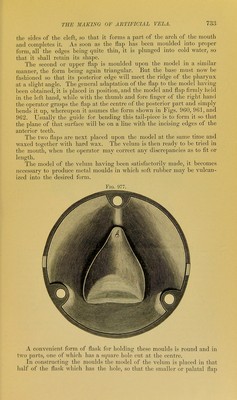
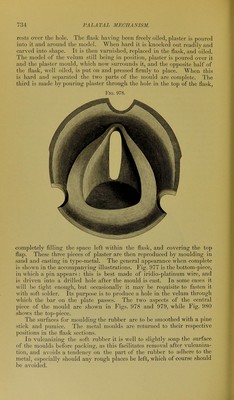
![upon the involuntary muscles of tlie throat endeavor to draw the parts away from the intruding substance. Thus the velum is elevated, and consequently were a model to be made from such an impression it would be inaccurate as to the posterior portion of the mouth, in that it would not be a representation of the parts at rest. With the velum divided as in cleft palate, the disturbance of these sen.sitive tissues upon the introduction of the impression material is even greater. The two halves of the soft palate are not only drawn upward, but tliey also approach each other. Thus the resultant model will show the cleft narrower than it really is when the parts are at rest, and the pose of the divided palate toill be wrong, so that no proper calculation can be made for restoring the true arch of the vault. This will obtain whether the impression be taken with plaster of Paris, or with impression com- pound softened by heat. Where the impression comijound, however, is not very soft, or where the divided palate is lacking in vital response, the impression material will merely press the soft tissues before it, the final model being absolutely worthless. Thus it is seen that no one can obtain an absolutely accurate impression of the divided velum in its normal pose. Nevertheless, a model may be made which will be as accurate as any model of the mouth can be. The method of procedure is as follows: Select an impression-tray of the ordinary form, just large enough to embrace the arch without stretch- ing the mouth, and long enough to reach slightly beyond the posterior border of the hard palate. In the majority of cases this will answer all purposes, but occasionally it may be advantageous to extend the cup by adding to it a flap of sheet gutta-percha. This may be carried back as far as the uvula, but should not touch the velum at any point. This is to be ascertained by introducing the cup empty. Plaster of Paris is mixed in the usual way, a little salt being added to hasten the setting, and warm water used to render it more acceptable to the mouth. A pinch of powdered vermilion will color the impres- sion, which will aid in separating, and is preferable to placing the color in the plaster for the model. The plaster is 2:)laced in the tray in quan- tity proportionate to the height of the roof, less being used where the cleft is in the velum only, than where the fissure enters the hard palate also. The use of too much plaster is to be avoided, lest it escape and trickle down the throat. The impression-tray is to be carried into the mouth just as the plaster gives evidence of setting, and is pressed up quickly and firmly, and then held steadily until sufficiently hard for removal. With a little ]iractice the calculation can be made with such nicety that the time required will be not more than one minute. The plaster which remains in the vessel in which it was prepared will be a guide to its setting, and as soon as it will fracture sharply the impres- sion should be withdrawn. Where the fissure extends into tlic hard palate it will occasionally occur that the plaster which ])asses up into the nasal cavity cannot be withdrawn with the impression ; but if the impression be removed at the proper moment, the ])laster will fracture along the line of the fissure, and that portion left up in the nares may be taken away with the tweezers.](https://iiif.wellcomecollection.org/image/b2144979x_0733.jp2/full/800%2C/0/default.jpg)
 No text description is available for this image
 No text description is available for this image
 No text description is available for this image