The great American fraud : Articles on the nostrum evil and quacks, in two series, reprinted from Collier's weekly / by Samuel Hopkins Adams.
- Samuel Hopkins Adams
- Date:
- [1906]
Licence: Public Domain Mark
Credit: The great American fraud : Articles on the nostrum evil and quacks, in two series, reprinted from Collier's weekly / by Samuel Hopkins Adams. Source: Wellcome Collection.
Provider: This material has been provided by the Francis A. Countway Library of Medicine, through the Medical Heritage Library. The original may be consulted at the Francis A. Countway Library of Medicine, Harvard Medical School.
147/156 (page 141)
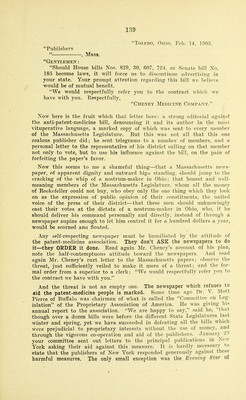
![under Mr, McRae's ownership—but I will use ]\Ir. Cooper's OAvn words: 'We not only reached the Cleveland Press by the movement taken up in that way, but went further, for the Cleveland Press is one of a syndicate fif newspapers known as the Scripps-McRae League, from whom this ex- planation is self-explanatory: 'Office Scripps-McRae Press Associatiox. 'Mr. E. R. Cooper, Cleveland, Ohio: 'Mr. McRae arrived in Xew York the latter part of last week after a three months' trip to Egypt. I took up the matter of the recent cut-rate articles which appeared in the Cleveland Press with him, and to-day received the following telegram from him from Cincinnati: Scripps-McRae papers will contain no more such as Cleveland Press published concerning the medicine trust—1^1. A. McRae. I am sure that in the future nothing will appear in the Cleveland Press detrimental to your interests. 'Yours truly, F. J. Carlisle.' This incident was told, in the exact words above quoted, at the nine- teenth annual meeting of the Proprietary Association of America. I could, if space permitted, quote many other telegrams and letters from the Kilmer's SAvamp Root makers, from the Piso's Cure people, from all the large patent-medicine manufacturers. The same thing that hapoened in Massachusetts happened last year in New Hampshire, in Wisconsin, in Utah, in more than fifteen states. In Wisconsin the response by the news- papers to the command of the patent-medicine people was even more humiliating than in Massachusetts. Not only did individual newspapers work against the formula bill; there is a Wisconsin Press Association, which includes the owners and editors of most of the newspapers of the state. That association held a meeting and passed resolutions, that we are opposed to said bill . . . providing that hereafter all patent medi- cine sold in this state shall have the formulse thereof printed on their labels, and Resolved, That the association appoint a committee of five publishers to oppose the passage of the measure. And in this same state the larger dailies in the cities took it on themselves to drum uu the smaller country papers and get them to write editorials opposed to the formula bill. Nor was even this the measure of their activity in response to the command of the patent medicine association, I am able to give the letter which is here reproduced [see page 83], It was sent by the publisher of one of the largest daily papers in Wisconsin to the state senator who introduced the bill. In one western state, a board of health officer made a number of analyses of patent medicines, and tried to have the analyses made public, that the people of his state might be warned. Only one newspaper in the state, he says in a personal letter, was willing to print results of these analyses, and this paper refused them after two publica- tion in which a list of about ten was published. This paper was the , the editorial manager of which is in sympathy with the effort to restrict the sale of harmful nostrums. The business management in- terfered for the reason that $5,000 in patent-medicine advertising was with- drawn in a week. In New Hampshire—but space forbids. Happily, there is a little silver in the situation. The legislature of North Dakota last year passed, and the governor signed a bill requiring that patent-medicine bottles shall have](https://iiif.wellcomecollection.org/image/b21176978_0147.jp2/full/800%2C/0/default.jpg)