A catalogue of medieval literature, especially of the romances of chivalry, and books relating to the customs, costume, art, and pageantry of the middle ages.
- Bernard Quaritch Ltd
- Date:
- 1890
Licence: Public Domain Mark
Credit: A catalogue of medieval literature, especially of the romances of chivalry, and books relating to the customs, costume, art, and pageantry of the middle ages. Source: Wellcome Collection.
56/100 (page 50)
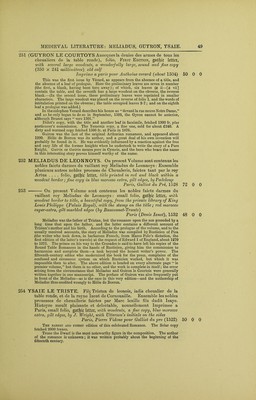
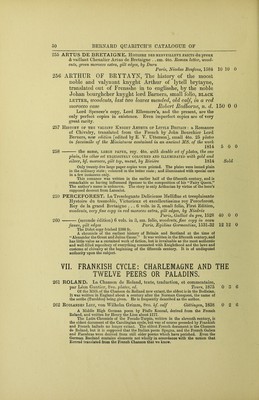
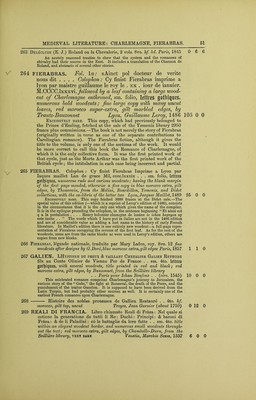
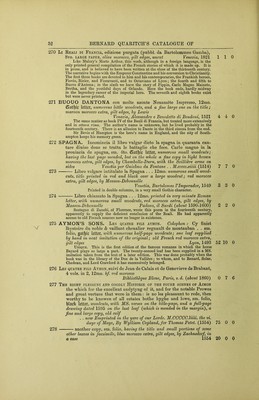
![255 ARTUS DE BRETAIGNE. Histoiee desmeeveillevx faicts dupreux & vaillant Cheaalier Artus de Bretaigne . . sm. 4to. Roman letter, wood- cuts, green morocco extra, gilt edges, by Duru Paris, Nicolas Bonfons, 1584 10 10 0 256 ARTHUR OF BRYTAYIST, The history of the moost noble and valyaunt knyght Arthur of lytell brytayne, translated out of Frensshe in to englisshe, by the noble Johan hourghcher knyght lord Earners, small folio, black LETTEK, woodcuts^ last two leaves mended, old calf, in a red morocco case Robert Redborne, n. d. 150 0 0 Lord Spencer’s copy, Lord Ellesmere’s, and the present, are the only perfect copies in existence. Even imperfect copies are of very great rarity. 257 History of the valiant Knight Arthur op Little Britain : a Romance of Chivalry, translated from the French by John Bourchier Lord Berners, new edition [edited by E. V. Utterson], small 4to. 25 jolates in facsimile of the Miniatures contained in an ancient MS. of the work 1814 500 258 the same, large paper, roy. 4to. with double set of plates, the one plain, the other set exquisitely coloured and illuminated with gold and silver, hf. morocco, gilt top, uncut, by Riviere 1814 Sold Only twenty-five large paper copies were printed. The plates were issued plain in the ordinary state ; coloured in the better state; and illuminated with special care in a few instances only. This romance was written in the earlier half of the fifteenth century, and is remarkable as having influenced Spenser to the composition of his “Fairy Queen.” The author’s name is unknown. The story is only Arthurian by virtue of the hero’s supposed descent from Lancelot. 259 PERCEFOREST. La Treselegante Delicieuse Melliflue et tresplaisante Hystoire du tresnoble, Victorieux et excellentissime roy Perceforest, Roy de la grand Bretaigne ... 6 vols. in 3, small folio, First Edition, ivoodcuts, very fine copy in red morocco extra, gilt edges, by Niedree Paris,, Oalliot du pre, 1528 40 0 0 260 (seconde edition) 6 vols. in 3, sm. folio, woodcuts, fine copy in veau fauve, gilt edges Paris, Egidius Gormontius, 1531-32 12 12 0 The Didot copy fetched 1500 fr. A chronicle of the earliest history of Britain and Scotland at the time of “Alexander the Great and Julius Cassar.” It was written in the fifteenth century, and has little value as a sustained work of fiction, but is invaluable as the most authentic and well-filled repository of everything connected with Knighthood and the laws and customs of chivalry at the beginning of the fifteenth century. It is of undisputed authority upon the subject. VII. FRANKISH CYCLE: CHARLEMAGNE AND THE TWELVE PEERS OR PALADINS. 261 ROLAND. La Chanson de Roland, texte, traduction, et commentaire, par Leon Gautier, 8vo. 'plates, sd. Tours, 1875 0 3 6 Of the MSS. of the Chanson de Eolland now extant, the oldest is in the Bodleian. It was written in England about a century after the Norman Conquest, the name of the scribe (Turoldus) being given. He is frequently described as the author. 262 Ruolandes Liet, von Wilhelm Grimm, 8vo. hf. calf Gottingen, 1838 0 2 6 A Middle High German poem by Pfaffe Konrad, derived from the French Boland, and written for Henry the Lion about 1177. The Latin Chronicle of the Pseudo-Turpin, written in the eleventh century, is the oldest document of the Carolingian cycle, but was of course preceded by Frankish and French ballads no longer extant. The oldest French document is the Chanson de Boland, but it is supposed that the Italian poem Spagna, and the French Galien and Fierabras were derived from still older poems which have perished. Even the German Buoland contains elements not wholly in accordance with the notion that Konrad translated from the French Chanson that we know.](https://iiif.wellcomecollection.org/image/b24887286_0056.jp2/full/800%2C/0/default.jpg)