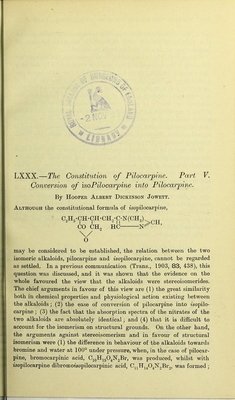
The constitution of pilocarpine. Pt. V. Conversion of isopilocarpine into pilocarpine / by H.A.D. Jowett.
- Jowett, Hooper Albert Dickinson, 1870-1936.
- Date:
- [1905]
Licence: Attribution 4.0 International (CC BY 4.0)
Credit: The constitution of pilocarpine. Pt. V. Conversion of isopilocarpine into pilocarpine / by H.A.D. Jowett. Source: Wellcome Collection.
Provider: This material has been provided by The Royal College of Surgeons of England. The original may be consulted at The Royal College of Surgeons of England.
4/12 page 795
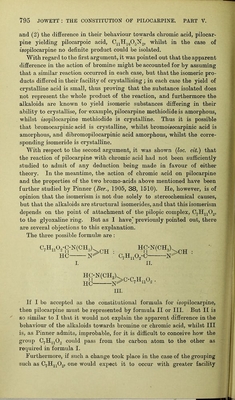
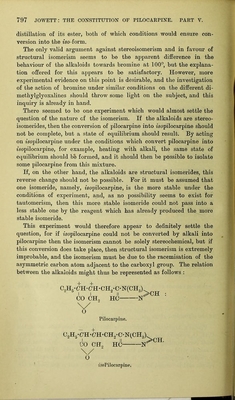
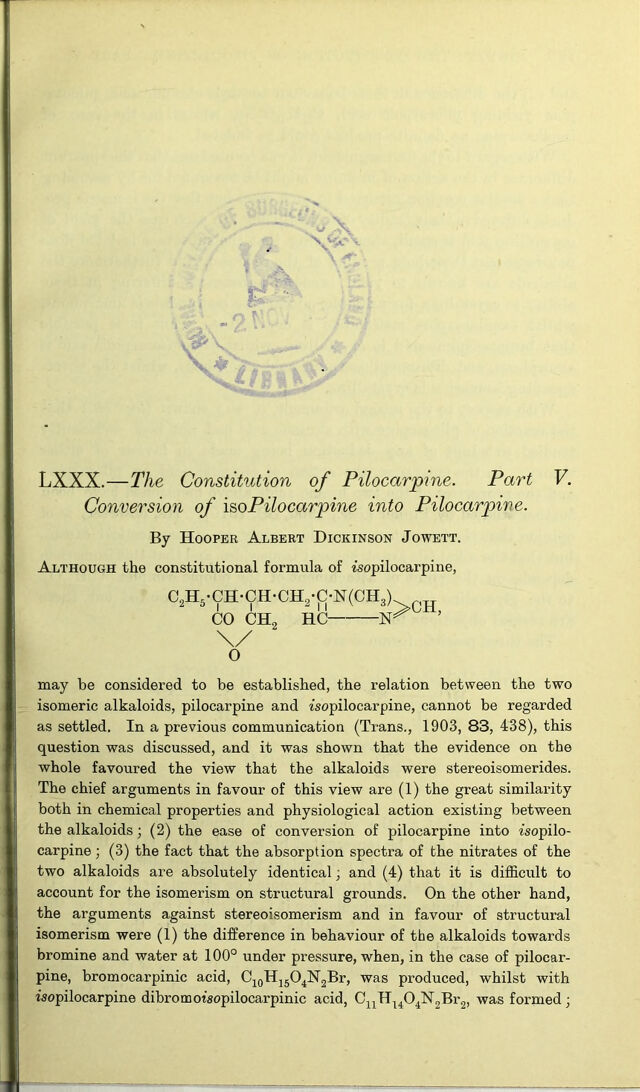
![and (2) the difference in their behaviour towards chromic acid, pilocar- pine yielding pilocarpoic acid, C11H1605N’2, whilst in the case of isopilocarpine no definite product could be isolated. With regard to the first argument, it was pointed out that the apparent difference in the action of bromine might be accounted for by assuming that a similar reaction occurred in each case, but that the isomeric pro- ducts differed in their facility of crystallising ; in each case the yield of crystalline acid is small, thus proving that the substance isolated does not represent the whole product of the reaction, and furthermore the alkaloids are known to yield isomeric substances differing in their ability to crystallise, for example, pilocarpine methiodide is amorphous, whilst rsopilocarpine methiodide is crystalline. Thus it is possible that bromocarpinic acid is crystalline, whilst bromoisocarpinic acid is amorphous, and dibromopilocarpinic acid amorphous, whilst the corre- sponding isomeride is crystalline. With respect to the second argument, it was shown (Joe. cit.) that the reaction of pilocarpine with chromic acid had not been sufficiently studied to admit of any deduction being made in favour of either theory. In the meantime, the action of chromic acid on pilocarpine and the properties of the two bromo-acids above mentioned have been further studied by Pinner (Ber., 1905, 38, 1510). He, however, is of opinion that the isomerism is not due solely to stereochemical causes, but that the alkaloids are structural isomerides, and that this isomerism depends on the point of attachment of the pilopic complex, C7Hu02, to the glyoxaline ring. But as I have* previously pointed out, there are several objections to this explanation. The three possible formulae are : C7Hu02-C-N(OH3] HC- ■N: >CH c7huo2-c- HC-N(CH,) 5>CH II. hc;-n(ch3) HC C7Hll~2 III. ,0., If I be accepted as the constitutional formula for isopilocarpine, then pilocarpine must be represented by formula II or III. But II is so similar to I that it would not explain the appai’ent difference in the behaviour of the alkaloids towards bromine or chromic acid, whilst III is, as Pinner admits, improbable, for it is difficult to conceive how the group C7Hu02 could pass from the carbon atom to the other as required in formula I. Furthermore, if such a change took place in the case of the grouping such as C7Hn02, one would expect it to oocur with greater facility](https://iiif.wellcomecollection.org/image/b22401799_0006.jp2/full/800%2C/0/default.jpg)