On deformity of the lower jaw in the cachalot (Physeter macrocephalus, Linn.) / by James Murie.
- Murie, James.
- Date:
- [1865]
Licence: Public Domain Mark
Credit: On deformity of the lower jaw in the cachalot (Physeter macrocephalus, Linn.) / by James Murie. Source: Wellcome Collection.
Provider: This material has been provided by The Royal College of Surgeons of England. The original may be consulted at The Royal College of Surgeons of England.
4/12 page 390
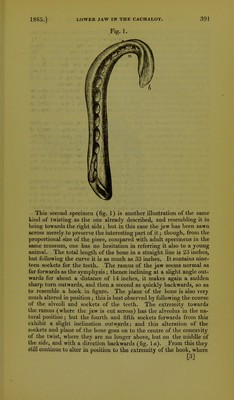
![390 The great length, the graceful elegance, and the beautiful sym- metry of the lower jaws, as well as the regularity of the teeth, of the common Cachalot, are often striking objects of admiration in our museums. Occasionally, however, these jaws are found deformed in a very curious manner, and in such a way as at first sight cannot readily be accounted for. With the exception of the short graphic account given by Mr. Beale in his 'Natural History of the Sperm Whale ' (1839, p. 36), J am not aware of any original description or observation on this anomalous condition ; and as three examples of a well-marked kind have fallen under my notice, I have considered it might not be un- interesting to examine, as far as the specimens have permitted, their exact condition, in order, if possible, to elucidate the cause of this abnormality. The first specimen I have to mention I saw when I was in New York a few years ago. I then paid a visit to the Museum in con- nexion with the United States Navy Yard at Brooklyn ; and among the various curiosities exhibited I observed the right moiety of the lower jaw of a Cachalot, which arrested my attention from its pecu- liar shape. I made inquiries concerning the specimen, but failed to obtain any history in connexion with it. The unusual form of this half of a lower jaw (of a comparatively speaking young animal) consisted in the symphysis and anterior half of the body being twisted at nearly right angles to the ordinary di- rection of the bone. The ramus was perfectly normal; and the body from thence onwards to about its middle seemed quite natural. From this latter part, however, it took a quick curve outwards almost rec- tangularly, then with a second larger sweeping curve it bent itself somewhat backwards, and further on towards the anterior end of the symphysis it again recurved itself a short vyay forwards, not unlike the manner depicted in fig. 2, of a somewhat similar-sized jaw in the British Museum. The specimen, no. 2452, vol. ii. of the Physiological Series in the Museum of the Royal College of Surgeons*, presented by Fred. D. Bennett, Esq., F.L.S., is described in the catalogue as The right ramus of the lower jaw of a Physeter, the anterior part of which is curved strongly inwards and backwards, in consequence of some injury received in youth. * My acknowledgments are due to the Museum Committee for permission to figure this most interesting oijject. [2]](https://iiif.wellcomecollection.org/image/b2228672x_0004.jp2/full/800%2C/0/default.jpg)