The diseases of children : medical and surgical / by Henry Ashby and G.A. Wright.
- Henry Ashby
- Date:
- 1900
Licence: Public Domain Mark
Credit: The diseases of children : medical and surgical / by Henry Ashby and G.A. Wright. Source: Wellcome Collection.
Provider: This material has been provided by the Augustus C. Long Health Sciences Library at Columbia University and Columbia University Libraries/Information Services, through the Medical Heritage Library. The original may be consulted at the the Augustus C. Long Health Sciences Library at Columbia University and Columbia University.
40/956 (page 10)
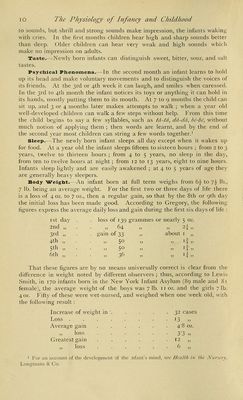
![to sounds, but shrill and strong sounds make impression, the infants waking with cries. In the first months children hear high and sharp sounds better than deep. Older children can hear very weak and high sounds which make no impression on adults. Taste.—Newly born infants can distinguish sweet, bitter, sour, and salt tastes. Psychical Phenomena.—In the second month an infant learns to hold up its head and make voluntary movements and to distinguish the voices of Its friends. At the 3rd or 4th week it can laugh, and smiles when caressed. In the 3rd to 4th month the infant notices its toys or anything it can hold in its hands, mostly putting them to its mouth. At 7 to 9 months the child can sit up, and 3 or 4 months later makes attempts to walk ; when a year old well-developed children can walk a few steps without help. From this time the child begins to say a few syllables, such as td-td^ dd-dd, be-be^ without much notion of applying them ; then words are learnt, and by the end of the second year most children can string a few words together.^ Sleep.—The newly born infant sleeps all day except when it wakes up for food. At a year old the infant sleeps fifteen to sixteen hours ; from 2 to 3 years, twelve to thirteen hours ; from 4 to 5 years, no sleep in the day, from ten to twelve hours at night; from 12 to 13 years, eight to nine hours. Infants sleep lightly and are easily awakened ; at 4 to 5 years of age they are generally heavy sleepers. Body Weig^bt.—An infant born at full term weighs from b^ to ']\ lb., 7 lb. being an average weight. For the first two or three days of life there is a loss of 4 oz. to 7 oz., then a regular gain, so that by the 8th or gth day the initial loss has been made good. According to Gregory, the following figures express the average daily loss and gain during the first six days of life : 2f 1st day . . loss of 13c 2nd „ . • „ 64 3id „ . gain of 33 4th „ 50 5th „ . 50 6th „ . „ 36 about I That these figures are by no means universally correct is clear from the difference in weight noted by different observers ; thus, according to Lewis Smith, in 170 infants born in the New York Infant Asylum (89 male and 81 female), the average weight of the boys was 7 lb. 11 oz. and the girls 7 lb. 4 oz. Fifty of these were v/et-nursed, and weighed when one week old, with the following result: Increase of weight in Loss . Average gain ,, loss Greatest gain loss 32 cases 13 » 4-8 oz. yi „ 12 „ 1 For an account of the developnient of the .nfant's mind, see Health iti the Nursery, Lons^mans & Co.](https://iiif.wellcomecollection.org/image/b21229715_0040.jp2/full/800%2C/0/default.jpg)