The diseases of children : medical and surgical / by Henry Ashby and G.A. Wright.
- Henry Ashby
- Date:
- 1900
Licence: Public Domain Mark
Credit: The diseases of children : medical and surgical / by Henry Ashby and G.A. Wright. Source: Wellcome Collection.
Provider: This material has been provided by the Augustus C. Long Health Sciences Library at Columbia University and Columbia University Libraries/Information Services, through the Medical Heritage Library. The original may be consulted at the the Augustus C. Long Health Sciences Library at Columbia University and Columbia University.
76/956 (page 46)
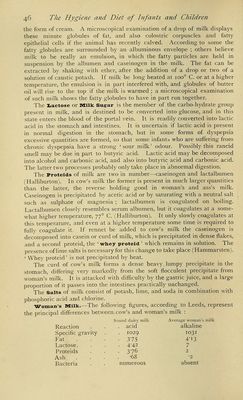
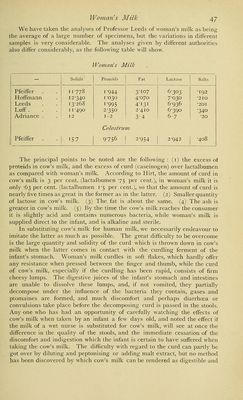
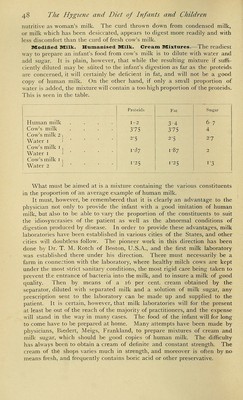
![the form of cream. A microscopical examination of a drop of milk displays these minute globules of fat, and also colostric corpuscles and fatty epithelial cells if the animal has recently calved. According to some the fatty globules are surrounded by an albuminous envelope ; others believe milk to be really an emulsion, in which the fatty particles are held in suspension by the albumen and caseinogen in the milk. The fat can be extracted by shaking with ether, after the addition of a drop or two of a solution of caustic potash. If milk be long heated at 100° C. or at a higher temperature, the emulsion is in part interfered with, and globules of butter oil will rise to the top if the milk is warmed ; a microscopical examination of such milk shows the fatty globules to have in part run together. The Kactose or IVIilk Sug-ar is the member of the carbo-hydrate group present in milk, and is destined to be converted into glucose, and in this state enters the blood of the portal vein. It is readily converted into lactic acid in the stomach and intestines. It is uncertain if lactic acid is present in normal digestion in the stomach, but in some forms of dyspepsia excessive quantities are formed, so that some infanta who are suffering from chronic dyspepsia have a strong 'sour milk' odour. Possibly this rancid smell may be due in part to butyric acid. Lactic acid may be decomposed into alcohol and carbonic acid, and also into butyric acid and carbonic acid. The latter two processes probably only take place in abnormal digestion. The Proteids of milk are two in number—caseinogen and lactalbumen (Halliburton). In cow's milk the former is present in much larger quantities than the latter, the reverse holding good in woman's and ass's milk. Caseinogen is precipitated by acetic acid or by saturating with a neutral salt such as sulphate of magnesia ; lactalbumen is coagulated on boiling. Lactalbumen closely resembles serum albumen, but it coagulates at a some- what higher temperature, T]° C. (Halliburton). It only slowly coagulates at this temperature, and even at a higher temperature some time is required to fully coagulate it. If rennet be added to cow's milk the caseinogen is decomposed into casein or curd of milk, which is precipitated in dense flakes, and a second proteid, the ' whey proteid ' which remains in solution. The presence of lime salts is necessary for this change to take place (Hammarsten). ' Whey proteid' is not precipitated by heat. The curd of cow's milk forms a dense heavy, lumpy precipitate in the stomach, differing very markedly from the soft flocculent precipitate from woman's milk. It is attacked with difficulty by the gastric juice, and a large proportion of it passes into the intestines practically unchanged. The Salts of milk consist of potash, lime, and soda in combination with phosphoric acid and chlorine. -Woman's l«ilk.—The following figures, according to Leeds, represent the principal differences between cow's and woman's milk : Sound dairy milk Average woman's milk Reaction . . . acid alkaline Specific gravity Fat Lactose. Proteids Ash Bacteria 1029 1031 ■ 375 4-13 . 4-42 7 . 376 2 •68 -2 numerous absent](https://iiif.wellcomecollection.org/image/b21229715_0076.jp2/full/800%2C/0/default.jpg)