Content advisory
This digitised material is free to access, but contains information or visuals that may:
- include personal details of living individuals
- be upsetting or distressing
- be explicit or graphic
- include objects and images of objects decontextualised in a way that is offensive to the originating culture.
Licence: In copyright
Credit: <i>Scientific American</i> - Supercoiling. Source: Wellcome Collection.
7/201
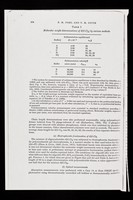
![fho other polymers described in this report were synthesized with similar procedures, ,.jmo cases using fraction 7. The molecular weights of the products were greater than The polymer poly(G-C) -poly(G-C) was synthesized with E. coli RNA polymerase using •.(dG-dC)-poly(dG-dC) as the template and conditions described by Nishimura, Jones Khorana (1965). The reaction was carried out at 37°C in 33 mM-Tris*HCl (pH 7-9 at q, 4 mM -MgCl 2 , 1 mM-MnCl 2 , 10 niM -2-mercaptoethanol, 0-4 mil each of CTP and iJp]GTP (spec. act. 10 5 cts/min/nmole), 0-1 mai-poly(dG-dC)-poly(dG-dC) and 50 units I S'A polymerase/ml. The synthesis was followed by the incorporation of [o¡- 32 P]GMP into ,¡-insoluble material. After 2 hr, 34% utilization was achieved and no further synthesis ■ degradation was observed. (In a parallel reaction with poly(dG) • poly(dC) as the tem uto the incorporation was 20% and the product was degraded upon further incubation.) liter 3 hr, pancreatic DNase was added to a concentration of 10 /xg/ml. and the incubation , ntinued for an additional 30 min in order to digest the template. An equal volume of íhanol was added and denatured protein removed by centrifugation. The polymer was •'¡riiied by passage over a Sephadex G75 column. (c) Determination of extinction coefficients and nearest-neighbour analysis Tho extinction coefficient e p of (dG-dC) s was determined by enzymic degradation with -*ncreatic DNase (20 /xg/ml.) and snake venom phosphodiesterase (10 /¿g/ml.) at 37°C in ¡■3 m-Tris • HCl (pH 7-9 at 25°C), 2 mM-CaCl 2 , 8 mM-MgCl 2 , conditions described for poly- IG )-poly(dC) by Bollum (1968). The reaction was carried out until no further change of fitical density ensued in time and after the addition of more enzyme. A comparison of >) resulting absorption spectrum with spectral data for dGMP and dCMP yielded the j; »lue 52 ±4% as the guanosine content of the polymer. The corresponding extinction ♦ fficient £p 33 the polymer is 7-1 X 10 3 cm -1 M -1 , somewhat lower than the figure ported by Wells et al. (1970). The extinction coefficient of poly(G-C)-poly(G-C) was determined after alkaline hydro- ysis (0-2 N -NaOH, 37°C, 24 hr) by comparison with the nucleotide spectra. The ep 55 of S tXlO 3 cm -1 M 1 for the polymer is in good agreement with the value reported by Karstadt & Krakow (1970). A nearest-neighbour frequency analysis was carried out on the ribopolynucleotide • nthesized with [ct- 32 P]GTP according to Nishimura, Jacob & Khorana (1964), with the - itiition. of an incubation with alkaline phosphatase in order to hydrolyse unreacted «ibstrate and the 5'-triphosphate termini of the product. Incubations were carried out as '■•scribed above for the synthesis of poly(G-C) -poly(G-C). After 3 hr, alkaline phosphatase v w added to a concentration of 40 /xg/ml. After 10 min at 37°C, the solution was absorbed ' Whatman DE81 paper and washed extensively with 0-3 M-ammonium formate, pH 8-3. \fter hydrolysis at 37°C for 15 hr in 1 M -NaOH, more than 90% of the radioactivity was leased from the paper. The solution was neutralized with Dowex 50 in the pyridinium ' nn and evaporated. Electrophoretic analysis at pH 3-5 indicated that more than 95% { ( tho label was in Cp, thus representing the sequence CpG in the polymer. In a parallel '''termination performed on the product of a synthesis using poly(dG)-poly(dC) as the í ' tnplate, all the label was found in Gp, confirming the sequence GpG. (d) Molecular weight measurements f A Beckman ultracentrifuge, model E, equipped with a photoelectric scanner, was used : 'f measurements of sedimentation velocity and equilibrium. The methods described by I j'idior (1965) and Scheffler, Elson & Baldwin (1968) were generally used. A supplementary ^ Y plotter increased the sensitivity and accuracy of the scanner. Double sector center- : r»oc<?8 (12 mm, filled Epon) were used. All measurements were at 20°C. I ^'our buffers were used: Buffer A (0-5 M-NaC10 4 , pH adjusted to 12-5 with NaOH); Í -for B (09 M-NaCl, 0-1 N -NaOH) ; buffer C (1 M -NaCl, 0-01 M-Tris-HCl, pH 8); buffer D V * 03 M-NaCl, 7-5 mai-sodium citrate). Secondary salt effects and preferential interaction ¡ Boivent were analysed for the sedimentation equilibrium data as described by % heiïler et al. (1968). These analyses, together with those from sedimentation velocity f '■''ûsurements, are given in Table 1.](https://iiif.wellcomecollection.org/image/b18181338_PP_CRI_H_6_11_0007.jp2/full/800%2C/0/default.jpg)



 No text description is available for this image
 No text description is available for this image
 No text description is available for this image