The old English versions of the Gesta Romanorum: edited for the first time from manuscripts in the British Museum and University Library, Cambridge, with an introduction and notes / By Sir Frederic Madden. Printed for the Roxburghe Club.
- Date:
- 1838
Licence: Public Domain Mark
Credit: The old English versions of the Gesta Romanorum: edited for the first time from manuscripts in the British Museum and University Library, Cambridge, with an introduction and notes / By Sir Frederic Madden. Printed for the Roxburghe Club. Source: Wellcome Collection.
40/544 (page 32)
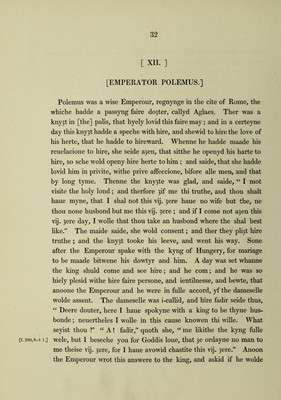
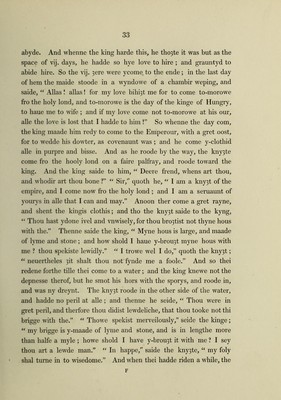
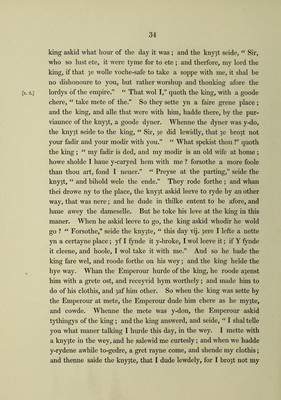
![C XII. ] [EMPERATOR POLEMUS.] Polemus was a wise Emperour, regnynge in the cite of Rome, the whiche hadde a passyng faire do3ter, callyd Aglaes. Ther was a kny3t in [the] palis, that hyely lovid this faire may; and in a certeyne day this kny3t hadde a speche with hire, and shewid to hire the love of his herte, that he hadde to hireward. Whenne he hadde maade his reuelacione to hire, she seide a3en, that sitthe he openyd his harte to hire, so sche wold openy hire herte to him ; and saide, that she hadde lovid him in privite, withe prive affeccione, bifore alle men, and that by long tyme. Thenne the kny3te was glad, and saide, “ I mot visite the holy lond; and therfore 3R me thi truthe, and thou shalt haue myne, that I shal not this vij. 3ere haue no wife but the, ne thou none husbond but me this vij. 3ere ; and if I come not a3en this vij. 3ere day, I wolle that thou take an husbond where the shal best like.” The maide saide, she wold consent; and ther they pl^t hire truthe ; and the kny3t tooke his leeve, and went his way. Sone after the Emperour spake with the kyng of Hungery, for manage to be maade bitwene his dowtyr and him. A day was set whanne the king shuld come and see hire; and he com; and he was so hiely plesid withe hire faire persone, and ientilnesse, and bewte, that anoone the Emperour and he were in fulle accord, yf the dameselle wolde assent. The dameselle was i-callid, and hire fadir seide thus, “ Deere douter, here I haue spokyne with a king to be thyne hus- bonde; neuertheles I wolle in this cause knowen thi wille. What seyist thou ?” “ A! fadir,” quoth she, “ me likithe the kyng fulle [f. 200,b.c. 1.] wele, but I beseche you for Goddis loue, that 3e ordayne no man to me theise vij. 3ere, for I haue avowid chastite this vij. 3ere.” Anoon the Emperour wrot this answere to the king, and askid if he wolde](https://iiif.wellcomecollection.org/image/b22007118_0040.jp2/full/800%2C/0/default.jpg)